Multiplayer Snakes and Ladders Game a Java Project

The project “Multi player snakes and ladders game a Java Project” is a game which has been designed in this project and can be played over LAN. The game has been built using Java platform which is platform independent and applet. It is also light weight.

A snakes and ladders game is a simple board game which can be played between two to four players. The four players race their token from start to finish by throwing their dice rolls. The board is played on numbered grid squares which are filled with ladders and snakes on selected boxes. The game is a game of chance and depends on the person’s luck. The size of the grid is 8×8, 10×10 and varies from board to board which will affect the duration  play.  

Description:

In this project Multi player snakes and ladders game, a minimum of two players and maximum four players can play this game. In the beginning of the game, the player’s pieces are placed in the start area. Every player will be given a chance and they have to go about it turn wise. If six appears on the dice then the player can proceed with the game. If the player does not get a six on the dice then the game cannot be played.

The buttons are moved according to the number that rolls onto the device. Once the player’s position is at the bottom of the ladder then he can climb it and reach to the top of the ladder. If the player encounters a snake he has to retrace his steps back by coming to the square where the tail of the snake is there. The game s won when the button of the player reaches the finish point first.        

Conclusion:

The project described above supports various resolution schemes. The save and exit feature in the game give it an extra flexibility. A provision for storing the high scores of the players is provided.
CSE Mini Project Report on Multimedia Database Management System

Introduction:

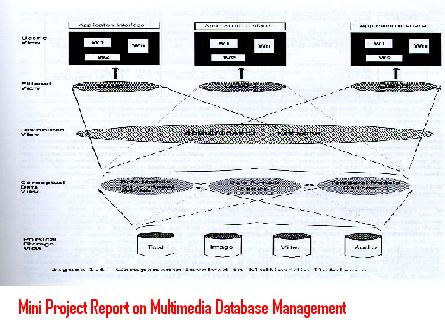
        The project “CSE Mini Project on Multimedia database management system” can be defined as a framework which can manage different types of data. This data is potentially represented by a wide diversity of formats on a wide range of media sources. This Multimedia DBMS provides support for all kinds of multimedia data types and also in the creation, storage of multimedia database.Mini-Project-Report-on-Multimedia-Database-Management

                  This multimedia database management fosters suitable environment for the use and management of the multimedia database information. All the traditional database functions are supported by this project like data access and organization, data independence, privacy, integration, integrity control and concurrency support.

Description:

           This project Multimedia database management system keeping the traditional functions of DBMS as guide, the purpose of this system can be explained. In the integration method, the data items need not be duplicated and require different program invocation for obtaining the data. Data independence is for separating the database and management functions.

    Concurrency control ensures that the multimedia database is consistent throughout the rules and usually imposes some form of execution order on concurrent transactions. Persistence is the ability of the data object to survive through the different transactions and invocations. The privacy component ensures that the system does not get unauthorized access. Any queries can be solved at the query support. The version control is used for organization and management of persistent objects.

Conclusion:

    Through this project it can be concluded that the database management for multimedia is a necessary requirement and can also be managed like the normal data which is very important for current multimedia applications. The multimedia systems do exist but they can be further enhanced by adding a lot of enhancements which will make the system work in a better way. 

download Project Report of CSE Mini Project Report on Multimedia Database Management System .

Mobile Banking GPRS Telecom Project

Introduction:

          In today’s current scenario, the need of the hour is to improve and enhance the way banking transactions are done. To make use of computerized banking, one needs to be in the vicinity of banks to go there. ATM has also minimized our banking procedures but even then one needs to physically to the ATM to operate. Internet banking is the next big leap. However one needs to have an internet connection to access it.Mobile-banking-GPRS-Telecom-Project

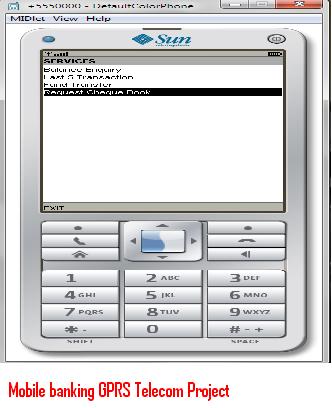
   The project “Mobile banking GPRS Telecom project” explains the concept of using mobile phone for banking operations. This system generates a term that is E-cash which allows round the clock transactions. The technology that is required to implement this technology on phones is J2ME and GPRS connectivity on your mobile. Oracle 9i is used for database.

Description:

             The project Mobile banking explains all the technologies that are used by a mobile to carry out transactions. The Java platform is for mobile devices and is known as J2ME. It was introduced by Sun technologies in the year 1999 for mobile devices. This is a subset of Java 2 standard edition. It is used for programming purposes for the mobile device. GPRS is another technology used and stands for General Packet Radio service.”

        The GPRS technology allows more data transmission and enables faster communication with the service provider. Data is transmitted in terms of packets. For extensive connectivity, MIDP is used as it also offers end-to-end security. Oracle 9i is used for the process of data recovery and is internet based. Also it is easy to use for mobile banking transactions.

Conclusion:

       The project discussed here can be applied to a wide variety of applications. It can be used for hotel reservations, flight reservations, mobile shopping and in security systems. In the future through mobile banking one could have loan access facility, DD orders etc.

download Project Report of CSE Mobile banking GPRS Telecom Project .

Mcafee Network Access Control a Linux C++ Project

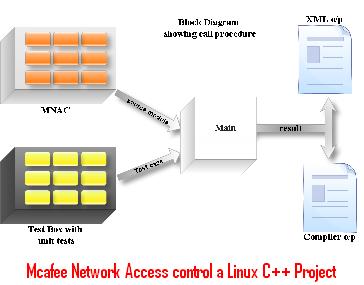
The project “Mcafee Network Access control a Linux C++ Project” is a system security solution that is designed for defining, assessing and enforcing IT security policies and is used to control managed as well as unmanaged systems. It is basically designed for protecting the corporate networks by blocking those systems which are not in compliance with the IT policies of the particular company.Mcafee-Network-Access-control-a-Linux-C++-Project

The method is powerful yet a flexible policy which detects threats and blocks them. This project is developed with an aim to make unit testing automated and also the BVT tests. It lessens the risk of undetected errors and saves costs by detecting problems earlier. Thus a high quality product is ensured by this system on a continuous basis.

Description:

This project Mcafee Network Access control is for the protection of remote access, high risk branch offices and also wireless networks that are passed on from infected workstations, servers, etc. This system works on the principle “Identify, quarantine and remediate attack vendors before they spread.” The e-policy orchestrator provides visibility and reports them to PCs that are used by guests/contractors. 

This system provides compliance for all the systems that are connected on the network. It also detects new systems when they send a request on the network. The Mcafee policy then scans the system and check if it meets the compliance policy of the network. Once the new system is scanned, it will decide what action to take.

Conclusion:

In this system, there’s a test known s the Build verification test which is a set of tests that run on every new build and this is then verified before it is released and then given for further testing. If BVT fails, then the build is assigned again to a developer for fixing it.

Matrimonial Project Report a .Net Project

The project “Matrimonial project report a .Net Project” is to provide prospective grooms and brides with an excellent matchmaking experience. Through this web application, it provides a wide range of opportunities and resources to meet true potential life partner. Thus a world renowned website has been created so that it provides a wide array of options.Matrimonial-Project-Report-a-Net-Projec

Through this project, matchmaking process is facilitated and information is provided. The user is helped by providing profiles of the bride and groom and this application also has a search facility for criteria based of applications. As internet is a modern business, the project path for modernizing the trade.

Description:

In this project Matrimonial project report, a new user will first register on the site and after successful registration e will receive an email confirmation. After this step, the user can access the profiles available in the website. The site is divided into quite a few sectors. These sectors are registration, partner, search etc. The option of email functionality will allow the provision of direct email correspondence.

This application is designed in a modular approach and has lot of modules. These modules are admin module, user registration module, image uploading module, creating album module, sending express interest module, sending personal message module, search module and various other modules. To ensure security and privacy, the matrimonial web application uses Http  protocol.

Conclusion:

Thus the project has been explained and executed in detail. Through this web application, future extensions can be incorporated in it. Web space could be provided for creating the portal. Also, an own mail server can be created. A chat server can be created for the user to communicate with each other. Also, provisions for creating a video album could be provided.

Mail Server with Intranet and Live Chat a Java Project

Email is very crucial in today’s business world. This electronic enabled communication has been embedded into the day to day life and nowadays businesses wouldn’t be able to function without them. This project “Mail server with intranet and live chat a Java Project” is an application program that has been designed to send electronic messages from one system to another. The organization’s requirement is kept in mind before designing this system.

To meet the contemporary business needs, mail servers have become very complex in nature and this additional complexity leads to increased expenditure. This project tends to create a mail server which will eliminate all these problems and at the same time fulfill the requirements of the  system.
Description:

The project here Mail server with intranet and live chat is based on communication and networking. Thus here mail server, intranet and live chat will be implemented. The mail server is an application which transmits electronic mail from one computer to the other and the standard used is RFC 822. Intranet is a term given to a private network which uses internet’s TCP/IP protocols as its architecture.

Every company has its own intranet which is protected by firewalls so as to prevent unauthorized access. These networks can be built using programming languages such as Java. The live chat consists of a virtual chat room where one can communicate with group members something similar to an online conference. This system is thus useful for exchanging information between group members.

Conclusion:

The project described here is generalized and can be used in any organization besides schools and colleges. This system enables information transfer in an easy and systematic way thus allowing free flow communication. In the existing systems, information transfer was usually done manually. However in these systems, this is not the case and communication is enabled online.

LINUX From Scratch a Linux Mini Project

Introduction:

The project “LINUX from scratch a Linux Mini Project” is basically formed to enable people to understand how the system works through inside out. This provides a learning experience for users to customize the Linux system according to their requirements. One of the important benefits of this system is that users can exercise more control over the system without depending on someone else’s implementation.

Another benefit of this system is to create a compact Linux system. When a regular installation of this system is done, it results in the inclusion of programs which are rendered unnecessary and they tend to waste disk space or even CPU cycles. The custom built system is a secured system and one gets empowered to audit everything from scratch and create a usable foundation level system.

Description:

The project LINUX from scratch is reconstructed again by making use of a previously installed Linux distribution. This previous system is like a starting point that provides necessary programs which includes compiler, linker and shell that builds up the system. The system designed here has five modules. They are ‘create a new Linux native partition and file system’, ‘download the packages and patches’, ‘constructing a temporary system’, ‘constructing a LFS system’ and a ‘making a LFS system bootable’.

In the first step, the petition that hosts the system is prepared and a file system created to mount it. The system is usually mounted on a dedicated partition and if not available, it creates a partition. After blank partition is created then it can be used to set up a file system. After creating the file system it is made accessible by creating a mount point. All these functions are carried out by the modules.

Conclusion:

The system designed in the project is compact and flexible in nature. It is also more secure and consumes less memory space. The system developed here goes through all phases of software development cycle.

download Project Report of CSE LINUX From Scratch a Linux Mini Project .

CSE Mini Project on Library management system

Introduction:

The project “CSE Mini Project on Library management system” focuses on the development skills of user. This project is developed using relevant technologies. This project is carried out in groups where in students learn to work in a team as well as manage project schedules.

The project is done by making use of the best coding technologies. It also sticks to the fixed convention and adheres to project documentation standards.CSE-Mini-Project-on-Library-management-system

In this project the front end technology that is used is VC++ and the back end tool is ms access. Here information about books and the students who have borrowed the books is stored into the database.

These details are displayed from the database by writing the query in the programming language.

Description:

In this project Library management system, the creation of database for storing the details is done in tables. A table for member details is allotted as well as a table for book details is allotted. Another table is also needed which stores the details about students who have taken books and this table is named as Member book details.

The various details are stored at run time and similarly the transaction details are stored at run time.

This information is either stored in the database and they can be seen when required or they can be seen at run time by selecting the option display.

The earlier systems used to do the performance evaluation part manually but the proposed system maintains all the information in a standard database and generates reports when necessary. The user can carry out the search operation based on the above criteria’s.     

Conclusion:

The project explains clearly the library management process in C++ and Visual C++. Here the connection between databases is established through the programming languages. Also, the system is flexible for future enhancements.

download Project Report of CSE Mini Project on Library management system .

LGI Monitoring System a VB.Net Project

The project “LGI monitoring system a VB.Net Project” is designed with the aim on handling details of loans, grants-in-aid and investments. This project is basically designed to make processing of loans and grants-in-aid cases in the ministry of Finance. The project is computerized and processes various cases in a systematic fashion right from form filling to the report generation for RBI. LGI-Monitoring-system-a-VB-Net-Project

The system is designed with software which will help an individual who is authorized to keep track of the information entered. The software then passes through three phases. In the first level, the first DH level user will fill in the sanction details and this is then passed on to the AAO for modifications. It is then passed to the PAO level where it is further modified. The final report is then submitted to the RBI.

Description:

The project LGI monitoring system replaces the manual system and gives rise to a computerized system. In the first step, the DH (Dealing Hand) user fills up all the data entries in a form. This is further verified by a second hand user which is the AAO. The DH user makes use of modules allocated for his use. The DH users then enter the data. The AAO user verifies all the data that has been sent by the DH user.

If the data is up to the requirements the AAO would sent it to the PAO. In the PAO level, complete access is given to all the master modules. He can then access information about the user accounts. All the records will be maintained in the database rather than the bulky files as was done earlier. In fact most of the work is done by click of a few buttons.

Conclusion:

The project discussed here is an efficient and accurate method. It has undergone all the phases of testing and thus is ready for implementation.

How Firewall Works Engineering Seminar

Description: The research paper How Firewall Works Engineering Seminar comments on Firewalls and the benefits derived by installing them on the system or a networked community. These days there is both reason and need for security because systems are connected a centralized system, it is like data is flowing from a terminal via a networked medium into many nodes i.e. where authenticated users work from. There is also interconnectivity among systems by way of LAN (Local Area Network). Local companies are connected both to one another and with the regional and main branches via Wide Area Network (WAN).

How Firewall Works: Employees working over systems are connected to one another; they even have internet access via ISP i.e. the Internet Service Provider. When there is dense sharing of information and active communication there is every reason for security threats. There could be hackers that play foul with the information shared. There could be threat from emails and other sources in the forms of bugs, worms and Trojans. Having an intrusion protection fixed to a system may not be a viable solution. Consider a network with hundreds or even thousands of systems, running a mix of various versions of UNIX, plus Windows. When a security flaw is discovered, each potentially affected system must be upgraded to fix this flaw. The alternative, increasingly accepted, is the firewall. The firewall is inserted between the premises network and the Internet to establish a controlled link and to erect an outer security wall or perimeter.

Conclusion: The research paper concludes on a note that a firewall defines a single choke point that keeps unauthorized users out of the protected network. A firewall prohibits potentially vulnerable services from entering or leaving the network. A firewall provides a location for monitoring security related events, Audits and alarms can be implemented on the firewall system. A firewall is a convenient platform foe several internet functions that are not security related.

Download How Firewall Works Engineering Seminar.