
CCRTD – Operating System (Cloud Computed REAL-TIME Distributed OS)

The main objective of this white paper is to emphasize the idea of using Cloud Computing concepts in Real Time environments. Since the idea is very generic and abstract so we have tried to come up with a case study, where there will be some level of implementation details.
We all know that when there is some level of implementation involved things get pretty easy to understand.  The use of technical jargons is very limited. As you read through this white paper you will find that the language is very simple and easy to understand.
The case study presented in the following few lines is not a fully fledged solution. It’s just an idea and its abstract implementation. We hope some good contributions will be made to this idea as it gradually grows.

Implementing Cloud Computing for RTC document contains the below Table of Contents

Abstract
Cloud Computing and Real-Time Computing
Is Cloud Computing concepts beneficial for RTC?    
Where and when does Real Time Computing come into picture?    
Why Cloud Computing inspired CCRTD-OS as a Case Study?    
Business Aspects of CCRTD-OS
Why not make Cloud Computing reach the common people?    
An Abstract Idea About The Implementation
CCRTD FRONT END    
CCRTD Architecture diagram    
Two Channels of communication
CPU-FAM, Machines, Service Machines or sun-machines    
Sixteen Machines and Control unit for CCRTD-OS    
Load Distribution Management Machine
Real Time SLA Monitoring Machine
Utility Calculation and Bill Generation Machine
Global Provisioning Service Machine (GPS)

Download CCRTD – Operating System (Cloud Computed REAL-TIME Distributed OS)
Paper Presentation on Cloud Computing

Suppose you want restructure your business application and reduce the cost of the software and its application. The special applications which are being used in current market are too costly and need highly skilled labor to maintain them. This business application requires huge data, they require big office space; maintain cost, electric power, bandwidth, network, servers and storage. Also they require complicated software and huge expert to solve configure and maintain them. Assume each servers remain stable they require upgrades or updates of software to ensure that business does not break. The chances of breaking the software application when there are any upgrades to the software. Assume to maintain a big application and it might require more software or business apps and to maintain it requires huge costs to acquire and maintain them.

The solution for the above problem, power computing is one of the better option to setup your own application which can run on their shared data centers which can be used as utility and can cost less. Example, Gmail which does not require servers and storage it uses cloud computing. When you use any application that can run on Cloud, you can login and customize the application

Advantages

  • Reduces hardware and software requirements
  • Reduces capital expenditure by purchasing software as service
  • Reduces IT infrastructure
  • Allows to increase or decrease computing by fly.

Disadvantages

  • Security Concern
  • Internet connection
  • Too many platforms
  • Location of servers
  • Time for Transition
  • Speed

Sample applications and services are available for cloud computing

  • Email Service
  • Human Resources Service
  • Project Management Service
  • CRM Service
  • Office applications Service
  • Backup Service
  • Storage Service

Download Paper Presentation on Cloud Computing

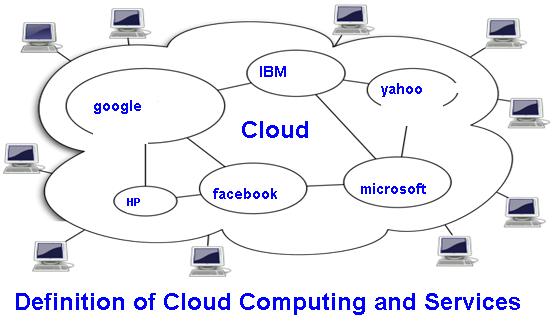
Definition of Cloud Computing and Services

The purpose of this paper is to introduce the fundamental information of Cloud Computing.  What Cloud Computing is about, Available Cloud Computing services and the key players, Cloud Computing benefits and the example, Cloud Computing challenge and the example are described. 

Definition of Cloud Computing and ServicesDownload Definition of Cloud Computing and Services

White Paper Topic on Cloud Computing Technology

 There is a  sliver lining in every cloud is what many cloud service providers are thinking; as many organizations are increasingly  looking at cloud computing as an answer to the shrinking budgets that their IT department is forced to deal with.

Cloud computing offerings look attractive to CIOs/CTOs to the following inherent advantages.

1. No upfront spending on Capex

2. Pay per usage

3. No maintenance personnel to keep the applications /services running and hence no fixed monthly cost

4. No hassles of procurement of HW and SW, patches, antivirus, security as all this is handled by the cloud vendor

5. Focus on core competency of the organization.

6. Cost effective and easy handling. Peak and trough demands in computing resources.

 Cloud computing is defined as computing using the ‘cloud’ (internet , intranet ).It is a way of computing to scale dynamically and often using virtualized resources as a service .Public cloud means that it is an offering over the internet to anyone having an internet connection .Certain larger organizations’ IT department   create a scalable and virtualized environment on the same lines as a public cloud but on the intranet(Private cloud)  to serve the different business units  who are their customers and this helps them charge back the SBUs in a transparent and automatic mode .This also provides most of  the benefits of the public cloud plus the the additional security of hosting on the intranet .However building a private cloud will need CapEx  spending upfront and the resources to keep it operational .

 Cloud Computing is a general term and can mean many things .Software as a Service (SaaS) is one of the offerings offered by various software providers .In SaaS , the user just pays as per his usage of the software and the SaaS provider takes care of maintaining the software as scales up or down as the customers demand .Google Apps and Microsoft are two major players which provide SaaS solutions to SMBs .(Small and Medium Businesses). Email and BPM products/workflow would be the early adopters in cloud computing,  Infrastructure is also offered as a Service (IaaS) as a cloud computing offering.

Here Infrastructure like storage, servers are provided in an easily scalable and virtualized solution which requires very lead little lead time .Amazon provides such computing resources on demand and pay per use basis.EMC’s Mozy provides backup    on demand solutions and so does Amazon .These are early days for EMC as a cloud provider but since EMC has acquired VMware and RSA , it is only a question of when and not if EMC would roll out massive solutions for storage and backups .

Platform as a Service (PaaS) is another trend that is catching up.Here middleware application servers, Databases are provided as scalable containers where the customer’s developer group  can develop/test/run his code and also provide it to the end users .Amazon and Google are two the two big players in this market , but Microsoft is also planning to enter this market in a big way.

 Increasingly CIOs are turning to cloud computing to handle peak demands on computing resources .CNN used cloud computing resources to handle the peak demand for CNN news during Obama’s election.The economic slowdown has also resulted in shrinking budgets and the cloud computing model of pay per use with no capital expenses and no binding contracts has found favor with many a CIO/CTO/decision maker.

The cloud service providers are providing excellent security using encryptions , firewalls and other techniques  to their customers .As the usage grows and reservations about security of data reduces , cloud computing is likely to grow exponentially. Besides the big cloud service providers ,network providers , large telecom service providers , large data center players , niche skills in maintenance of technologies used in these cloud computing data centers , grid computing softwares , virtualization software and  encryption and firewall software and software products which automate the billing based on usage of computing resources will be needed to meet the growing demands of cloud computing .

Download White Paper Topic on Cloud Computing Technology

Cloud Computing White Paper

In today’s world, we are using Mobile phone Service from a Mobile Service provider, we are not knowing anything about how our mobile phone is communicating with external world with a single touch, but we are nicely enjoying this service without knowing the internal functions of the mobile services (like what infrastructure, platform, software, material are used), but we are paying for the usage of the service on a monthly basis without any pain. Similarly, we are consuming the electricity for our day today activities, but we never interested to know how this electricity are made, how it is distributed across the nation, what are natural resources are required to make the electricity and how many resource are involved in this process.

Without taking any pain on these activities, we are enjoying this vital resource by switching on the single button with our finger without any pain, but it involves some cost for usage of the electricity every month. Similar examples like Cable, Internet and water are utilized by us for our day today life without knowing anything on this.

Now, my boss asked to build a very robust salary system for our organization. We will see, what are the key ingredients required for this recipe.

We need

1)     Infrastructure to communicate internal and external world (Banks, third party vendors)

2)     Servers and Operating system to run on the application

3)     Application tools to develop this system

4)     People to develop and maintenance application

When we see how to build this system with all this ingredients, it is very big process, like setting up a infrastructure, buy the rights servers, operating system and software’s and also we need to find a the right resource and knowledge to start the development activities. For example if we need to start from scratch by setting up the infrastructure, buying servers, loading the software its going to take more time. To compete with today’s market we need to build solution ASAP to see the immediate revenue. The Buzz word called “Cloud Computing” is talking about all these pains and it says, using cloud computing we have remedy.  The below section gives some details about cloud computing and see how the cloud computing solution helps us to build the system.

Download Cloud Computing White Paper

Cloud Computing in Insurance Seminar

Cloud computing has been gaining industry momentum lately. Its promise to deliver cost effective solution over cloud is so fascinating that many industries have started investing in cloud computing instead of having to own and manage the IT infrastructure which includes both hardware and software. One industry which is yet to fully understand the implications, both positive as well as negative, of cloud computing is Insurance industry.

This paper focuses on how cloud computing can be leveraged upon by the insurance industry to expand their businesses, to stay competent in a cost effective way, to reach to their customer in shortest possible time, to focus on their niche area of operation instead of focusing on managing IT infrastructure, etc. This paper will also provide some insights on current cloud computing platforms available in the market and their capability and limitation in serving to insurance industry.

Cloud computing is a term used to refer to the services offered on demand over internet. These services include software, platforms to develop new software/tools, and infrastructure such as servers and data center space. These services are offered by sharing resources among many consumers.

The biggest advantage of cloud computing is the provision for scalability at a lower cost. As and when required a consumer can scale up or down the services offered to it as they are provided on demand.  Businesses, as consumer of the services offered over cloud, do not need to deploy more resources when they scale up their operations or remove excess resources when they scale down their operations as this responsibility lies with the cloud provider. Instead, businesses can focus on their area of operation.            

Download Cloud Computing in Insurance Seminar

Basic Concepts of Cloud Computing Architechture

Now we can discuss about cloud computing Architecture with a real world example to get a clear understanding about it.

Aryn started Home delivery of pizzas on the order from Customers. He is worried about how to deliver the pizzas on time and how to manage the pizza delivery. He is also concerned about hiring the drivers and keeping the bikes running. But the below scenario makes him worried.

He is a pizza delivery person and not a mechanic – delivery is a distraction. With his limited budget, maintaining the deliveries costs a lot.  His business suffers when he can’t keep up the deliveries as he has promised to give 20% of deduction on total amount of the bill, whenever the delivery is late. It is difficult for him to estimate about how many bikes are required based on deliveries. Then he came to know about the new kind of Delivery Company of bikes and drivers. He can use the services provided by this company, on as need basis and pay only for what he uses. Now he can depend on that company to handle the deliveries.

A few years later his business expanded to more branches and started with new problems as well. It is difficult for him to maintain all the software’s and data in local servers which costs a lot. His business is constantly running out of storage space and fixing broken servers. Then he came to know about cloud computing, which gives a solution to his problem. Instead of maintaining all the data and software’s at local machines, he can now depend on another company which provides all the features that he requires and are accessible through the Web. At the same time his data is secure, backed up at another location. “This is called Cloud Computing”.

Cloud computing means computers don’t have to limit business. Business can grow without worry as Cloud companies have nearly unlimited storage and resources, as well as information is safe because the servers are normally backed up in multiple locations. Aryn is happy as he is using cloud computing and he pays only for what he uses. If his business grows, then his computing costs will also go high and vice versa.

Cloud computing gives us new kinds of services from emails to word processing or photo sharing etc that live in the cloud. For example  when he needs a new billing system, he  can go for  installing and supporting one on-site, or he can use  a product that lives in the cloud and works using his web browser.

Imagine if there is a weighted developed web application that would lower costs and increases users’ scalability. This is how web applications are curly? developed. Databases and business logic’s are build. Web servers are procured improvising to handle PC’s allowed. When ever corporations connect load balancing ladders and then finally users are connected to the web application.

Download Basic Concepts of Cloud Computing Architecture

The Challenges of Cloud Computing

The word ‘cloud’ has become the hottest buzz word these days. Everything has started moving towards cloud and we could feel that ‘Cloud Computing’ as a revolutionary concept that is going to bring us to Internet ubiquity. At the same time there are also barriers to it. This paper discusses about various cloud computing challenges, security challenges for cloud & security benefits of cloud.

The Below Attached Document contains the following table of contents..

 Table of Contents

Introduction

Cloud Computing Challenges

Security Challenges

Data Security

Cloud Computing Security Issues

Security Benefits

Conclusion

Download The Challenges of Cloud Computing

Basics of Cloud Computing

Cloud computing industry is the one which is going to propel forward with an increased momentum in near future. SaaS, Software as a Service type of cloud computing delivers a single application through the browser to thousands of customers using a multi-tenant architecture.

–      Highlights:

  • Minimum capital expenditure that encourages more new entrepreneurs, as everything is managed in the cloud and one doesn’t need to build offices, distribution centers, data centers etc
  • Optimal utilization of resources, globally. That domino effect global warming.
  • Paying for a resource or a service only for the instance one uses it, instead of owning an infrastructure. Software as a Service.
  • The Catalytic effect of using Cloud Computing (Lesser life cycle time from requirements to deployment. Customer will be able to see finished product much earlier when Cloud Computing is used than in traditional implementations)
  • Challenges involved

–      Key differentiation/creativity brought out/intended:

  • Development environments can be on clouds, by reducing cost at-least by 20%
  • Perfect globalization

–      Immediate account / customer / market need

  • Carbon Accounting Tool
  • Reduction of Operational Costs

Download Basics of Cloud Computing

Introduction to Cloud Computing and Microsoft Windows Azure

Introduction to Cloud Computing and Microsoft Windows Azure:-

Web Role

¨Based on ASP.NET 3.5 SP1 – 64bit
¨Web Projects
.ASPX
FastCGI applications (e.g. PHP)
Java Apps
Static Content
¨Http(s)
¨WebRole
New web.roleConfig to support FastCGI

Worker Role

¨Managed Class Library
¨Inherits RoleEntryPoint
¨Start() Method
¡Called by Fabric on startup
¡Do not return from Start
¨Stop() Method
¡Called when role is to be shutdown
¨GetHealthStatus()
¡Heartbeat for Health

Azure Components – AppFabric

  – Extending .NET to the Cloud with Internet scale utility services

Service Bus:
General purpose application bus on Internet – such as Enterprise Service Bus on-premise

Access Control:
 Rules-driven, claims-based access control rules transformation engine

Workflow Service – Not available currently:
 Shared hosting of workflows

Azure Components – SQL Azure

  – Extending SQL Server Data Platform to the Cloud


Queues

¨Decouple Roles
¨First In Last Out
¨Design for guaranteed message delivery
Configuration

 Two main configuration files

ServiceConfiguration.csdef – Definition File
ServiceConfiguration.cscfg – Instance Data Configuration
Web.Config vs. ServiceConfiguration.cscfg

Environments

There are 2 environments available on Azure
¡Staging
¡Production

Applications can be promoted or demoted from staging and production

Logging

¨No debugging in Cloud
¨Standard diagnostics Trace APIs
¨Collect the following types of diagnostics data
IIS Logs
Failed Request Logs
Performance Counters
Windows Event Logs
Application crash dumps
¨Use Azure Storage for transferring logs on an on demand or scheduled basis
¨To enable the diagnostic trace listener, add the following configuration file to your role’s web.config or app.config file:

Few Cloud scenarios-

-Large User Load for application(s)
-Variable User Load for application(s), dynamic Scale up / down required
-Start ups who do not intend to invest in infrastructure
-Seasonal / Periodic applications

Enterprises required Cost effective web / data  solutions

Download Introduction to Cloud Computing and Microsoft Windows Azure