
Online Recruitment System an Java Project.

The project “Online recruitment system an java project” has designed an online website wherein jobseekers can register themselves at the site, apply for jobs and attend exams. This system can be implemented at a global level. This website is very useful for prospective candidates who can upload their CVs and apply for jobs they wish to join.Online-Recruitment-System1-an-Java-Project.
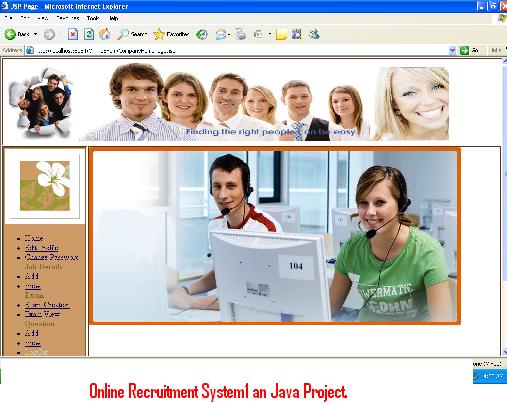
This site is also useful from the recruiter’s point of view as the company can post their staffing requirements and check the profiles of various candidates. These recruitment methods are designed to get the best candidates for the job. This system makes it possible for the managers for managing staff and also for promotion decisions as well as succession planning. 

Online Recruitment Java Project description:

The project online recruitment system is designed with a modular approach. The three main modules of the project are administrator, jobseekers and company. The first module is the administrator who has absolute authority over the entire system. he can have a view of the registered users and also has the power to delete them. He can edit the web pages and update them periodically. The company details also can be viewed him.

The second module is the jobseeker who can register on the site and after registration purposes will be directed to his home page. He can update his profile, change the password and check the examination details. The final module is the company module and it can register, conduct the exam online and approve/disapprove of the candidates. Also results are provided.

Conclusion:

It is said that online recruiting will emerge as an upcoming trend in the years to come. This system designed can be enhanced in the future as per the requirements. Information can be easily updated on this site and is pretty flexible and easy access of information can be done on this web site designed by the project.
Human Computer Interactions-HCI Web 2.0 Seminar

Description: The research paper suggests the viable solutions that could be obtained from Human Computer Interactions. The research paper Human Computer Interactions-HCI Web 2.0 Seminar suggests that the only thing that is constant in this ever changing world is ‘change’. There is a new discovery every second and enhanced functionality that aids this new discovery. There is information explosion, data explosion, and so means for securing these data and the information shared on e-transactions is occupying the primary concerns of the computer scientists.

What is Web 2.0:

Web 2.0 is such a breakthrough in the browsing technology. Web 2.0 offers a technology and facilities like never before. Web 2.0 functions as a platform for all the world web services. The Web 2.0 has many mind blowing features that sets it apart from the rest. First and foremost it is the fact that one can download the latest software available in the circuit. One can update the system requirements to the latest. Web 2.0 allows remixing and consuming data. AJAX and SOAP allow easier and hassle free communication while using Web2.0.

The Web 2.0 technology gives people a faster access and solutions to problems. It rises the browsing to a higher level of getting things done and fixed. AJAX makes every application on Web 2.0 a distributed application. Also virtually every web page designer ends up effectively designing their own widgets. Issues pertaining to user have occupied the center stage during these years. Technologies that are user friendly are alone focused upon. The functions of Web 2.0 are interesting. They are folkonomies, blogs and mashups.

Conclusion: The research paper concludes on a note that human computer interaction basically infers the idea upon the incessant human interaction with the computer. Although beneficial to the users in many ways the technology of Web 2.0 keeps evolving matching the changing requirements of human beings.

Download Human Computer Interactions-HCI Web 2.0 Seminar.

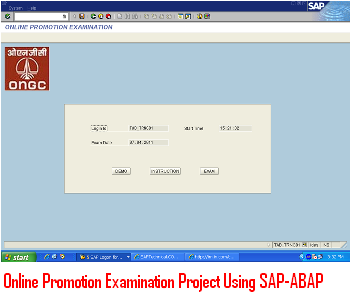
Online Promotion Examination Project Using SAP-ABAP

Introduction:

                 The project “Online promotion examination using SAP-ABAP” is a system wherein the students can appear for the examination online. Its main goal is to provide a quick and easy way for appearing in the exam conducted by ONGC. This system is managed by collaborating with partnerships with agencies/boards that conduct the exam. It can also provide special advantage to the applicants.Online-Promotion-Examination-Project-Using-SAP-ABAP

               This exam consists of many procedures once you are an employee of ONGC and then you have to enter your CPF number. Once you log on, then you can view all the instructions that are related to the examination. The time limitation of the examination is set by the administrator. Once your exam is complete, you can click on the submit button.

SAP-ABAP Examination project description:

This project online promotion examination is developed on a SAP platform in ABAP programming language. There are two types of user groups for this project. One is the administrator and the other is the candidate. The administrator has several roles to play. He has to upload the question bank and the correct answers corresponding to the question bank. He has to also validate the master data of the candidates and prepare the final result.

            The candidate has to register for the exam with the personal number before the exam. He can then login and appear for the exam. He has the option of appearing for a demo session of the exam where he can get to see how the real examination process would be. He can get a list of instructions to be followed for the main examination and can access the result after the exam is completed.

Conclusion:

              The project discussed here is flexible in nature and changes can be incorporated very easily into this system. The system can be maintained very easily. An additional feature that can be added in the future would be that a mail response can be sent to the user to let him know whether he is eligible for the exam or not.

Download Project Report of CSE Online Promotion Examination Project Using SAP-ABAP.

Online Medical Portal an Java Project

Introduction:

In today’s world, everything can be controlled and accessed without the physical presence of a person-this is the requisite in today’s modern world. The project “Online medical portal a Java Project” is implemented to fulfill this particular requisite. This project follows a modular approach. In this medical portal, the administration module updates the number of patients and doctors in the portal.Online-medical-portal-an-Java-Project

The admin module can also add doctors along with the details like qualification and specialization on the system. He can also view the details of doctors and patients and has full control over the medical portal. All patients are given a unique id which has his complete details and this is also fed into the system software.

Description on online medical Java project :

In this project online medical portal a Java project, the patients can register on the portal on a free basis. He can make use of the services after he finishes registering. The doctors also require a permanent id by the admin for finishing the registration. The id is provided by the admin after verifying the credentials. The patients can chat with the doctor on the portal which enhances the site’s response.

The user has the option of changing his password when he wishes to. This ensures security and privacy on the part of the user. The user can also upload images of X-rays and scan images and also diagnostic reports. This can be viewed by the doctors who will ten guides the patient to a better understanding of his ailment.

Conclusion:

The project is an idea of the medical portal and offers scope for future enhancements. This system provides benefits to the patients. The best possible combination of digital media and human intelligence has been combined in this project. Thus, this project also gives the benefit of direct interaction with the doctors with the help of chat facility.

Mobile Ad-Hoc Networks Extensions to Zone Routing Protocol

Secure communication is a significant challenge in ad hoc networks. The MANET paradigm enables communication across networks. Its main feature is that network nodes collaborate for supporting the network functionality.

Mobile Ad-Hoc Networks Extensions to ZONE ROUTING PROTOCOL contains peer-to-peer communicating nodes which are highly mobile. An ad-hoc network lacks infrastructure and topology of the network changes dynamically. The task of routing data from a source to a destination is challenging. Many routing protocols proposed for wireless ad-hoc networks. So we consider a routing protocol called the zone routing protocol (ZRP) which has been proposed for wireless ad-hoc networks with bi-directional links. This zone routing protocol employs a hybrid proactive (table driven) and reactive (on- demand) methodology for having scalable routing in the ad-hoc network.

 A wireless network which transmits from computer to computer is provided by Ad-Hoc network. The peer-to-peer mode operation extends the distance of the wireless network. To access to the Internet, the computer can be connected via wire or wireless to an ISP routing from one node to another on such a “mesh” network typically uses an on-demand routing protocol like PROACTIVE and REACTIVE, which generates routing Information.

 The proliferation of Mobile Ad Hoc Networks (MANETs) introduced new requirements to service discovery. It is a collection of mobile computing devices with wireless network interfaces that connect together dynamically to create a multi-hop wireless network.

 There are many implementations of the Ad-hoc On-demand Distance Vector (AODV) routing protocol available for the Linux platform. The AODV protocol has a number of messages that uses for route discovery, route maintenance and repair, and neighbor detection.

 Conclusion:

 ZRP is widely used in wire less technology such as mobiles, laptops, Wi-fi connections, and blue tooth technology. It tries to maintain the most up-to-date map of the network. It is easy to use by every one. It is easy to understand the mechanism. It requires less band width.

Download Mobile Ad-Hoc Networks Extensions to ZONE ROUTING PROTOCOL

Zigbee Technology CSE Seminar Topic-Idea-Abstract

Zigbee Technology CSE Seminar Topic-Idea-Abstract is specification for a suite of high level communication protocols using small, low-power digital radios. The technology is intended to be simpler and cheaper than Blue tooth. ZigBee is the newest specifications which have low data rates, consume very and low power.

 With ZigBee technology, interoperability will be enabled in multi-purpose, self-organizing mesh networks. ZigBee is standard for embedded application software. The bandwidth of Blue tooth is 1 Mbps and ZigBee has one-fourth of this value. ZigBee has low costs and long battery life. ZigBee is meant to cater to the sensors and remote controls market and other battery operated products.

 ZigBee is designed for sensors and remote controls that are many in number. It needs small data packets and extremely low power consumption for long life. There are three different types of ZigBee device. They are ZigBee coordinator (ZC), ZigBee Router (ZR), and ZigBee End Device (ZED).

 The ZigBee Standard has three sets of solutions, called ‘layers’. These layers facilitate the features such as low cost, easy implementation, reliable data transfer, short-range operations, very low power consumption and adequate security features. The three layers are Network and Application Support layer, Physical (PHY) layer, and Media access control (MAC) layer.

The different topologies are star, peer-to-peer, and mesh. There are four frame structures. They are Beacon frame for transmission of beacons, Data frame for all data transfers, Acknowledgment frame for successful frame receipt confirmations, and MAC command frame. Zigbee offers four inherent, beneficial characteristics. They are Low cost, Range and obstruction issue avoidance, Multi source products, and Low power consumption.

Zigbee Technology Conclusion:

ZigBee is one of the global standards of communication protocol which is formulated by the relevant task force. It is the newest and provides specifications for devices which have low data rates, consume very low power thus, characterized by long battery life.

Download Zigbee Technology CSE Seminar Topic-Idea-Abstract.

ASP.Net Project on E-Examination.

 ASP.Net project on E-Examination project is for final year computer science B.Tech students who are looking to develop online website related project which is based on a real time issue. This projects main idea to overcome present procedure implemented in every college which is performed  through manual process..Net-Project-on-E-Examination

Existing system

In present situation procedure implemented for conduction examination is done through manual process. This procedure includes many problems. In order to solve these problems new systems in introduced Student. Existing system contains work like filling forms manually, mark sheets submissions, Time delay for results. In order to solve this problems new system is introduced.                                                                       

Proposed system

All the problems mentioned above can be solved through this E-Examination system which will provide features like filling of forms through online, attempting exams through online and results are displayed in few minutes. In this process records are stored in data base which can reduce lot of work for every department.

Objectives of the ASP.Net Project on E-Examination system   

The main idea of this project is to efficiently calculate the student examination procedure through automated online system. Which will save lot of time and provides fast result facility? It is one time implementation project which can be implemented with very less  cost.

ASP.Net project on E-Examination project is developed in different modules among them admin module is provided for professors who will prepare test paper for examination which is maintained securely. Then in student module students should log in using their hall ticket and password then they can attempt for the examination which is entirely automated. This application will display random questions which will differ from each student. Using this procedure invigilator risk will be reduced.

 There are four types of the modules in ASP.Net Project on E-Examination.

1:  Student Module
2:  Course Module
3:  Exam Module
4:  Administrator module

XML-Web Services CSE Seminar Idea-Abstract

XML-Web Services CSE Seminar Idea-Abstract: Web services allow applications to share data, invoke capabilities from other applications. Though Web services remain independent, they can link themselves into a collaborating group that performs a particular task. A Web Service is simply an application delivered as a service which is integrated with other Web Services using Internet standards. It is a URL-addressable resource and programmatic returns information to clients. One basic feature of Web Services is that clients do not need to know how a service is implemented.

 Technically, a Web Service is making a remote method call (RPC) where underlying transport is HTTP (internet). The methods are defined in WSDL using XML. The message is transported over HTTP in XML using SOAP protocol. The implementer implements web service with the help of technology like .NET or Java publishes its interface (WSDL) in UDDI (IBM, Microsoft). The user discovers web service (WSDL), and makes a call to the appropriate Method/function.

 An XML Web service is a programmable entity which provides an element of functionality like application logic which is accessible to any number of systems using ubiquitous Internet standards such as, XML and HTTP. XML Web services depend on the broad acceptance of XML and Internet standards for the creation of infrastructure which supports application interoperability that solves the problems.

XML-Web Services CSE Seminar Idea-Abstract Conclusion:

 An XML Web service is used either internally or externally over the Internet by any number of applications. An XML Web service allows heterogeneous systems to work together as a single web of computation because it is accessible through a standard interface. XML Web services provide a viable solution for data and system interoperability. XML Web services use XML-based messaging as a fundamental means of data communication. It helps to bridge the differences exist between systems that use in congruent component models, operating systems, and programming languages.

Download XML-Web Services CSE Seminar Idea-Abstract.

XML- Extensible Markup Language Seminar

XML is a cross platform tool or a language to gain data transfer between the cross platform. It is used to display the data in a formatted matter. It is used to represent the information or data and does not have any capability to perform any tasks on its own. It always requires an application in order to work with the XML documents.

 Rules for writing a Well Formed XML- Extensible Markup Language document are: extension for the file should be XML, XML documents are case sensitive files and hence the tags and the attribute values of the documents should be maintained in proper case, XML document should have at least one root element which can have one or more Child elements. Whenever the XML document is designed based on the DTD file then it is said to be valid XML document.

 Data Type Definitions: It is used to provide the definitions for the data to be used or to be provided in the XML document. Entity: It is used to define a user specific named entities which can be used in the XML document. When ever a named entity is used within a XML document then the value of the named entity will be substituted as a macro substitution within the XML document.

 External DTD Binding, whenever the data type definitions are specified in a DTD file and if it has been explicitly binded to the XML document then it is said to be external DTD binding.

 Conclusion:

 This XML- Extensible Markup Language Seminar PowerPoint presentation describes about XML. It is a cross platform tool or a language to gain data transfer between the cross platform. XML is not a replacement for HTML. Where the definitions of the XML document can be provided using either the Data Type Definitions (DTD) or XML Schema Definitions(XSD) file. For a well formed XML document, it is used for representing the data only. Valid XML document, it is used for representing the data along with its definitions.

Download XML- Extensible Markup Language Seminar.

Worldwide Interoperability for Microwave Access (Wimax) Seminar Topic

This paper Worldwide Interoperability for Microwave Access (Wimax) presents the features of the Worldwide for Microwave Interoperability Access     (WiMAX) technology and discussion on comparing Wireless Fidelity (Wi-Fi) with WiMAX. Broadband technology is a need for the population. Internet Service Providers (ISPs) have challenges in order to have broadband solutions. Digital Subscriber Line (DSL) technology appeared to be pioneer solution.

 Despite Wi-Fi in LAN solutions, it is used in MAN solutions also with bandwidth, coverage, and power consumption for the promotion of conformance and interoperability of the IEEE 802.16 standard, known as Wireless MAN.

 The WiMAX is described as a standards-based technology that enables wireless broadband access to cable and DSL. WiMAX is not a technology, but rather a certification mark or stamp of approval.

 Based on IEEE 802.16 and ETSI HiperMAN, WiMAX has common mode of operation, Concentrated in 2- to 11-GHz WMAN and Defines both the MAC and PHY layers. The IEEE 802.16 technical has evolved into three generations. They are IEEE 802.16,   IEEE 802.16-2004, and IEEE 802.16-2005.

 A WiMAX system consists of two parts. One is WiMAX tower and other one is WiMAX   receiver. IEEE 802.16 supports two modes of operation, PMP and PTP. Point-to-point (PTP) link refers to a dedicated link that connects only two nodes, BS and subscriber terminal.

 Topologies are Point-to-multipoint (PMP) and Mesh Topology. Mesh networks are wireless data networks that give the SSs more intelligence than traditional wireless transmitters and receivers.

 Conclusion:

 WiMAX becomes the dominant standard for Wireless MAN networks in today’s world market. The importance of OFDM makes the difference between the 802.16 and 802.16a standard. There are prototypes and development kits using WiMAX standard that are used for education. There are also few products which have been introduced into the market that already contains the WiMAX standard. Market is the key word to take into account. Products need to be delivered as per the market needs.

Download Worldwide Interoperability for Microwave Access (Wimax) Seminar Topic.