The following research paper Data Validations Engineering Technical Presentation talks of attaining Network Security. It talks about securing websites from any external attack. It talks about the modular approach as the most effective one in identifying a potential hacker at various stages of information transmission. It talks about how modular approach gives the best data validation approaches that defend the website from being corrupted.This B Tech Final Year Seminar talks about two very important principles.1. How data validation is done in the data model where validation rules interpret the data.2. How to protect from the harmful meta characters while validating
The possibility of threats introduced by improper data validation are many, but the cause almost same. The attacker could possibly application logic, execute unauthorized commands or code on backend systems or compromise the trust the user has in the application.
What is Code Injection?
When data is passes through a program that operates in a particular processing context. This context has its rules for identifying data and commands. This identification is important from a security perspective because commands are issued from a trusted source, whereas data could be supplied from a non-trusted source.
Inadequate data validation might prove disruptive to the normal functioning of website. These include:
• Path traversal
• Various buffer and format string vulnerabilities that affect languages such as C and C++
• Encoder attacks, which defeat security and validation mechanisms, such as the double decode and Unicode vulnerabilities that affected IIS version 5
• LDAP injections that affect the application in a similar fashion to SQL injection and allow an attacker to run arbitrary LDAP queries.
Conclusion: Web applications are of colossal nature and there are hundreds of applications included daily. The vulnerability of a web page in a scenario like this increase many times. In such a situation it is very important to undertake proper data validation approaches.
Download Data Validations Engineering Technical Presentation.
Embedded Java Technology CSE Paper talks about the Embedded Java Technology.The research paper says that JAVA language is a high-level programming language that is simple, object oriented, secure, distributed, dynamic and multithreaded. A programming language allows you either to interpret or compile a program whereas Java helps you to both interpret and compile.
The compiler first helps to translate the program into an intermediate language called the Java Byte Codes —the platform-independent codes interpreted by the interpreter on the Java platform. The interpreter parses and runs each Java byte code instruction on the computer. Compilation happens just once; interpretation occurs each time the program is executed.
The research paper explains how a program runs over a system. It describes ‘platform’. A platform is the operating system and the hardware. The Java platform has two components:
The Java Virtual Machine (Java VM)
The Java Application Programming Interface (Java API)
The Java VM is the base for the Java platform and is ported onto various hardware-based platforms. The Java API is a large collection of ready-made software components that provide many useful capabilities, such as graphical user interface (GUI) widgets. The Java API is grouped into libraries of related classes and interfaces; these libraries are known as packages.
Applets and Applications are two common types of programs written in Java. Although applets are not the only easy things done by Java the technology enables to write powerful software programs.
Conclusion: Embedded Java technology enables an effective means to standardize software development for embedded devices. By integrating a compact Embedded Java application environment directly into new devices, manufacturers can decrease development costs and get their devices to market in a quicker and easier way. Breakthrough Embedded Java tools compress the strong functionality of a Java application environment into a small memory footprint. Embedded Java technology also offers device manufacturers a well-to-do software development environment.
The Final Year Computer Science Engineering Elliptic Curve Cryptosystem Student Seminar talks about what Elliptic Curve Cryptography is. Cryptography is the science of coding some information with an intention of securing it.Cryptography is an indispensable tool today in the vast expanding world of information technology. Today there is an information leak at the drop of hat. Sometimes information needs to be saved and protected. It could be very crucial and very personal information which when leaked could create some massive problems. In a era where transaction happen on line, what we call e-transactions- and people use smart cards in order to buy, sell or indulge in activities like withdrawal of amounts the role of cryptography becomes more and more important.
The world of cryptography has evolved since the time it was invented. These days there are three cryptographic keys in vogue. The switch key, the public key and the hash key. All the three run on specific algorithms. Switch key mode uses a single cay for encryption and decryption. Public key mode uses two keys for encryption and decryption and hash key uses an algorithm that permanently encrypts the information and that too irreversibly.
Elliptic curve cryptosystem is a very secure and proven way to encrypt information whose security rests on the discrete logarithm problem over the points on an elliptic curve. ECC can be used to provide both a digital signature scheme and an encryption scheme.
Conclusion: The public key cryptography stands ahead of all the other models. Implementors today are faced with a choice between three types of public key systems: integer factorization systems, discrete logarithm systems, and ECC. Each of these systems is capable of providing confidentiality, authentication, data integrity and non-repudiation. Of the three, however, the ECC proves to be the best owing to its strength –per-bit factor.
The research paper Data Warehousing Implementation talks about effective ways of implementing Data Warehousing techniques. The speed at which data is churned out is astronomical. Data is released from any responsible organization almost at a second to second basis. Researchers say that Data is going to be doubled in just a few years. But the rate at which the data is secured is not at all in harmony with its production. Effective Data Base Management Systems empower organizations.
What are Mining and Warehousing:
Data mining offers some practical solutions to manage data and put them in some manageable patterns and formats. Data Mining helps the organizations to discover some invaluable ‘hidden’ data. This hidden data might expedite the business processes or help business in doing some very good competitor analyses. Data Warehousing is a valuable tool that helps in putting the data in patterns so as to facilitate prediction, forecast and analyses. The aim of warehousing is to see that almost all crucial decision business making goes ‘online’.
Problems: The research paper casts light on some practical issues faced by giant companies like AT and T which rely heavily on data warehousing without which tackling problems pertaining to storage and analyses becomes a herculean task.
Conclusion: Data warehousing projects are highly vulnerable and harder in comparison with traditional projects. Data warehousing experts alone can tweak the problems concerned to the domain. Data Warehousing works on Boolean Logic which the users might not be able to comprehend.
Data Warehousing has a very promising future although it might have a few initial hiccups.
The research paper Electro Dynamic Suspension Electro Magnetic Suspension speaks about Magnetic Levitation (Maglev) in which automobiles do not run over wheels/tyres but they surf over an electromagnetic wave. Maglev enabled automobiles run at a speed of 330 miles/hour. The research paper talks about two types of Magnetic Levitation.
1. Electro Dynamic Suspension ( EDS)
2. Electro Magnetic Suspension (EMS)
EDS is known as repulsive levitation and EMS is known as attractive levitation. The maglev enabled vehicles run over specific guideways although they can adapt themselves to respective topography. However the construction cost of such automobiles may definitely be on the higher side with respect to construction costs, electricity that is very efficiently stored in electromagnets, The magnetic levitation is a breakthrough research which will enable a train run over a electromagnetic track not touching it. Since commuting through air is not possible, magnetic levitation can give a very close traveling experience like that. A magnetic levitated train will run at a speed of 60 km per hour in simpler words a person aspiring to reach Delhi from Hyderabad will reach Delhi in flat 4 hours!
How Maglev works: In the EMS-attractive system, the electromagnets which do the work of levitation are attached on the top side of a casing that extends below and then curves back up to the rail that is in the center of the track. The rail, which is in the shape of an inverted T, is a ferromagnetic rail. When a current is passed through it, and the electromagnet switched on, there is attraction, and the levitation electromagnets, which are below the rail, raise up to meet the rail. The car levitates. The gap between the bottom of the vehicle and the rail is only 3/8″ and an electronic monitoring system, by controlling the amount of attractive force, must closely control the size of the gap.
Conclusion: Although magnetic levitated vehicles are seeing the light of the day in other countries it might take some time for the concept to hit India.
Download Electro Dynamic Suspension Electro Magnetic Suspension.
Description: The research paper DNS Domain Name System Technical Paper talks about Domain name systems. It suggests that it is not possible to have an email id indicating the IP address it would create a problem when the person moves his/her office. In a scenario like this email ids have to keep changing. In order to avoid huge confusion such a thing might rope in the Domain name system has come into existence.
The essence of DNS is the invention of a hierarchical, domain-based naming scheme and a distributed database system for implementing this naming scheme. It is primarily used for mapping host names and e-mail destinations to IP addresses but can also be used for other purposes. DNS is defined in RFCs 1034 and 1035.
What is Domain Name System: The research paper suggested that the Domain Name System (DNS) is a set of protocols and services on a TCP/IP network that allows users of the network to utilize hierarchical user-friendly names when looking for other hosts (that is, computers) instead of having to remember and use their IP addresses. This system is used extensively on the Internet and in many private enterprises today. If you’ve used a Web browser, Telnet application, FTP utility, or other similar TCP/IP utilities on the Internet, then you have probably used a DNS server.
The research paper mentions that the DNS protocol’s best-known function is mapping user-friendly names to IP addresses. For example, suppose the FTP site at Microsoft had an IP address of 157.55.100.1. Most people would reach this computer by specifying FTP.microsoft.com and not the less “friendly” IP address. Besides being easier to remember, the name is more dependable. The numeric address could change for any number of reasons, but the name can always be used.
Conclusion: The Domain name system has helped users have a user friendly email id because remembering the Internet Protocol Address could generate colossal confusion.
Description: The research paper DNA Computing Seminar Vs Silicon Chip Seminar Report speaks about the differences between traditional computing using Silicon Microprocessor as the storage device and DNA Computing that uses the DNA recombination technique.
DNA Computing that works on the principle of nucleotide sequencing has potential to increase the storage potential of any information/ data over a billion times. The breakthrough research was first conducted in the labs of University of Southern California when Professor Adleman first thought of nucleotide sequencing to replace the traditional binary 1’s and 2’s of traditional computing. He also used a primitive algorithm to find solutions to the famous Hamilton Pathway problem wherein the shortest distance to be traveled through seven cities was to be determined for a salesman.
Adleman mixed the DNA strands to get a recombinant nucleotide sequencing each sequence was unique and represented distance between two cities. And shortest distance at that. The only problem was the unnecessary intermediary chemical reactions which Adleman meticulously eliminated. This research has opened vistas for DNA Computing which has become a buzz word ever since.
The silicon microprocessor can store data but in comparison with DNA Computing it is just a fragment of information that it can store. The storage capacity of DNA is suggested to be almost unlimited and in the future the scientists predict that silicon chip will be completely replaced with DNA.
Conclusion: DNA Computing is not as easy as it sounds to be. The tear drop sized DNA Computer has to be understood and welcomed. The test tube method of storing information and the type of lab environment that facilitates DNA Computing could be intimidating. There are many potential hiccups as of now. There could be many unnecessary chemical reactions in DNA Computing which need to meticulously removed by the subject experts. The manual assistance required for DNA Computing makes it a hard dream to realize.
Download DNA Computing Seminar Vs Silicon Chip Seminar Report.
Intrusion detection in Wireless Sensor Network Java Project is for computer science final year students.This project main idea is to trace moving objects which will be useful in fields like military and aviation.This application can be useful in battle field in order to find out moving objects.
Data transfer is done using wireless sensor network. This application is implemented using two sensor detection models :single sensing and multiple sensing detection. This project will show advantages of multiple heterogeneous wireless networks.
Existing System:
1) In present existing system single sensing detection is used where only one object is detected for a single time in wireless sensor network.
2) Our Previous work was according to homogeneous and heterogeneous single sensor in wireless sensor network
Proposed System:
1) In Heterogeneous wireless sensor ,Intruder detected anywhere in the network.
2) We are detecting the intruder in multiple sensor heterogeneous wireless sensor network.
Modules:
1) Constructing Sensor Network
2) Packet Creation
3) Find authorized and un authorized port
4) Constructing Inter-Domain Packet Filters
5) Receiving the valid packet
Modules Descriptions:
Module-1:
In this module, we are going to connect the network .Each node is connected the neighboring node and it is independently deployed in network area. And also deploy the each port no is authorized in a node.
Module-2:
In this module, browse and select the source file. And selected data is converted into fixed size of packets. And the packet is send from source to detector.
Module-3:
The intrusion detection is defined as a mechanism for a WSN to detect the existence of inappropriate, incorrect, or anomalous moving attackers.
In this module check whether the path is authorized or unauthorized. If path is authorized the packet is send to valid destination. Otherwise the packet will be deleted. According port no only we are going to find the path is authorized or Unauthorized.
Module-4:
If the packet is received from other than the port no it will be filtered and discarded. This filter only removes the unauthorized packets and authorized packets send to destination.
Module-5:
In this module, after filtering the invalid packets all the valid Packets will reach the destination.
CONCLUSION.
This paper presented a novel highly automated approach for protecting Web applications from SQLIAs. Our approach consists of
1) Identifying trusted data sources and marking data coming from these sources as trusted,
2) Using dynamic tainting to track trusted data at runtime, and
3) Allowing only trusted data to form the semantically relevant parts of queries such as SQL keywords and operators.
Unlike previous approaches based on dynamic tainting, our technique is based on positive tainting, which explicitly identifies trusted (rather than untrusted) data in a program. This way, we eliminate the problem of false negatives that may result from the incomplete identification of all untrusted data sources.
False positives, although possible in some cases, can typically be easily eliminated during testing. Our approach also provides practical advantages over the many existing techniques whose application requires customized and complex runtime environments: It is defined at the application level, requires no modification of the runtime system, and imposes a low execution overhead.
download Project Report,Code and paper presentation of CSE Intrusion detection in Wireless Sensor Network Java Project .
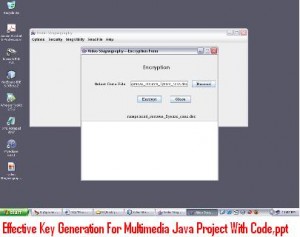
Effective Key Generation For Multimedia Java Project entitled Effective key Generation for Multimedia Application is the application developed to embed an video file in another video signal. It is concerned with embedding information in an innocuous cover Speech in a secure and robust manner. This system makes the Files more secure by using the concepts Steganography and Cryptography.
Stenography, poor cousin of Cryptography is the art of hiding messages inside other messages such that the very existence of the message is unknown to third party. The goal of cryptography is to make data unreadable by a third party, the goal of Steganography is to hide the data from a third party Through the use of advanced computer software, authors of images and software can place a hidden trademark in their product, allowing them to keep a check on piracy.
This is commonly known as watermarking. Hiding serial numbers or a set of characters that distinguishes an object from a similar object is known as finger printing. Together, these two are intended to fight piracy. The latter is used to detect copyright violators and the former is used to prosecute them. But these are only examples of the much wider field of Stenography.
The cover data should not be significantly degraded by the embedded data, and the embedded data should be as imperceptible as possible. The embedded data should be as immune as possible to modifications from intelligent attacks or anticipated manipulations. Thus it is necessary that the hidden message should be encrypted.
System Description:
The Effective key Generation for Multimedia Application system is designed basically in four different modules they are GUI module, Security System module, Stegnography Module, Connection Manager Module.
GUI Module basically deals with the design of the interface which include the service of providing the user with the flexibility of accessing the file system and selecting the required file for the transfer.
It should also provide the system to collect the information from the user to check the authorization in providing the access to the file system. The interface is also to consider the design, which include the services of sending and receiving of the files with encryption and decryption standards.
Existing System.
In the traditional the server was only a data base server that can only offer data. Therefore majority of the business logic i.e., validations etc. had to be placed on the clients system
The data has to be transported over the network to the client, which requires a secured format of the transfer method.
Proposed System.
In the proposed system we use both cryptography and stenography
First the information is encrypted and then it is embedded in to a video file.
In this way two levels of security is provided and it is difficult for the hacker to read the information
Software Requirements For Multimedia Java Project
Operating System:
Windows NT/2000 (Client/Server).
Software requirements:
Front-end: Java J2SDK 1.5, Swings.
Hardware Requirements:
System Configuration:
Pentium III Processor with 700 MHz Clock Speed
256 MB RAM, 20 GB HDD, 32 Bit PCI Ethernet Card.
download Project Report and source code and paper presentation of CSE Effective Key Generation For Multimedia Java Project .
The project entitled LIBRARY MANAGEMENT SYSTEM A C PROJECT is developed as part of the VI Semester RDBMS package project for the partial fulfillment of the BE (Computer Science) degree.
The main objective of the application is to automate the existing system of manually maintain the records of the Book Issue, Book Return from the student, Stock Maintenance, Catalogue and Book Search to be computerized. So the Book Issue, Return, Searching will be a more refined and quicker process.
It is a software application to maintain the records related to Book Purchase, Stock Maintenance, Book Search, Catalogue, Book Issue, Book Returns, Fine Collection, and all necessary requirements for the Library to manage the day to day operations.
This application can be used by any Library to automate the process of manually maintaining the records related to the subject of maintaining the stock and Book Issues.
It is seen that there is no loss of books and students don’t waste time to search for the book required. It is preferred in college libraries where management of books is slightly complicated where students are always referring and borrowing them.