Grid Computing and Internet Btech Cse PPT

Description: The research paper Grid Computing and Internet Btech Cse PPT speaks about Grid Computing and how it redefines the world of internet technology. The research paper suggests that grid computing is now the buzz word in the technological domain and has to certain extent replaced the concept of ‘distributed computing’. Grid computing primarily focuses on enhancing compute performance, distributing valuable and important information along the network, sharing innovative applications and high performance orientation. The research paper primarily focuses on the data sharing among various virtual organizations and data sharing. In an environment like this there are inherent problems like resource authentication, authorization, resource access, resource discovery and many more.

The research paper also casts light on extensible and open grid architecture in which programming, protocols, services, software development kits and interfaces and others have been categorized and explained in detail.

Advantages of grid over power-grid:

  • “On-demand” access to ubiquitous distributed computing
  • Transparent access to multiple byte distributed data bases
  • Easy to plug resources into
  • Complexity of the infrastructure is hidden

The research paper identifies certain problems pertaining to grid computing. They are identified as coordinated resource sharing and problem solving in dynamic, multi-institutional virtual organizations. Current distributed computing technologies do not address the concerns and requirements just listed. For example, current Internet technologies address communication and information exchange among computers but do not provide integrated approaches to the coordinated use of resources at multiple sites for computation. Business-to-business exchanges focus on information sharing (often via centralized servers).

Conclusion: The research paper concludes on a note that the domain of computer science engineering has always been evolving and researching in order to come up with breakthrough researches that would aid in enhanced, reined and high-speed functionality in an utmost secure medium. Grid computing offers exactly such a thing. Grid computing aids is heightened and secure resource sharing alongside interoperability.

Download Grid Computing and Internet Btech CSE & MCA PPT.
Grid Computing What it is CSE 2012 Project Seminar

Description: The research paper Grid Computing What it is CSE 2012 Project Seminar talks about Grid Computing and how it is done. The research paper suggests that it is human nature that evolves almost from second to second with an urge to perform better. Such a thing is happening in computer- Internet applications. Grid is an application that allows internet with advanced features like advanced web for computing, communicating and collaborating. Grid computing, most simply stated, is distributed computing taken to the next evolutionary level. The goal is to create the illusion of a simple yet large and powerful self managing virtual computer out of a large collection of connected heterogeneous systems sharing various combinations of resources.

The research paper talks about the major issues and concerns involving and revolving around grid construction. It is suggested that the high expansion rates of computer domain, networking and concepts like LAN, WAN have triggered the concept of Grid. The term Grid is chosen as an analogy to a Power Grid that provides consistent, pervasive, dependable, transparent access to electricity irrespective of its source. This new approach to network computing is known by several names, such as meta-computing, scalable computing, global computing, Internet computing, and more recently peer to peer (P2P) computing.

Grid computing allows sharing, selection and aggregation of various computer devices like supercomputers, storage systems, data storage devices that are distributed and the information therein is shared by different organizations. Grid computing also allows resolving problems pertaining to science, engineering and commerce. Although the concept of grid computing was initiated considering the geographically dispersed computers, it has gone way ahead above that. Now grid computing is used in many applications, including collaborative engineering, data exploration, high-throughput computing, and distributed supercomputing.

Conclusion: Grid computing has been initiated to resolve many an engineering problem. As of now the system offers many effective solutions and things may evolve to a much greater and higher level in the future.

Download Grid Computing What it is CSE 2012 Project Seminar.

Geographical Information System Cse IT Technical Seminar ppt

Description: The research paper Geographical Information System Cse IT Technical Seminar ppt speaks about Geographical Information System GIS. The research paper suggests that GIS is a system that allows mapping and analyse information that exists on the earth. Burrough in 1986 defined GIS as, “Set of tools for collecting, storing, retrieving at will, transforming and questions are posed to determine what happens, for example, if a new road is added to a network or if a toxic substance seeps into the local ground water supply. Answering this type of question requires both geographic and other information (as well as specific models). GIS permits spatial operation.

Two types of questions can be posed in a GIS. They are Aspatial and Spatial Questions. An aspatial question is something like this: How many buffaloes are present in each location? A spatial question is like this: How many people work for GIS?

Factors allowing rise of GIS:

  • Information Technology.
  • Computer Technology.
  • Remote Sensing.
  • Global Positioning System.
  • Communication Technology.
  • Rapidly declining cost of Computer Hardware, and at the same time, exponential growth of operational speed of computers.
  • Improved functionality of software and their user-friendliness.
  • Visualizing impact of GIS corroborating the Chinese proverb “a picture is worth a thousand words.”
  • Geographical feature and data describing it are part of our everyday lives & most of our everyday decisions are influenced by some facet of Geography

It is suggested in the research paper that GIS comprises five major components: Hardware, software, data, people, and method.

Conclusion: The research paper concludes on a note that as of GIS is a costly affair, but with the increasing demand in computer based applications this domain may become cst effective for the for the future generations. GIS has almost become part and parcel of our lives with many of us still unaware of it.

Download Geographical Information System Cse IT Technical Seminar ppt.

Boolean and Fuzzy Logic Technical Presentation

Description: The research paper Boolean and Fuzzy Logic Technical Presentation talks about Boolean and Fuzzy logic. The research paper also explains the difference between the two. It is suggested that data and information are tough to understand quantitatively. It is suggested that it is easy to decipher imprecise data rather than the precise data. Fuzzy logic is akin to human reasoning it comes to decision seeking not so clear premises and imprecise data. It uses mathematical expression to come to a decision based on premises that are both insufficient and imprecise. Fuzzy set involves segregating classes and groups that are not precisely defined. In simpler words they are fuzzified by generalizing a crisp set with a fuzzy set having unclear boundaries. Linguistic variables are of a critical importance in fuzzy logic. For example an 85 kg man can be grouped both under ‘medium’ and ‘large’ headings. Fuzzy set theory encompasses fuzzy logic, fuzzy arithmetic, fuzzy mathematical programming, fuzzy topology, fuzzy graph theory, and fuzzy data analysis, though the term fuzzy logic is often used to describe all of these.

Boolean logic is totally different from fuzzy logic in the sense truth value is determined only by the binary values 0 and 1, unlike fuzzy logic where in impreciseness determines many an answer and the truth value lies somewhere in the middle of all these. It is put forth in the research paper that the fuzzy logic and its seeds were sown as early by Buddha who posited that ‘the rose may be red or may not be’. This led to the breakthrough research in the domain at the University of California, Berkeley.

Conclusion: The passage concludes on a note that, Fuzzy logic has myriad application value in computational applications like embedded systems and many more. Fuzzy logic provides the most precise way of coming to a conclusion based on vague premises. It somehow works close to human reasoning skills which allow making decision considering approximate values.

Download Boolean and Fuzzy Logic Technical Presentation.

Online Blood Bank a C# .Net Project

Entering the details about the blood groups, members, addresses etc. And tracking the database is complicated when the details are maintained manually. This makes the maintenance of schedule erroneous. There are quite a few constraints causing hindrance to the existing system.

The whole process is time consuming and is not accurate leading to error prone results. It requires lot of manpower in order to get effective results and also lacks data security. The retrieval of data at any given point of time is time consuming. 

The percentage of accuracy is less and reports take time in order to be produced. The Online Blood Bank C# .Net Project is  a windows application allows you to access the whole information about Blood Bank Management Software, readily scalable and adaptable to meet the complex need of Blood Banks Who are Key Facilitator for the Health care Sector, it also supports all the functionalities of Blood Bank. 

It is used for maintaining information about the campus. The project includes 3 modules; The Admin, Donors and Acceptors. The admin module focuses on the both donors & acceptors. Each member in a donor & acceptor is given a user id and password, which identifies him uniquely. The member is given a login form. he enters the login details user id and password. 

Conclusion: 

Each member in a Donor is given a user id and password, which identifies him uniquely. The member is given a login form. he enters the login details user id and password. The options given to a each member in a staff are to change the password, inquire on a particular blood group and information on, “why donate blood”. 

In this you can   store the information about   Acceptors. The whole project makes work easier for every person using the software in their required category.

Hospital Management a VB Project

Hospital management VB project deals with student marks and management. It simplifies managing the student details which are inclusive of personal, academics and providing marks list in a college. This program also provides immediate details needed in the student marks management.

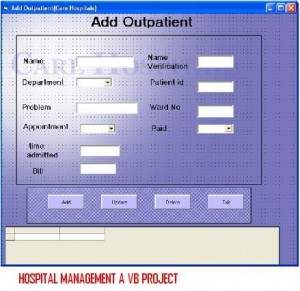
This Hospital management VB project complex project has the scope of adding new employees, doctors, admitting outpatients, fixing appointments etc.  This project also displays the services provided to outpatient. It consist of several interfaces which include Welcome interface Login interface, MDI main interface, Application interface, Doctor interface, Employees interface, Ward interface, Outpatient interface and Services interface.

HOSPITAL-MANAGEMENT-A-VB-PROJECT

In welcome interface, it includes just progressing, intimates that the administrator is getting in the management program. In login interface, we provide authorization to the user getting in. The multiple document interface, provides base screen for all management program actions present in the management program.  

It contains menu bar which list the manipulation forms for management. Application interface provides the basic accessories that are required for certain essential operations. This interface provides us the facilities such as viewing doctor’s details including his/her id, qualification and specialization, address etc. 

It also displays the list of doctors present in various departments. We can search a doctor by his id and then view his details. This interface also provides us the facility to add new doctors in. 

Myriad Advantages:

This interface provides us the facilities such as viewing employee’s details including his/her id, qualification, address etc..  It also display the list of employees present in various departments. We can search an employee by his id and then view his details. This interface also provides us the facility to add new employees in. The ward  interface provides us the details about wards and the habited patients in those wards. 

Conclusion: 

This interface provides us the information about the outpatients, what for they are in, appointments with doctor, bill details, time they are in etc. This interface provides us the information about the services present in that hospital, which time they are scheduled to be open, and the in charge administrator.  The basic functionalities of hospital management system is to provide convenient way of management to the administrator. 

It should be highly user defined and all the details of doctors, employees and patients can be conveniently maintained due to the presence of the data base.

Dynamic Heterogeneous Grid Computing a Java Project

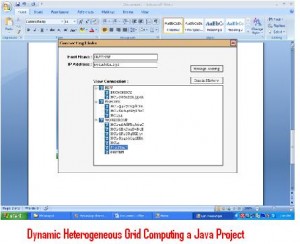
Dynamic Heterogeneous Grid Computing a Java Project is for computer science final year students who are interested in grid computing java project.

Description: 

Communication Induced Check-pointing protocols usually make the assumption that any process can be check-pointed at any time. An alternative approach which releases the constraints of always check-point able processes, without delaying, “Any do not message reception” or altering message ordering enforcement by the communication layer and by the application.

Dynamic-Heterogeneous-Grid-Computing-a-Java-Project

Reason for implementation and others: 

This protocol has been implemented within Pro-Active, an open source Java middle ware for asynchronous and distributed objects implementing the ASP (Asynchronous Sequential Processes).However, large applications executing on Grid or cluster architectures consisting of hundreds or thousands of computational nodes create problems with respect to reliability. 

A Glittering Problem: 

The source of the problems is node failures and the need for dynamic configuration over extensive runtime. 

Conclusion: 

By allowing recovery even under different numbers of processors, the approaches are especially suitable for applications with a need for adaptive or reactionary configuration control. The low-cost protocols offer the capability of controlling or bounding the overhead. A formal cost model is presented, followed by an experimental evaluation. It is shown that the overhead of the protocol is very small, and the maximum work lost by a crashed process is small and bounded. 

The solution to this is two fault-tolerance mechanisms called Theft-Induced Check pointing and Systematic Event Logging. These are transparent protocols capable of overcoming problems associated with both benign faults, i.e., crash faults, and node or subnet volatility. Specifically, the protocols base the state of the execution on a data flow graph, allowing for efficient recovery in dynamic heterogeneous systems as well as multi threaded applications.

Flexible Deterministic Packet Marking CSE Paper Presentation Java Project

Description:

Flexible Deterministic Packet Marking CSE Paper Presentation .Internet Protocol (IP) trace back is the enabling technology to control Internet crime. Without a proper termination condition, the attack graph constructed by the PPM algorithm would be wrong. There are quite many defects in the existing system.

It is not easy to find out pack travel path, the packet can be lost and duplicate packets can be received by the receiver. If this process is repeated over and over receiver will not have any original packet because of the increase in duplication of messages. 

However, the FDPM algorithm provides an autonomous way for the original PPM algorithm to determine its termination. The most significant merit of the FDPM algorithm is that when the algorithm terminates it guarantees that the constructed attack graph is correct, with a specified level of confidence. 

We carry out simulations on the FDPM algorithm and show that the FDPM algorithm can guarantee the correctness of the constructed attack graph. 

Different probabilities that a router marks the attack packets .It is easy to find out packet loss, Duplicate packets and find out each and every packet path. It also reduces the network traffic. In this paper, we present a novel and practical IP traceback system called Flexible Deterministic Packet Marking (FDPM), which provides a defense system with the ability to find out the real sources of attacking packets that traverse through the network. 

While a number of other traceback schemes exist, FDPM provides innovative features to trace the source of IP packets and can obtain better tracing capability than others. In particular, FDPM adopts a flexible mark length strategy to make it compatible to different network environments; it also adaptively changes its marking rate according to the load of the participating router by a flexible flow-based marking scheme. 

Conclusion: 

Evaluations on both simulation and real system implementation demonstrate that FDPM requires a moderately small number of packets to complete the traceback process; add little additional load to routers and can trace a large number of sources in one traceback process with low false positive rates.

The built-in overload prevention mechanism makes this system capable of achieving a satisfactory traceback result even when the router is heavily loaded. The motivation of this traceback system is from DDoS defense. 

It has been used to not only trace DDoS attacking packets but also enhance filtering attacking traffic. It has a wide array of applications for other security systems. We present a novel and practical IP trace back system called Flexible Deterministic Packet Marking (FDPM).

FDPM provides a defense system with the ability to find out the real sources of attacking packets that traverse through the network. FDPM requires a moderately small number of packets to complete the Trace back process.

Enhancing Performance of Data Migration CSE Final Year Project

Description: 

Transferring of data between storage types, formats, or computer systems is termed as Data migration CSE final year project , it is usually performed programmatically to achieve an automated migration, freeing up human resources from tedious tasks. When organizations or individuals change computer systems or upgrade to new systems, or when systems merge, this can be put to potential use. Data-migration-CSE-final-year-project

To achieve an effective data migration procedure, the data on the old system is mapped to the new system providing a design for data extraction and data loading. The design relates old data formats to the new system’s formats and requirements. Programmatic data migration may involve many phases but it minimally includes data extraction where data is read from the old system and data loading where data is written to the new system. 

If a decision has been made to provide a set input file specification for loading data onto the target system, this allows a pre-load ‘data validation’ step to be put in place, interrupting the standard ETL process. Such a data validation process can be designed to interrogate the data to be transferred, to ensure that it meets the predefined criteria of the target environment, and the input file specification. Data migration phases (design, extraction, cleansing, load, verification) for applications of moderate to high complexity are commonly repeated several times before the new system is deployed. 

Similarly, Data Compression is useful because it helps to reduce the consumption of expensive resources, such as hard disk space or transmission bandwidth. On the downside, compressed data must be decompressed to be used, and this extra processing may be detrimental to some applications. For instance, a compression scheme for video may require expensive hardware for the video to be decompressed fast enough to be viewed as it is being decompressed. 

The design of data compression schemes therefore involves trade-offs among various factors, including the degree of compression, the amount of distortion introduced, and the computational resources required to compress and uncompress the data. 

Data Compression: 

There are two kinds of data compression Lossy and Lossless. Generic, data-specific, and parallel compression algorithms can improve file I/O performance and apparent Internet bandwidth .However, when integrating compression with long-distance transport of data from today’s parallel simulations. 

Issues: 

These issues include: what kind of compression ratios can we expect? Will they fluctuate over the lifetime of the application? If so, how should we make the decision whether to compress? Will the compression ratios differ with the degree of parallelism? If so, how can we handle the resulting load imbalance during migration? Are special compression algorithms needed? Can we exploit the time-series nature of simulation snapshots and checkpoints, to further improve compression performance? What kind of performance can we expect on today’s supercomputers and internet?

download Project Report  of CSE Data migration CSE final year project.

Detecting Malicious Packet Losses a Java Project and Source Code

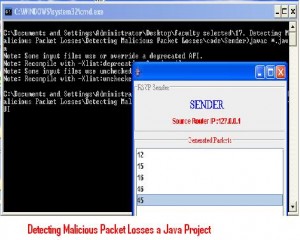
Detecting Malicious Packet Losses a Java Project is for B.tech computer science final year students who are interested in implementing java related projects.

Description: 

Network routers occupy a unique role in modern distributed systems. They are responsible for cooperatively shuttling packets amongst themselves in order to provide the illusion of a network with universal point-to-point connectivity. However, this illusion is shattered – as are implicit assumptions of availability, confidentiality, or integrity – when network routers are subverted to act in a malicious fashion. 

DetectingMalicious-Packet-Losses-a-Java-Project

By manipulating, diverting, or dropping packets arriving at a compromised router, an attacker can trivially mount denial-of-service, surveillance, or man-in-the-middle attacks on end host systems. Consequently, Internet routers have become a choice target for would-be attackers and thousands have been subverted to these ends. 

Advantages: 

The solution is taken to detect whether a compromised router is maliciously manipulating its stream of packets. In particular, the system is concerned with a simple yet effective attack in which a router selectively drops packets destined for some Victim. 

Unfortunately, it is quite challenging to attribute a missing packet to a malicious action because normal network congestion can produce the same effect. Modern networks routinely drop packets when the load temporarily exceeds their buffering capacities.

Previous detection protocols have tried to address this problem with a user-defined threshold: too many dropped packets imply malicious intent. However, this heuristic is fundamentally unsound; setting this threshold is, at best, an art and will certainly create unnecessary false positives or mask highly focused attacks. 

Conclusion: 

The designed, developed, and implemented system is a compromised router detection protocol that dynamically infers, based on measured traffic rates and buffer sizes, the number of congestive packet losses that will occur. Once the ambiguity from congestion is removed, subsequent packet losses can be attributed to malicious actions. We have tested our protocol in Emulab and have studied its effectiveness in differentiating attacks from legitimate network behavior.