Arduino Based Weather Station Monitoring System

The objective of this Arduino project is to build weather monitoring station. In this project, we are measuring temperature, Humidity, atmospheric pressure etc.

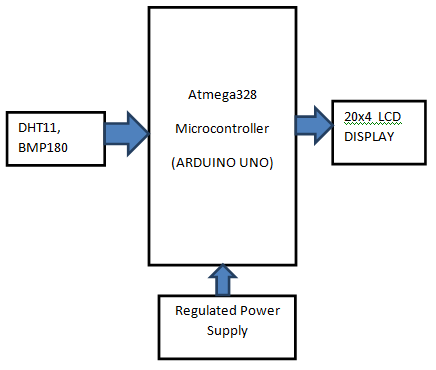
The main features of our project design are that it is small in size, low cost, less weight, less power consumption etc. We are here using DHT11 Sensor which can measure physical parameters temperature, humidity. BMP180 Sensor from Bosch is basically a pressure sensor.

We are here using Arduino board which has Atmega328 microcontroller to process data. It displays the result on 20x4LCD. It shows parameters such as temperature, humidity, pressure etc. It plays important role in weather stations.

SOFTWARE :

• ARDUINO IDE
• EMBEDDED CPP CODE

HARDWARE:

1. Atmega328 Microcontroller (Arduino UNO)
2. DHT11 , BMP180
3. 20×4 LCD Display
4. Regulated Power Supply

BLOCK DIAGRAM :

Portfolio Project IS/IT Case Study

The portfolio project for ISM 6026 is to develop a case study (similar to what we have been doing in class) and critique the case. The portfolio project will consist of two parts: part one is the case study narrative itself; part two is your analysis of the facts of the case.

Approximate length should be about 4000-5000 words (e.g., about 16-20 typed pages) for the case study narrative itself (e.g., Part I of your project). This length is exclusive of the title page, tables of contents, any reference pages, and transcripts of interviews. The case study must be a thorough and rigorous study of the use (or lack thereof) of information systems in an organization.

Your first step in developing the narrative description of your case project is to select your target organization and secure their cooperation. I suggest you offer to provide the organization a copy of your case study analysis and critique as an incentive to allowing you access to the organization: rather like getting a semester consultant for the price of their time. Your target organization should be of sufficient size (i.e., number of employees and dollar volume) that justifies a case study analysis of their information system/technology activities.

Hint: that means your cousin’s one person, home mailing operation is not a satisfactory target organization; nor should you personally be anything other than a passive participant in the case study activities. If you choose an organization with which you are, or were, affiliated, then you may not have been a participant in the decision processes involved in your case study. Further, you must provide sufficient data from your interviews and your references to justify the material in your case study. That means you cannot just make up the details of the case based solely, or even significantly, based on your own recollections.

Second, you must begin to reconstruct the scenario of the organization and its actions. This means searching for information on the organization and the competitive environment in which it operates. For example, if you are writing on the introduction of a new customer relationship management system for a brokerage firm, you would need background material on CRM, SEC constraints, customer demands, and desires, etc.

Third, you must conduct interviews with all the relevant personnel in the organization. I would expect that to include a minimum of three people. You want to make sure that your description of the organization and its environment, problems, opportunities, and actions is accurate and not just the biased impressions of one or two individuals.

An attachment to your case study write up should be the interviewquestions (structured or unstructured) you asked each person in the organization and a transcript of their responses. This transcript may be edited for brevity, but should include all relevant responses.

When you are finished with your fact finding, data digging, and interviewing, you should write a narrative description of the information you collected (e.g., Part I of your portfolio project). Remember, this is 16-20 pages in length, not including title page and table of contents. You might use the following as a very rough general guideline for some of the sections you could include in your case narrative. Pick the writing style manual with which you are most comfortable. Opening Paragraph: emphatically state the situation and any problems. Background/Context for the firm; the case participants; the industry Situational description.

portfolio project /issue narrative – this should be the majority (> 60%) of Part I Conclusion including any questions The narrative should succinctly but completely (avoid unnecessary detail) describe the organizational environment (e.g., the context), the personnel involved, the policies and procedures involved, and the actions performed (this assumes there is some question or controversy involved) and the reasoning for same. The case study narrative portion of your project should be similar in length, content, and detail to the case studies used in class.

For the second part (so indicated clearly and distinctly by headings and in your table of contents) of your portfolio project after you have completed your case study narrative, you should analyze and critique the situation and any decisions involved in the systems project described in part one of your project.

The length should be similar to the length of the other case analyses you have written for this course. Remember, this case study should show the knowledge you gained through this course and others you have taken, plus any relevant experiential knowledge. You should make sure to ground your analysis in the material from the course (e.g., the textbook, readings, lectures, etc.) This project is worth 40% of your grade in this course. Please put the effort into the case that is reflective of that fact and shows what you have learned.

Should it be necessary to return your portfolio project for corrections of any type, there will be a 15% reduction in your portfolio project grade. This applies for each time your project is returned. However, your grade will be recorded as an “I” until such time as you complete your portfolio project. The MBA program has a requirement that the minimum grade allowed for a portfolio project is a 70 for the student to graduate. See the ISM 6026 portfolio project grading rubric for more details as to the expected grading items.

Role of Joint Ventures in Profitability Strategies

From this case study, we can understand the Importance of Joint Ventures for two different countries to keep their brand reputation and earn profits rather than competing in line with their business objectives.

Abstract

The logistics operations in India is gearing up in India due to many reasons like FDI, Increase in Manufacturing inline with Make in India Initiatives etc., which has created a tremendous demand for trucks, tippers with wide range of capacities, models etc., In this case study Eicher which is an Indian Company based out of Gurgaon which has a strategic alliance with Swedish based truck manufacturer Volvo in capturing business demand in India with technological and strategically aspects by protecting their individual business objectives and profitability getting ahead of competition.

Introduction:

Objectives of the case study:

To understand the Logistics & Supply Chain Management Industry trend in India.

How Indian companies are trying to come up with the Increasing demand in line with increasing the market share.

How strategically the foreign companies are entering into Indian markets either Individually or in association with Indian companies.

The Association of Eiche and Volvo (VE Commercial vehicles) in meeting the demand of trucks in India and how it leads to mutual benefits.

Need of the Study:

Any business if it has to grow irrespective of Industry or the nation is purely based on the trends in the industry and increase in economy of the particular country/nation. Indian GDP, Per Capita Income is increasing as the Industrialization is growing as a part of Make in India or the Government initiatives like foreign policy, Industrial Policy, Foreign Direct Investment etc., lead to tremendous change and demand in Indian Supply Chain, Warehouse Management, Logistics and allied  segments and Industries and Heavy and Normal commercial Vehicles and one of the key components in transportation etc.,  Based on above mentioned reasons I felt there is need and because of my interest I have selected this case study for assessment on how Volvo has streamlined their business in India after series of concerns, issues and damages etc.,

The scope of the Study:

The Scope of the study is confined to Eicher which is one of the leading truck manufacturers in India and the Volvo which is a Swedish truck manufacturing company and the scopes here is further confined to the trends in the market and their business growth etc., which will not speak about the key strategies and decision-making, key points in alliance and the financials.

Limitations:

The major limitation is the data availability. The major data analysis is purely based on the strengths, weakness, opportunities, and threats of Volvo and Eicher inline of their association to tap Indian Market as per increasing demand.  The financials, top line, bottom line, legal terminologies, etc, were not discussed or not evaluated which is a limitation while arriving for the conclusion and writing suggestions and recommendations. The time is one more constraint along with the getting the data from companies associates and even from the market.

Research Methodology:

The case taken in this study is how Volvo has resolved its issues while entering into Indian market which came with a plan of penetrating into the Indian market and the methodology used in this study is:

Primary data & Secondary data was collected from the websites of the Volvo & Eicher Companies. The merging business-related data is been collected from different articles and the theoretical part of data pertaining to business metrics has been collected from academic and other books. The SWOT analysis was the technique used in this case study to arrive at a conclusion and to give suggestions and recommendations.

Data Analysis & Interpretation:

SWOT Analysis & PESTLE Analysis:

Strengths:

Eicher:

Eicher is an Indian Company which has its presence in the automobile business since 1948 which entered into Heavy trucks business in 1986 with vast experience on Market.

Infrastructure facilities:  Recently Eicher has built world-class facility at Gurgaon which is built on green concepts where there are maximum resources which are renewable. It’s based on Mantra “Maximum utilization of available resources”

Availability of resources: There is the availability of wide range of resources like Manpower, Infrastructure, Government subsidies etc., which will help them to expand.

Volvo:

Financially Strong: Volvo has Invested Rs.1083 Crore in India on VECV (Volvo Eicher Commercial Vehicles) which has given a boost to Eicher to get set and go.

Technology: It took 7 years for Eicher to build a truck and the cost Implication is Rs 25 Crore after association with Volvo Eicher has Managed to produce trucks with the very low process. The technology and changing demands and needs of the market helped Eicher and Volvo to capture the market. The vehicles from 6 ton capacity to 40 ton capacity with the latest technology were made to cater the needs of the Industry in India.

Weakness:

Eicher:

Technology: Eicher has got experience in service and retail model business of Automobile and it has no R & D facility and even the latest technology to build high-end commercial vehicles.

Expansion: The commercial truck manufacturing and selling business are viable only if the business is carried out in more than one country whereas Eicher don’t have operations other than India.

Financial: Eicher cannot afford to build high-end trucks and sell them within India and even expanding business across the horizons which is an obstructive aspect of Eicher.

Volvo:

They don’t have an understanding of the needs of the logistics, warehousing, Supply Chain, Manufacturing, power etc. in India which is a demand.

The cost Implications will be more if they have to start from scratch.

The government policies on FDI & may change because it is a political area and the Investment etc., will go on the toss.

Opportunities:

Eicher:

Eicher can improve technologically as they are associated with world No. 2 truck manufacturer Volvo and the strategies and the mode of operandi can also be Improvised.

Eicher can expand its business in other parts of the world as they have expertise in maintaining retail business in Automobile Industry along with service centers.

Volvo:

Volvo can get exposure and expertise in Indian Market.

Volvo can sell its vehicles like trucks and buses in India with low cost in India.

It can have trusted service centers in India as it is in association with Eicher.

Threats:

Eicher:

If Volvo gets market leader position in India it will have a wide range of opportunities and which may affect the market presence of Eicher.

As Volvo is Investing on Eicher in terms of technology, etc. and Eicher is providing only Infrastructure facility may lead to misperceptions.

Volvo:

Eicher can adopt the technology, mode of operandi etc., from Volvo and can Start its own manufacturing and produce high-end commercial vehicles at low cost.

Volvo has already Invested Rs. 1083 Crore in India as a part of Joint Venture / Strategic Alliance and if anything goes wrong there may be so many legal consequences which will lead to stake of Brand Reputation etc.,

PESTLE Analysis:

Political:

The Political stability and if the government is firm on its policy on foreign direct investment etc. will give a positive wave to this alliance.

The legalities and the inconsistency in Politics and the governments at the state level and central level may lead to unnecessary obligations.

Economical:

As the economy, GDP & Per Capita Income grows the earning capacity Increases which lead to business transactions at various levels which is a boost to Industry.

Social:

The people in India are emotional and sentimental and as Volvo is a foreign company it always has to ensure that the emotion of Indians is been taken care of Business at various levels like Promotional activities, designing the product etc.

Technological:

Volvo may be very strong in Technology but the Roads and Infrastructure challenge any technology which means the technology has to be customized as per the requirements and Infrastructure of India and the locations.

Legal:

The constitution of Indian and the legal framework of India is a typical framework which will give results often after postmortem of the issue.

Volvo & Eicher has to focus more on a legal framework which has to be in long-term relationship in line with their respective business needs and objectives.

Environmental:

The Eicher Plant at Gurgaon is strategically located where the climatically it is a cool place and the chance of natural calamities are low. The connectivity to different parts of the country and logistically to the ports and other means of transport is good.

Findings:

Swedish based company Volvo is the second largest manufacturer of trucks in the world after Daimler which is from Germany has tied up with Indian truck manufacturer Eicher to expand their Business in India by Investing Rs. 1083 Crore which is equal to 50% share.

Volvo has contributed and brought their advances technology in Manufacturing, Warehousing, Retail and after-sales service in Eicher in India.

Volvo is clear in Expanding its business India and on the other hand, Eicher is keen on and working towards expanding its business through exports to other nations keeping India as a base.

VECV Volvo Eicher Commercial Vehicles has Invested Rs. 1300 Crore on New facility which is been set up in Pithanpur, Madhya Pradesh which has got the capacity of making 100000 Engines/ Year out of which the target is to export 30% of the engines to Europe. The VEVC has also Invested Rs. 1200 Crore on Body Shop plant to make closed body trucks.

The growth rate of VEVC is consistent by recording 27 % growth every year. The VEVC has crossed the turnover of Rs. 5443 Crore with a cash surplus of Rs. 700 Crore recording net profit of Rs. 366 Crore.

The exports of 4% were recorded for neighboring countries like Srilanka, Nepal, Bangladesh & Bhutan whereas 12% exports were to Southeast Asia, West Asia & Africa.

Conclusion & Recommendations:

Joint venture will always have tricky issues as there will be an alliance of two businesses with two philosophies. VEVC has to concentrate more on Management principles: Convergence, Complementaries, Compatability, and the Commitment. Now VEVC stood as 5th Largest commercial Vehicle manufacturer at the Global level and they have to strive hard to keep this alliance alive and expand strategically t other locations as they have reached only 50% of the targeted exports.

Low Cost Intelligent Wheelchair Embedded Project

Design and Implementation of Low-Cost Intelligent Wheelchair

The main aim of this project is to design of low-cost intelligent wheelchair. This chair is designed for physically disabled persons.

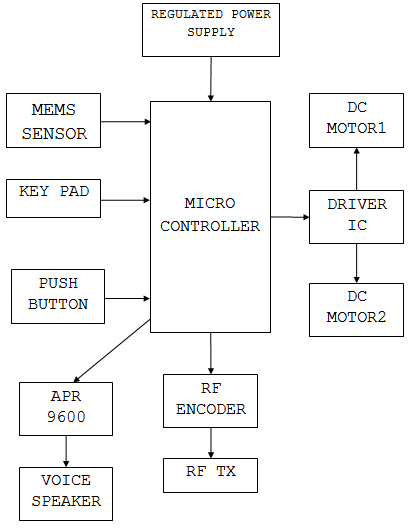
It designed to control devices and to ask others their minimum basic needs like water, food etc. wheelchair movement is controlled by using MEMS sensor which attached to their hands; based on hand movement the direction wheelchair is changed.

If the hand moves towards right wheelchair move right direction if hand moves towards left it moves towards left. The movement of the wheelchair is done by using motors connected to the controller through driver IC.

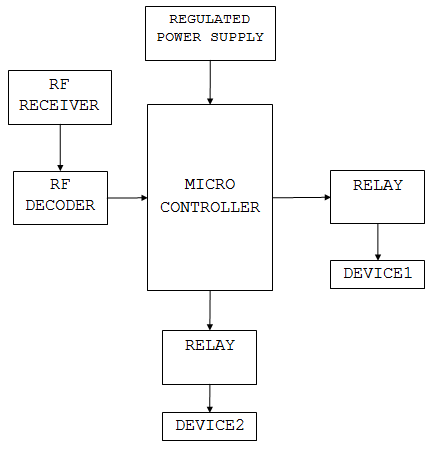
To wheel chair two modes (Mode0, Mode1) particular mode can be selected by using push button. Keys are used to control the devices when it is one mode and in same way same keys are used to tell his basic requirements through voice using APR9600 voice IC.

Devices are connected to controller through relays. The communication between wheel chair and devices controlling board is done by using RF technology. If RF communication is used we require RF transmitter connected to wheel chair and RF receiver connected to devices to control.

The system uses a compact circuitry built around AT89S52 microcontroller Programs are developed in Embedded C. Flash magic is used for loading programs into Microcontroller.

BLOCK DIAGRAM:

WHEELCHAIR:

DEVICES CONTROLLING BOARD:

Health Prediction Management System

ABSTRACT

“Health Prediction Management System” is a project which is developed to provide an easy and simple way to both users and doctors communicate with each other directly. In this application, users can search the symptoms of the diseases to the doctor from anywhere and at any time.

The user can also ask queries about their problems online directly with the doctor. Doctors can see all the details of the users and give the answers to their queries anytime.

IMPLEMENTATION

Modules:

Admin:

Admin gets logged into the application with a valid username and password. Admin can view all the details of the user and doctor.

User:

The user should give all the details in the registration form to get registered in the application. The user will be given username and password after registration. The user can consult a doctor by selecting the symptoms of the disease. The user can send a query directly to doctor. The user can get the response in view feedback field.

Doctor:

The doctor should give all the details in the registration form to get registered in the application. The doctor will be given username and password after registration. The doctor can view users query and send them to reply.

SCREENSHOTS

HOME PAGE

Application main page displays main modules like Admin, User and Doctor.

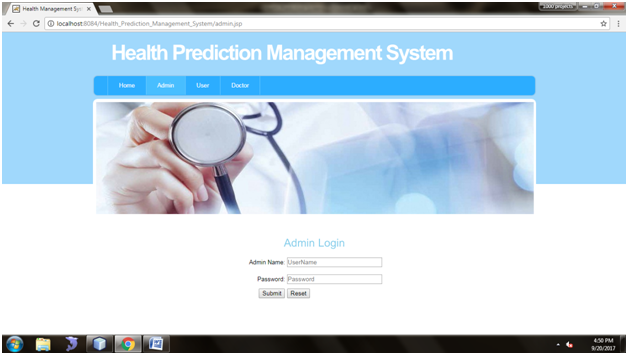
ADMIN LOGIN PAGE

Admin login page in which admin can get logged in by entering valid username and password.

ADMIN MAIN PAGE

Admin main page displays modules like view users and view doctors.

VIEW USERS PAGE

Admin view all details of users in user details page.

VIEW DOCTORS PAGE

Admin view all details of doctors in doctor’s details page.

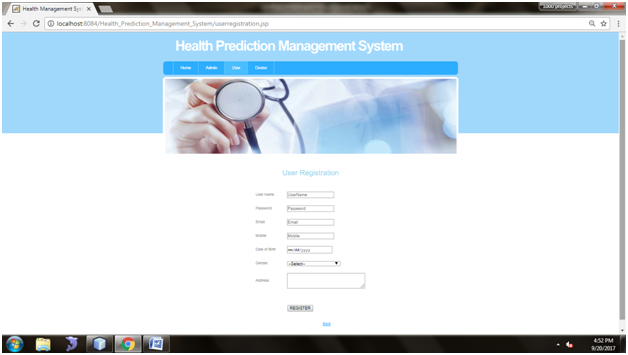
USER REGISTRATION PAGE

Users need to fill all the details in the registration page to get username and password.

USER LOGIN PAGE

User can get login by entering unique username and password

USER MAIN PAGE

User main page displays modules like search and doctor feedback.

USER SEARCH PAGE

Users search page enables users to select options and find the result.

USER SEARCH RESULT PAGE

USER VIEW DOCTOR INFORMATION PAGE

USER VIEW DOCTORS FEEDBACK PAGE

DOCTOR REGISTRATION PAGE

Doctors need to fill all the details in the registration page to get username and password.

DOCTOR LOGIN PAGE

The doctor can get login by entering unique username and password.

DOCTOR MAIN PAGE

Doctor main page displays modules like view feedback.

DOCTOR VIEW FEEDBACK PAGE

The doctor can view the details of users query in view feedback page.

DOCTOR REPLY TO USER PAGE

The doctor sends a reply to the user.

CONCLUSION

Our project “Health Prediction Management System” provides an easy and simple way to users and doctors to communicate with each other. Our project also saves lot of time and effort to both users and doctors.

Electronic Siren ECE Project

We the undersigned had certified and acknowledge the successful completion of the Project Report entitled ” ELECTRONIC SIREN”

We certify that we have examined and recommended to Government Technological College for Under-Graduate studies for acceptance the project entitled “ELECTRONIC SIREN” submitted by in partial fulfillment of the requirements for the Diploma of Engineering.

The 555 IC Circuit

The 555 monolatic integrated circuit timer was first introduced by Signetis Corporation in 1927 u8sing bipolar technology. It quickly became an industry strand for, timing and oscillation functions. Many Manufactures produce a version of a 555 IC, some in the CMOS technology. The 555 is a general-purpose IC that can be used for precision timing, pulse generation, sequential timing, time delay generation. The 555 can operate in both astable and monostable modes, with timing pulse ranging from microseconds to hours. It also has an adjustable duty cycle and can generally source or sink output currents up to 200m.

Basic Operation

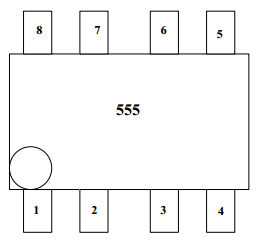
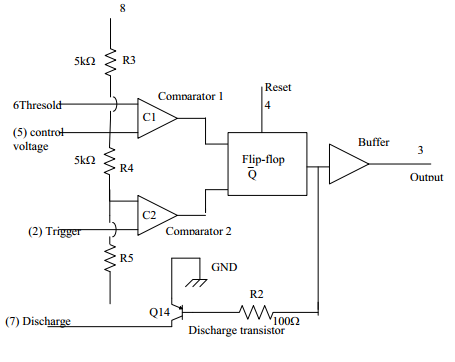
The basic block diagram of the 555 IC is shown in Fig. The circuit consists of two comparators which drive an RS flip-flop, an output buffer, and a transistor that

discharges an external timing capacitor. The actual circuit of an LM555 timer is also shown.

The RS flip-flop is a digital circuit that will be considered in a later chapter. Here, we will only describe the basic digital function of the flip-input with voltage references set at (2\3)V by the voltage divider comparator output goes high, producing a high output at flip-flop terminated Q. This turns the discharge transistor on and an external timing capacitor starts to discharge.

The output state of the 555 IC is driven by output Q of the RS flip-flop. This output is usually a totem-pole circuit, or a simple buffer, and is generally capable of sourcing or sinking 200mA.

An external reset input to the RS flip-flop overrides all other inputs and is used to initiate a new timing cycle by turning the discharge transistor on.

Fig. Basic Block Diagram 555 IC Timer Circuit Diagram, LM555 Timer Circuit

RESISTER

A component is used for its resistance. In the past, most resistors were manufactured from carbon composition, a baked mixture of graphite and clay. These have been almost completely superseded by carbon or metal film resistor. Wire-wound resistors are used for comparatively low values of resistance where the precise value is important, or for high dissipation. They are unsuitable for RF use because of their reactance.

CAPACITOR

A passive circuit component is a capacitance. A capacitor is formed from a pair of conducting surfaces separated by a layer of insulator. A capacitor made from a pair of parallel conducting plates of area S separated by a distance d, with the gap between the plates filled by a dielectric of relative permittivity E, will have a capacitance C given by

C = εrεoS d
where εo is the permittivity of free space.

A component that converts an electrical signal into light signal can be injected into the Fiber.

TRANSISTOR

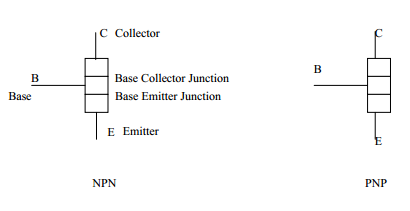
The bipolar junction transistor (BJT) is constructed with doped semiconductor regions separated by two PN junctions. The three region is called emitter, base, and collector. The physical representation of the two types of bipolar transistors are shown in Fig; One type consists of two n regions separated by a p region (PNP)and the other consists of two p regions separated by an n region (PNP).

The PN junction joining the base region and the emitter region is called the base-emitter region. The junction joining the base region and the collector region is called the base-collector junction.

Fig. Standard Bipolar Junction Transistor (BJT) Symbols

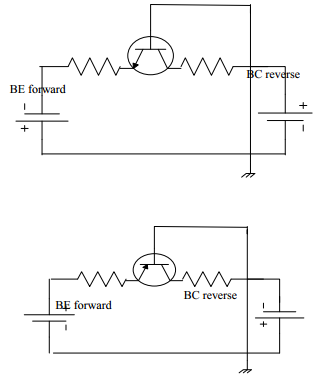
Fig. Forward Reverse Bipolar Transistor

The directions of the current in on NPN transistors are as shown in Fig; These diagrams show that the emitter current (IE); the same of the collector current (IC)and the base current (IB).

RECTIFIER

Fig. Block Diagram of Rectifier Circuit

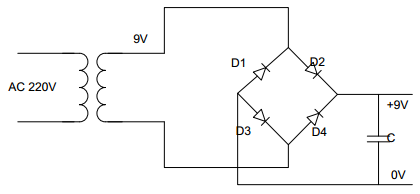
The power supply consists of a transformer, receiver, and filter circuit. The transformer is probably one of the most useful electric devices. The transformer provides a simple means of changing an ac voltage or current from one value to another. A simple transformer consists of two coils (windings). The coil connected to the source is called primary winding and the other one is called the secondary winding. The coils are insulated from each other and from the core.

If a transformer receives energy at a low voltage and delivers it at a higher voltage, it is called step up transformer. When a transformer is supplied some lower voltage, it is called a step-down transformer. We used a step-down transformer in the circuit.

For an autotransformer, the secondary winding is actually part of the primary winding. The rectifier circuit is the process of converting an alternating (ac) voltage into one, that is limited to one polarity.
Rectifier circuit that contains diode is called rectifier diode. The diode can pass current easily in one direction only.

Rectifier diode can be used to charge a RESERVOIR CAPACITOR in order to obtain smooth DC. The rectifier circuit is classified as half-wave and full-wave rectifier.

The output voltage appears only during the positive cycle of the input signal, the circuit is called a half-wave rectifier.

A rectifier output voltage occurs during both the positive and negative cycles of the input signal, this circuit is called a full-wave rectifier.

Full-wave rectifier consists of

(a) Central-tapped full-wave rectifier; and

(b) Bridge full-wave rectifier.

We used Bridge full-wave rectifier.

Fig. Schematic Circuit Diagram of Rectifier

Filter circuit provides a constant voltage to a load. The capacitor used in the filter circuit.

DIODE

The diode can be made of either two of semiconductor materials, silicon, and germanium. Power diodes are usually constructed using silicon and germanium. Silicon diode can operate at higher current and at higher junction temperature, and they have greater reverse resistance.

The structure of a semiconductor diode and it symbol are shown in Figure. The diode has two terminals, an anode, A terminal ( P junction ) and a cathode K terminal ( N junction ). When the anode voltage is more positive than the cathode, the diode is said to be forward biased and it conducts current readily with a relatively low voltage drop. When the cathode voltage is more positive than the anode, the diode is said to be reverse biased, and it blocks current flow. The arrow on the diode symbol shows the direction of convection current flow when the diode conducts.

CIRCUIT OPERATION OF ELECTRONIC SIREN

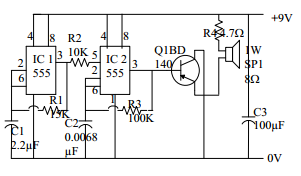
The electronic siren using op-amp 555IC is shown in Fig.This circuit can be used for calling Bell or the emergency etc.

IC1 produce the low-frequency square wave pulses that can be used as the oscillator and IC2 also work for the high-frequency oscillator. The 5th supplied node of IC2 is connected at the end of IC1 output by connecting R2.At low state IC1 output reach 0V and the ground will be simultaneously cut off. In this way, the output signal (high frequency) of IC2 will cause the sound that is simultaneously cut off. The output signal of IC2 will increase by transistor Q2.

By changing the value of R3 and C2 it can be used as the siren of the ambulance and the police cars.

REFERENCES

  1. Electronic Project 1
  1. Electronic Project 2
  1. Devices (Fourth Edition)
  1. Power Electronic

Online Book Review Management System

INTRODUCTION

PROJECT DESCRIPTION

The online book review management system project is to implement a computer-based online book review system and alerts will be given to the user with the help of mobile Sms when new books are updated.

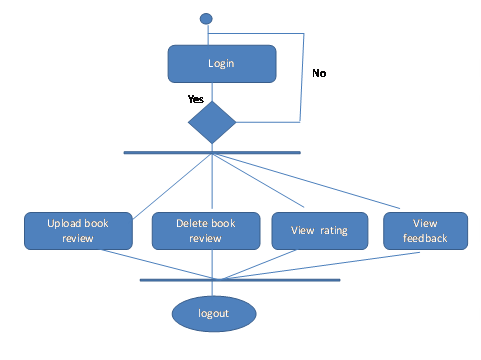
This system objective is to the system design Book Review Management system, and to develop a customer web-based Review Management system. The publisher will upload the Reviews on the website. The reader can give the ratings and feedback to the reviews. Based on the feedback and the ratings given by the user, the publisher can publish the books.

Problem Definition

Existing System

In the existing system, the publisher will publish the book without considering the views of the user.

Problems with the Current System

  • It is more time-consuming.
  • It includes wastage of manpower.

It includes wastage of money.

Proposed System

The proposed system is globalized-website which contains the reviews of new books which are uploaded by the publisher before publishing the book. It will also help the user to know the latest books of their interests being introduced into the market like fiction, science, technology etc.

Stakeholders are:

1. Publishers
2. Readers
3. Administrator

Requirements Specification (RS):

No. Module Requirement/ Functionality Essential or Desirable Description of the Requirement
RS1 User Management Users.


Essential Maintain the details of users.
RS1 Book Management Books Essential Maintaining the details of books.
RS1 Search Management Books Essential Searching the details of books.
RS1 Feedback Books. Essential Feedback on books.
RS1 Rating Engine. Books . Essential Rating on books.
RS1 Review Management Books. Essential Reviewing the book management.
RS1 Forum Books. Essential Generating the forum.
RS1 Analysis Management. Books. Essential Analysing the details of the book.

Diagram:

Use case Diagrams:

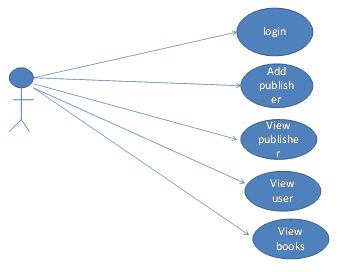
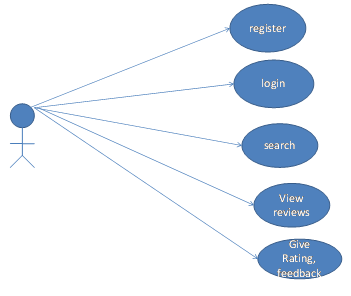
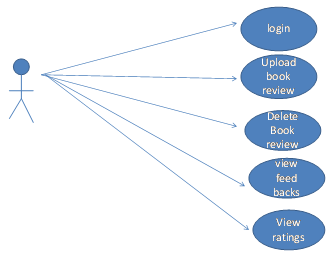
Use Case for Admin:

Use Case for User:

Use Case for Publisher:

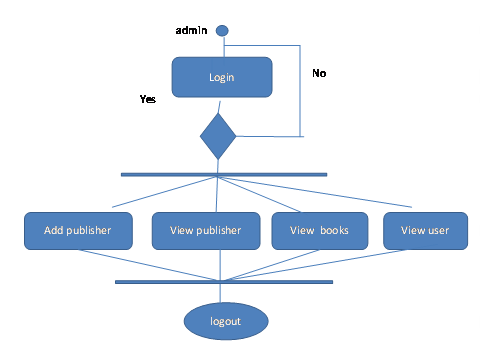
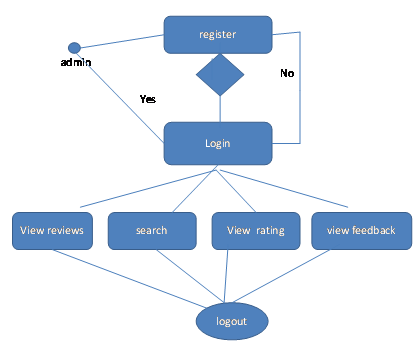
Activity Diagrams:

Activity Diagram for Admin:

Activity Diagram for User:

Activity Diagram for Publisher:

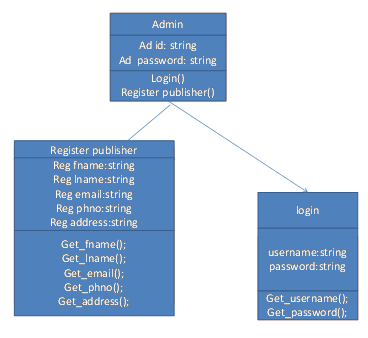
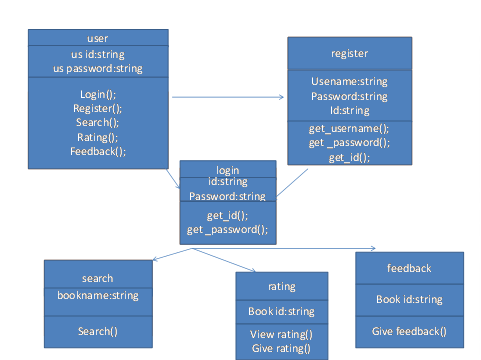
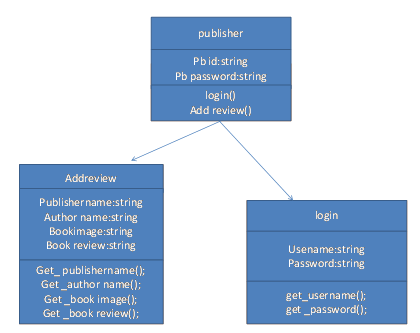
Class Diagrams:

Class Diagram for Admin:

Class Diagram for user:

Class diagram for Publisher:

Sequence Diagrams:

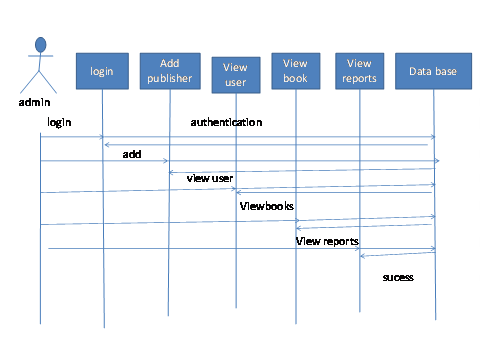
Sequence Diagram for Admin

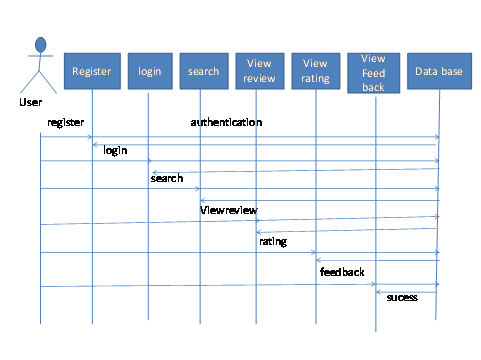
Sequence Diagram for User

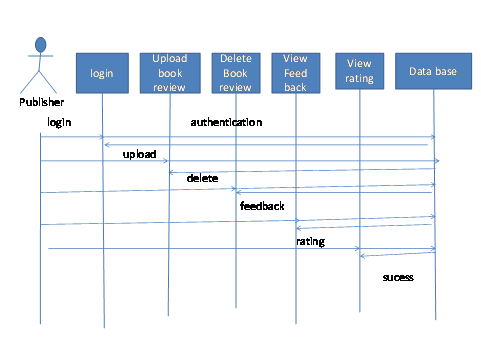
Sequence Diagram for Publisher

HARDWARE AND SOFTWARE REQUIREMENTS

Hardware Requirements

Processor: Pentium-III (or) Higher

Ram: 64MB (or) Higher

Cache: 512MB

Hard disk: 10GB 

Software Requirements 

Technology: Java 2 Standard Edition, JDBC

Web Server: Tomcat 6.0

Client Side Technologies: HTML, CSS, JavaScript

Server Side Technologies: Servlets, JSP

Data Base Server:  MySQL

Operating System: Microsoft Windows, Linux or Mac any version

MODULE DESIGN:

The major modules of the project are

  • Administrator Module
  • Publisher Department Module
  • User Department Module

Test Cases:

TEST CASE 1 :

Test case for Login form:

When a user tries to login by submitting an incorrect ID or an incorrect Password then it displays an error message “NOT A VALID USERNAME”.

TEST CASE  2:

Test case for User Registration form:

When a user enters user id to register and ID already exists, then this result in displaying error message “USER ID ALREADY EXISTS”.

TEST CASE 3 :

Test case for Change Password:

When the old password does not match with the new password, then this results in displaying an error message as “ OLD PASSWORD DOES NOT MATCH WITH THE NEW PASSWORD”.

TEST CASE 4 :

Test case for Forget Password:

When a user forgets his password he is asked to enter a Login name, ZIP code, Mobile number. If these are matched with the already stored ones then the user will get his Original password.

OUTPUT SCREENS

Home Page:

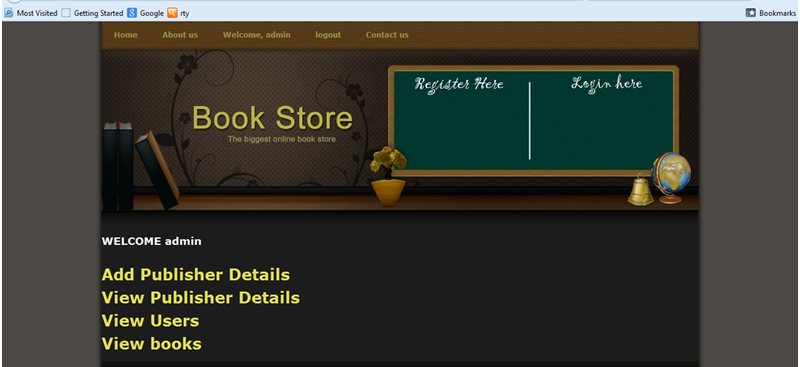
Admin Home Page:

User Home Page:

User Registration Page:

User Details Page:

Publisher Registration Page:

Publisher Details Page:

Book Store Page:

Upload Book Page:

Search Page:

View Feed Back Page:

CONCLUSION

The Online Book Review Management System project has been successfully completed. The goal of the system is achieved and the problems are solved.This project is developed in this manner that is user-friendly and required help is provided at different levels.

The primary objective is to provide the interactive service to all the students. Different types of services are provided to both the students and staff. The student can avail this service anytime.

This system certainly doesn’t reduces the manpower but helps the development of the available manpower and optimizes the manpower.

LIMITATIONS

The present system is developed for offline communication only.
As the memory capacity is limited to server’s memory we can’t accommodate an infinite number of users.
An unauthorized candidate can take the exam instead of an authorized candidate if he knows his user ID and password.
The images or pictures, which are drawn by the Drawing Tool Bar, can’t be saved.

FUTURE ENHANCEMENTS

To make that only authorized candidates taking the exam their fingerprints, can be taken and compared with stored ones.

Examination centers can be set up at various places and candidates can be asked to take the exam in those centers only. Invigilators should be asked to invigilate at those centers. This eliminates copying and any malpractices by the candidates.

Voice can be provided to all the students by using VOIP (voice over internet protocol).

Embedded Project on Missile Detection and Automatic Destroy

AIM:

The main aim the project is to design “Missile Detection and Automatic Destroy”.

COMPONENTS:

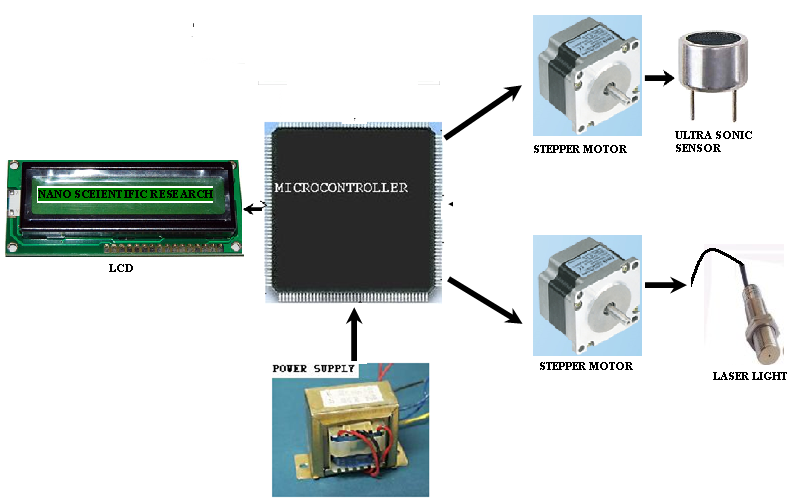
8051, ultrasonic sensor, stepper motor, Laser light, LCD.

EXISTING METHOD:

In the existing method we can detect the missiles and after detecting it informs the control room that some missile is present some location and we need to take certain action after detecting the missile.

PROPOSED METHOD:

In the proposed method we overcome the disadvantage of an existing method. In this, we detect the missile by using ultrasonic sensor after detecting the missile it automatically destroys the missile by emitting the laser beam on the missile.

In this, the sensors are connected to the microcontroller which is used to monitor the at different directions by rotating the stepper motors.

The sensors are connected to the stepper motor so by rotating the stepper motor all directions are the monitor.

Block Diagram:

SOFTWARE: Embedded ‘C’
TOOLS: Keil, Flash magic
TARGET DEVICE: 8051 Microcontroller.
APPLICATIONS: Used for missile detecting.
ADVANTAGES: Detection and destroying of the missile are done automatically.

REFERENCE:

1. The 8051 microcontroller and embedded systems by Mazidi.
2. Datasheets and the user manuals of AT89S52.

Scheduling SMS Android Application

Scheduled SMS is an android application concept which enables users to delay their SMS by specifying a
Specific time and date along with the receivers contact number.

About Scheduling SMS Application:

This android app automatically sends the SMS on the time specified by the user to the selected contacts and adds a pre-defined message which will be sent when the specified time is reached.

Additionally, the user is provided with the ability to edit date, time and message content after scheduling according to the user’s need.

Test Cases: 

Event Id: 1

  • While clicking on add event button it will show a menu

Event Id: 2

  • While clicking on add button it will show contact list

Event Id:3

  • Add date and time which user want to send it.

Event Id:4

  • Write Message.

Event Id:5

  • While clicking on send button it automatically sends message.

Test Data and Results: 

Event Id Description Input Expected Output Actual Output Status
1 Add button Single click Main menu open Main menu open pass
2 Contact add Single click OpenContactList OpenContactList Pass
3 Add date Single click Date add Date add Pass
4 Add time Single click Time add Time add Pass
5 Write Message Single click Write Message Write Message pass
6 Send Button Single click Notify to user for Add Notify to user for Add Pass

 User Manual:

  • First we have to select the application logo.
  •  It will open the application.

Add button

  • There are two buttons where “Add” is used to add date and time and Message
  • While we selecting on “Add” button there is another page will open which contain add button which is used to add contact from contact list or write contact number.

Set Date and Time

  • first we select in date and then time at which you want to send a message.

      Write Message

  • Write the particular Message

      Click on send

  • It will automatically send a message at deferred date and time.

Future Enhancement:

Facebook updation :

  • Here in this application user can send multiple messge and send mail to a particular person.
  • While in future user can wrote in wall of person’s account.

Multiple Mail sending:

  • Here in this application is able to send a mail to only one person whose birthday or other event.
  • While user can send mail to multiple person at a time.

Pace Maker Demonstration Unit Project

ABSTRACT

In the body, the heart is the main vital organ, which works continuously without any rest since the baby is in the womb until the death.

There is no rest for the heart and works at a rate of 72 beats per minute on an average, in a healthy person day in day out. In order to make the heart work, there is a specialized tissue located on the heart muscle and is known as Sino-Atrial node or abbreviated as S-A node.

This node generates impulses at regular intervals, and is under the control of autonomic nervous control system, and is popularly known as “natural pacemaker”.

In certain physiological conditions or with certain diseases related heart, the working of S-A node is impaired and in those circumstances the heart does not stop all at once, and provides sufficiently long time for the ultimate failure.

In such cases, there is occasional missing of a heartbeat, initially, and the disease progresses slowly, and the missing heartbeats increases in its frequency, which will lead to other problems, if not attended.

In such cases an artificial pace maker is devised and this instrument identifies the missing heart beat and provides its own pulse at the site stimulating the heart, so that ceased heart beat is continued.

In the proposed project, a micro controller based unit is devised which continuously monitors the ECG waveform, to identify the missing heart beat.

When ever it identifies the missing heart beat it provides the stimulating of sufficient energy, to make the heart function. The proposed project clearly demonstrates the function of the Pacemaker.