Online Event Planning System Java Project

Project Title: Online Event Planning System.

Project Description: Online Event Planning System is a web based project which act as a bridge between users and Event planners. As people spend lots of money and time for booking Events, Parties and Weddings and any other functions.

By this application the time of the user reduces because they can access any information related to event Address/venue/Hall. From the remote place.

So that we are trying to make a web project that includes all the planning’s for the food, venues, invitation cards, Photography and all Event related things can be done on time. This project is developed to make the users comfortable to enjoy each and every function along with their family, friends,relatives and colleagues..

Goals and Objectives:-

  • The main aim of this project is to provide the information regarding Events and  the information about the Booking of users choice.
  • Online Users can submit their queries by giving the Event destination, tentative date, number of guests, contact number etc.
  • Event themes are available in the websites.
  • There is a facility to book caterers, decorators, photographer and all function related categories/ facilities.
  • Mailing facility to reply clients.
  • Different venues are available for the choices.
  • To provide the functionality of online Booking and Cancellation.
  • To provide the information of status of catering, facilities available.
  • To provide the facility to maintain the records of users.
  • Information can be easily accessed.
  • This system will save the time of the Users.

Intended Audiences or Beneficiaries:-

The Online Event Planning System is a Event services provider that offers Event plans and services.
Online Event Planning System deals with the information System for Bookings.

This project explains about the booking of the Event/Function Places from a short event to a complete combination of activities, including meetings, conferences, exhibitions, weddings, birthdays etc.

This website helps any authorized person to book the places from internet and also shows the availability of a particular requirement at the chosen date and time.

Services to be provided:-

By using this Web Application we provided all the information which is required to book a venue/Hall.
So a user can access information easily from anywhere using internet.
And we also provided some service details like.

Service Details: when the user clicks on this module he/she will be informed about the detailed services offered by the website. This website also provides various bookings such as for photographers, transporters, Flower decoration, Audio System, DJ, Lightning and Video Recording etc.

Methods:

  • First of all we studied of existing system.(which is manual)
  • Then find out what are the problems are in existed system.
  • Now the problems can be solved using this web application
  • And provided a better mediator between user and venue owner.
  • Build a web based system.
  • The project is to develop customize software package for reducing the manual problems.
  • It should deals with the online Wedding Planning as well as cancellation.

Anticipated Phases, Milestones, and Schedule.

Phases:

  • Title Finalization
  • Synopsis submission
  • Design completion
  • Model/Work completion
  • Two paper presentation on project
  • Project report writing & submission
  • Project exhibition at BMIT

Project Schedule:

  1. Title Finalization : 1 Day
  2. Synopsis submission : 15 Days
  3. Design completion: 15 Days
  4. Model/Work completion: 3 Months
  5. Two paper presentation on project : 15 Days
  6. Project report writing & submission : 15 Days
  7. Project exhibition: 15 Days

Required Systems and Equipment:

Software requirements

Operating System : ANY With a Web Browser
Interface : Java Programming
IDE : My Eclipse/Spring source
Database : MySQL
Documentation Tool : Ms Office.

Hardware requirements

Processor : Standard processor with a speed of 1.6 GHz or more
RAM : 256 MB RAM or more
Hard Disk : 20 GB or more
QR Images Optimized Image Embedding in QR Codes

Existing System:

In the existing System, the concept shown was to how to embed an image with a QR Code, which can be implemented much easily with the currently online tools then the explained algorithm.

Proposed System:

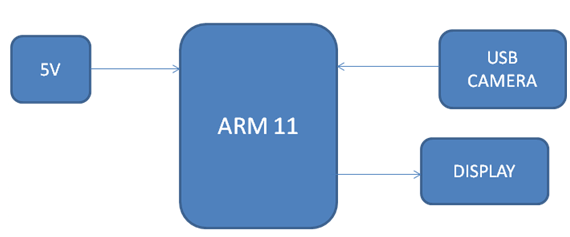
In the QR Images Optimized Image Embedding in QR Codes Proposed System, we are going to develop a new approach GUI based algorithm to read the data embedded into the QR Code using the open source tools live USB camera will continuously stream the video with the data recognition algorithm running background, whenever to the system a QR Code is displayed in front of the Camera, it will decode the data of the QR image onto the screen.

BLOCK DIAGRAM

Hardware:

Raspberry pi (ARM11), USB Camera

Software:

Raspbian OS, QR Image Recognition algorithm

Applications:

Data hiding, Security, advertisements.

Advantages:

1) Developed on ARM 11 Based processor, which runs at high speed due to which no data lapse will be done
2) Low power consumption and high accuracy.

Real Time Hand Gesture Recognition for Computer Interaction

ABSTRACT

The Real Time Hand Gesture Recognition system presented, uses only a webcam and algorithms which are developed using OpenCV computer vision, image and the video processing algorithms.

Existing Work:

The Existing work carried was done a PC based MATLAB software, where it has readily available all the algorithms and such system is not used to full extent in embedded side.

Proposed Work:

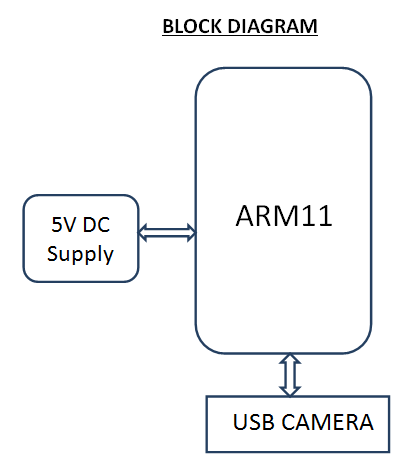
Proposed Real Time Hand Gesture Recognition for Computer Interaction work will be carried out on Linux based single board computer with ARM 11 architecture. This board will be ported with Raspbian Operation System and OpenCV Image processing Library. Using which will design an algorithm such that the system will identify the finger tips and count them how many fingers have been displayed.

BLOCK DIAGRAM


Hardware:

ARM11, USB Camera, Power supply.

Software:

OS: Embedded Linux, Language: C/ C++, IDE: Qt Creator, Opencv.

Applications:

Computer Interaction, Gesture recognition based control

Advantages:

• Elimination of external hardware like mouse
• Easy to access and control appliances using gestures.

Online Student Feedback System Project Synopsis

The purpose of Online Student Feedback System is to provide Periodical feedback by students about the course conduction.

Abstract:

“Online Student Feedback System” is generally used by four kinds of users:

1. Admin
2. Student
3. Staff (faculty of each course)
4. Coordinators (M.Tech, M.Sc., MCA)
5. Chairman

  • Each user has their own login id and password.
  • All of these users are to be provided different access rights.
  • Chairman and Admin will be able to view the statistics generated by the system.
  • Faculty will provide access to students for giving feedback
  • Students will fill in the feedback form.

Project Detailed Description:

Semester beginning

Ist month:

  • At the beginning of the semester coordinators enter list of the courses and faculties.
  • Faculty will create list of students in the course.

Month 2 to end of the semester:

  • Each faculty will give permission to students (who have regularly attended the classes) in the course to provide the feedback.
  • Students will login and give the feedback (they will fill the feedback form).
  • Preparation of statistics by the system
  • For each course, for each question, find the percentage of the students who ticked on ‘just right’
  • Overall statistics can be mailed to admin and Chairman month after month.

Initial stage:

1. Creating the login-id:

  • Admin will give the login id and password for the faculty and the coordinators.
  • All other users, Faculties will all register into the system, once.
  • When a student gets admitted they will be provided login and password to register into the system.
  • Login id of the students could be their register numbers (which is available at the time of admission)

2. Different permission for different users:

Faculties:

  • The faculty will create the list of the students who opted the course.
  • At the end of each month, Faculty will give the permission to student who are regular, to give the feedback for that course during that month.

Students :

  • Students can register to the system.
  • At the end of every month, when the student login, they get to know the list of courses for which they can provide feedback. They complete the feedback.

Coordinators :

  • At the beginning of the semester, prepare the course list and the corresponding faculty

Chairman and Admin :

They have the permission to see the overall statistics prepared by the system, using the feedback forms submitted by the students.

SYSTEM REQUIREMENTS:

Hardware Requirements

  • Processor: Windows 8.
  • Primary Memory: 2 GB RAM.
  • Hard Disk: 100 GB.
  • The above specified requirements are the minimum required to run the application

Software Requirements

  • Language used: Visual Basic (VB)
  • Database: M.S.Access
  • Platform : windows 8
  • Tools used: Visual Studio 2010.

Conclusion:

The “Online Student Feedback System” will be helpful for the students as well as the Chairman. Students are free to express their opinion on the course conduction and Chairman has the opportunity to know the manner in which the courses are conducted and perhaps advise the faculty in case the feedback is not satisfactory.

Download this Online Student Feedback System .Net Project Synopsis Code and Database Files.

Campus Mobile Application

Abstract: 

‘Campus’ is mobile application for student, which is used to know the campus up to date like – What’s going on? , What is next? , And past what has done?

The main reason behind this Campus application the students know the more information about the university and what’s going on – upcoming events, any cultural programs, the student activities, sports, and about the examination complete details.

This Campus Mobile application also having the detailed information about the professors, course structures, about the administration department, gallery of the university and recently conducted event images, videos and also having the information about the past students.

This Campus Mobile application have the information which already in the website but it’s in the simple way, sometimes we miss the important information in website because website having the lot of information.

This is only access the students and professors by login with their ID’s. Additionally, this application provides the weather reports of the location of the university and provides the scheduling details of the library as well as university.

Job Portal Android Application

The main aim of developing this Job Portal android application is to provide job opportunities to the job seekers, To meet manpower requirements of Industries and Projects in corporate sectors and To provide live vacancies on the android application.

The main objective is to provide a web-based interface for the corporate sector Employers to choose from amongst the registered candidate database.

other features included here are Online registration/ updating of candidate database, Electronic sponsorship of candidates for private employers.

The Job Portal android application was developed for exchanging information between unemployed people and private companies. Job seeker can register and see which companies are trying to see and status of resume.

The online registration of private employers, submission of vacancy information, searching and sponsoring of candidates, issuance of letters to candidates, entry of interview and joining status of selected candidates etc.

All vacancies notified by the private sector will be automatically available on the site. Maintain another type of information about the job as a group, administration dashboard application.

Domain: Android Application Development
Programming Languages: Core Java
Tools: Android SDK Platform Tools, SVN
Others: JSON,XML,SQLite

B.Tech & M.Tech 2017-2018 Java Projects

Latest developments of the below Transaction journal papers using Java and MySQL on different domains

Example Domains are Cloud Computing, Data Mining, Knowledge and Data Engineering, Internet of Things, Services Computing, Multimedia, Software Engineering, Parallel and Distributed Systems, Computational Social Systems, Information Security, Mobile Computing, Dependable and Secure Computing, Industrial Informatics, Learning Technologies, Information Processing over Networks, Information Processing over Networks, etc.

Cloud Computing

1 A Lightweight Secure Data Sharing Scheme for Mobile Cloud Computing

Video : https://www.youtube.com/watch?v=ZfmxfbGY-qM

2017
2 An Efficient and Fine-grained Big Data Access Control Scheme with Privacy- Preserving Policy

Video : https://www.youtube.com/watch?v=B4zCjgWskIs

2017
3 TEES: An Efficient Search Scheme over Encrypted Data on Mobile Cloud TEES (Traffic and Energy saving Encrypted Search)

https://www.youtube.com/watch?v=Nnf0qHjIOXw

2017
4 Attribute-Based Storage Supporting Secure De-duplication of Encrypted Data in Cloud.

Video : https://www.youtube.com/watch?v=yqI6xok_3k8

2017
5 Efficient and Expressive Keyword Search Over Encrypted Data in Cloud.

Video : https://www.youtube.com/watch?v=BM3Qd04O9c8

2017
6 Privacy-Preserving Multi-keyword Top-k Similarity Search Over Encrypted Data

Video : https://www.youtube.com/watch?v=udieKOaxpWU

2017
7 RAAC: Robust and Auditable Access Control. With Multiple Attribute Authorities for. Public Cloud Storage

Video : https://www.youtube.com/watch?v=cCxoidciGx0

2017
8 FastGeo: Efficient Geometric Range Queries on Encrypted Spatial Data

Video : https://www.youtube.com/watch?v=po6dCweCmfk

2017
9 TAFC: Time and Attribute Factors Combined Access Control for Time-Sensitive Data in Public Cloud 2017
10 Securing Cloud Data under Key Exposure

Video : https://www.youtube.com/watch?v=6EEMI3P89Kw

2017
11 Achieving Flexible and Self-Contained Data Protection in Cloud Computing

Video : https://www.youtube.com/watch?v=mzh0XvJy5OE

2017
12 Securing Aggregate Queries for DNA Databases

Video : https://www.youtube.com/watch?v=9vFtFk8zuww

2017
13 FaaSeC: Enabling Forensics-as-a-Service for Cloud Computing Systems

Video : https://www.youtube.com/watch?v=HsTU3SS0QkA

2017
14 Privacy Protection based Access Control Scheme in Cloud-based Services.

Video : https://www.youtube.com/watch?v=veOy2FWXQIA

2017
15 A Robust Reputation Management Mechanism In The Federated Cloud

Video : https://www.youtube.com/watch?v=EdpZ3RfNVkY

2017
16 Fast Phrase Search for Encrypted Cloud Storage 2017
17 Provably Secure Key-Aggregate Cryptosystems with Broadcast Aggregate Keys for Online Data Sharing on the Cloud 2017
18 Privacy Protection and Intrusion Avoidance for Cloudlet-based Medical Data Sharing 2017
19 Achieving Secure, Universal, and Fine-Grained Query Results Verification for Secure Search Scheme over Encrypted Cloud Data

Video : https://www.youtube.com/watch?v=wWXylI5vX6Y

2017
20 Strong Key Exposure Resilient Auditing for Secure Cloud Storage 2017


Data Mining / Knowledge and Data Engineering


21 Semantically Enhanced Medical Information Retrieval System: A Tensor Factorization Based Approach

Video : https://www.youtube.com/watch?v=QEdgMBebX4c

2017
22 Detecting Stress Based on Social Interactions in Social Networks

Video : https://www.youtube.com/watch?v=sSTIW6RanVE

2017
23 Influential Node Tracking on Dynamic Social Network: An Interchange Greedy Approach

Video : https://www.youtube.com/watch?v=9n7A7FCZCVE

2017
24 PPRank: Economically Selecting Initial Users for. Influence Maximization in Social Networks

Video : https://www.youtube.com/watch?v=Q5d_7GherfY

2017
25 SocialQ&A: An Online Social Network Based Question and Answer System

Video : https://www.youtube.com/watch?v=bUSTgBkTheU

2017
26 Personal Web Revisitation by Context and Content Keywords with Relevance Feedback

Video : https://www.youtube.com/watch?v=LPGB9WszFFA

2017
27 Computing Semantic Similarity of Concepts in Knowledge Graphs

Video : https://www.youtube.com/watch?v=12cUhG86UzU

2017
28 A Situational Analytic Method for User Behavior Pattern in Multimedia Social Networks

Video : https://www.youtube.com/watch?v=3vP5JOoTBvo

2017
29 User Vitality Ranking and Prediction in Social Networking Services: A Dynamic Network Perspective

Video : https://www.youtube.com/watch?v=iVl8SQa025s

2017
30 Analyzing Sentiments in One Go A Supervised Joint Topic Modeling Approach. 2017
31 User-Centric Similarity Search

Video : https://www.youtube.com/watch?v=lxEzkQAoKLw

2017
32 Dynamic Facet Ordering for Faceted Product Search Engines

Video : https://www.youtube.com/watch?v=xIkbDG1JBv0

2017
33 Search Rank Fraud and Malware Detection in Google Play

Video : https://www.youtube.com/watch?v=I7SRFcW-mEs

2017
34 Query Expansion with Enriched User Profiles for Personalized Search Utilizing Folksonomy Data 2017
35 Influence Maximization in Trajectory Databases 2017
36 Towards Real-Time, Country-Level Location Classification of Worldwide Tweets

Video : https://www.youtube.com/watch?v=1PIrP0J_hp8

2017
37 An Iterative Classification Scheme for Sanitizing Large-Scale Datasets 2017
38 DA: A Query-Driven Approach to Entity Resolution 2017
39 Mining Competitors from Large Unstructured Datasets 2017
40 Aspect-Level Sentiment Analysis 2017
41 Incremental Semi Supervised Clustering Ensemble for High Dimensional Data Clustering 2017
42 Trajectory Community Discovery and Recommendation by Multi-Source Diffusion Modeling 2017

Internet of Things

43 Leveraging Crowdsourcing for Efficient Malicious Users Detection in Large-Scale Social Networks

Video : https://www.youtube.com/watch?v=_6-BtZP_eLE

2017
44 Follow But No Track: Privacy Preserved Profile Publishing in Cyber-Physical Social Systems 2017


Services Computing


45 Collaborative Filtering Service Recommendation Based on a Novel Similarity Computation Method 2017
46 Transactional Behavior Verification in Business Process as a Service Configuration 2017

Multimedia


47 Two-Stage Friend Recommendation Based on Network Alignment and Series Expansion of Probabilistic Topic Model

Video : https://www.youtube.com/watch?v=I_-8m37WI6o

2017


Software Engineering


48 A System for Profiling and Monitoring Database Access Patterns by Application Programs for Anomaly Detection 2017


Parallel and Distributed Systems


49 iASK: A Distributed Q&A System Incorporating Social Community and Global Collective Intelligence

Video : https://www.youtube.com/watch?v=8KYV4JYN2ow

2017


Computational Social Systems


50 Collaborative Filtering-Based Recommendation of Online Social Voting 2017


Computers


51 Privacy-Preserving Selective Aggregation of Online User Behavior Data

Video : https://www.youtube.com/watch?v=LT_zzk7ILq0

2017


Information Security


52 ProGuard: Detecting Malicious Accounts in Social-Network-Based Online Promotions 2017


Mobile Computing


53 Quantifying Interdependent Privacy Risks with Location Data 2017
54 Searching Trajectories by Regions of Interest 2017


Dependable and Secure Computing


55 Towards Detecting Compromised Accounts on Social Networks

Video : https://www.youtube.com/watch?v=6MPzh2lxmDw

2017


Industrial Informatics


56 Public Interest Analysis Based on Implicit Feedback of IPTV Users

Video : https://www.youtube.com/watch?v=iQR5C8lrD5s

2017


Learning Technologies


57 Privacy-Preserving Learning Analytics: Challenges and Techniques

Video : https://www.youtube.com/watch?v=JRECKARYkeA

2017


Information Processing over Networks


58 When to Make a Topic Popular Again? A Temporal Model for Topic Re-hotting Prediction in Online Social Networks

Video : https://www.youtube.com/watch?v=sjWYD7Iexuc

2017


Information Processing over Networks


59 Twitter Trends Manipulation: A First Look Inside the Security of Twitter Trending

Video : https://www.youtube.com/watch?v=kN2ov28EXPg

2017
60 NetSpam: A Network-Based Spam Detection Framework for Reviews in Online Social Media

Video : https://www.youtube.com/watch?v=jkmzt22uHcI

2017


Android Based Voice Controlled Notice Board

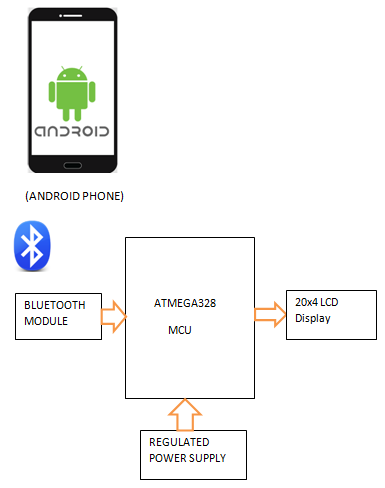
We are using voice recognition Android App for updating message on 20×4 LCD with the help of Bluetooth module HC-05. The android app converts speech into text using google speech to text conversion.

We are sending text data using mobile phone which is received by Bluetooth module and given to microcontroller. The microcontroller used here is from Arduino UNO(Atmega328) which sends the same message on it.

Software:

• ARDUINO IDE
• EMBEDDED CPP CODE
• Proteus Simulator

Hardware :

1. ATMEGA328 Microcontroller
2. Bluetooth Module
3. 20×4 LCD Display
4. Regulated Power Supply

BLOCK DIAGRAM:

Shared Steering Control between Driver and an Automation to avoid Accidents

AIM: The main objective of this project Shared Steering Control between Driver and an Automation to avoid Accidents when the driver is in fatigue State is to develop an embedded system, which is used follow a line and also giving a buzzer while any obstacle comes in the way.

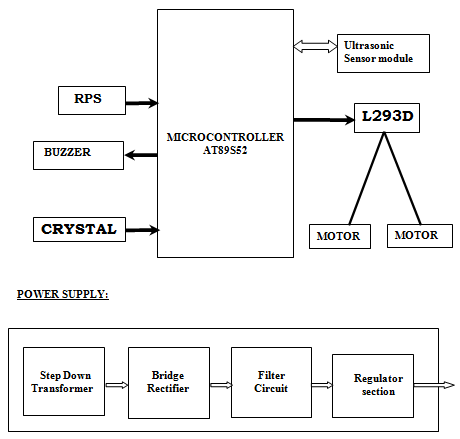
IMPLEMENTATION: This Shared Steering Control between Driver and an Automation to avoid Accidents project is implemented 8051 based At89s52 developed board interfaced with Photosensors, ultrasonic sensor, H-Bridge driver, and motors.

BLOCK DIAGRAM & POWER SUPPLY:


DESCRIPTION: A car is having many capabilities. The car will do any number of tasks according to the program done by the controller inside. It seems a useless thing if it is uncontrollable. Here controlling a car is the main task has to consider while the driver is in fatigue state.

The car Platform employs two DC motors for the drive. In this project, the car will be followed a line up to the tracking object meanwhile any obstacle comes it will give a buzzer sound. After removing the obstacle it follows the line normally.

Since car Platform is equipped with two motors for the drive, controlling the motors, i.e. when making a right turn, the right wheel can be stopped i.e. power to the DC motor is switched off. The left wheel is driven i.e. left DC motor is on. This causes the system to take a right turn. Similarly for a left turn.

The detector circuitry consists of the ultrasonic integrated detection module. The detector houses the emitter as well as a detector. The detectors are positioned accurately either side of the line. They are placed such that they are just out of the line.

SOFTWARE:

Embedded ‘C’
RIDE to write code
ISP to burn the chip

HARDWARE:

At89s52 based our own developed board
Power Supply
Photosensors
H-Bridge driver
Robotic platform
Ultrasonic sensor

ADVANTAGES: Low cost, automated operation, Low Power consumption.

REFERENCES

1. The 8051 microcontroller and embedded systems by Mazidi.

2. www.wikipedia.org

3. WWW.atmel.com

4. www.8051projects.com

5. Embedded systems with 8051 by kenith j ayala

Micro Controller Based Drug Dispenser Project

ABSTRACT

With the present day environment, and with the work pressure the individual is carrying, it becomes highly impossible to take of a family member, who is undergoing therapy.

Sometimes it may be impossible to remember his/her own medicines and their time of consumption, thereby missing their medicine or the time of its administration.

In such cases, if any equipment is there which can give some sort of indication, to the individual concerned so that he can take his medicine. The same can be used even to use for other patients also.

In the present project, a microcontroller based drug dispenser is to be developed. The drug dispenser can be used to provide an indication of the medicine time, and it also dispenses the medicine to be consumed. The present project deals with a minimum of six medicines.

The doctor will prescribe each medicine time and dosage, and the same can be fed to the instrument, via a keyboard hooked up to the microcontroller. At the time when the said drug is to be consumed, the instrument provides the medicine (tablet or capsule) in the tray.

The medicine goes to the tray by rotating a motor, which dispenses only one tablet or capsule into the tray, and in the similar fashion all the drugs to be consumed are provided in the tray, and then the instrument provides the alarm.

The drugs and their timings can be programmed and can be easily programmed.

The instrument to be designed is to use an advanced microcontroller and needs to have an interface to a keyboard and also motors and sensors.