MS Dissertation Project Conclusion on Evaluation of Lending Practices in Commercial Banks

This study provides the detailed information on the problem called Non-performing assets which is been faced by the banks and the financial institutions. The non performing asset is considered as the significant problem which is showing the major impact on the economy of the banks and the financial institutions. According to this study it is been concluded that there are different types of reasons for the causes of non-performing assets and they are not even taking the measures to solve this problem. Most of the banks are not considering the non performing asset as the problem, for this reason there is a rapid increase in the existence of the non performing assets.

There are different reasons for the existence of the non performing asset problem such as the improper selection of the genuine customers, the inappropriate guidance by the management to the customers, the lack of awareness of the banking procedure to the customers, the non payments the pending loans and debts by the customers and many more. In order to overcome all these problems the government related to those specific countries has established some of the legal acts to the banks in order to recover their loans and debts. By making use of these acts the banks should initially send the notification to that customer regarding his due payments and dates, and even after receiving these notifications if the customers are not paying the loans and debts in the specified time, then the banks as well as the financial institutions can make use of these acts and can take any sort of legal and illegal actions on the customers. Another measure to reduce this problem is to planning and implementing the efficient recovery process. The banks and financial institutions will appoint the recovery agents in order to recover their loan amount and these recover agents will visit the customers place and will explain the payment modes and due dates, in some situations in order to handle typical customers the recovery agents will take some illegal actions on them, so to solve this the banks should allot certain principles to the recovery agents while dealing with the customers, the recovery process should recover the loan amounts but should not spoil the relationship between the banks and the customers.

Another measure is that the banks should verify and cross check the customer’s standards twice and thrice before allotting the loans and should clearly explain the payment procedure and should indirectly warn the customers regarding the acts and actions taken on them if the payments are not done in time. A strong banking sector is important for a flourishing economy. The failure of banking sector may have an adverse impact on other sectors. There is also a general prescription of 40% of net bank credit to priority sectors have lead to higher NPA, due to credit to these sectors becoming sticky. In the changed context of new prudential norms and emphasis on quality lending and profitability, managers should make it amply clear to potential borrowers that bank resources are scarce and these are meant to finance viable ventures so that these are repaid on time and relevant to other needy borrowers for improving the economic lot of maximum number of households . Hence, selection of right borrowers, viable economic activity, adequate finance and timely disbursement, correct end use of funds and timely recovery of loans is absolutely necessary preconditions for preventing or minimizing the incidence of new NPA.

The function of NPAs pressures the importance of the sound thinking of the system issues and macroeconomic variables pertaining to banks as well as the economy so as to resolve the problem of NPAs  beside with the considerably of a strong legislative framework and legal frame work. Clear understanding is not required but also it very important to utilize the foreign experiences for the local conditions in order to generate a tailor made solutions and this solution for all the stakeholders should be fair and transparent .      

It is also analyzed in these studies that in India the public sector bank’s expressed non-performing loans in terms of NPLs response to terms of macroeconomic condition variables, credit and bank size.  The results offer significant insights for lending behavior of bank. From perspective of policy, these results are aligned with method of policy to Indian banking sector, which in turn emphasizes on lending policy as well as suitable credit culture designed with appropriate financial as well as economic factors. The impact of business cycle on non-performing loans could be controlled with suitable lending in terms of capital requirement, maturity and loan interest rate.   
MBA Dissertation Project on Evaluation of Lending Practices among Indian Banks

Introduction

Discussion is one of the most important parts of any research. Researcher has linked the theory with literature review and data analysis with empirical data. Researcher discussed the interviews responses based on the theories that have been presented. Detailed discussion of effects in Non-performing assets. 

Classification of assets for making provision:

For the purpose of making provisions for doubtful loans, banks need to classify them into following broad categories:

Performing assets

Non-performing assets

Performing assets:

Performing assets is also known as standard assets/loans where the interest or principal are not overdue beyond 180 days at the end of the financial year. Such business will not carry more than normal business risk.

Non-performing loans:

Any loan the repayment of which is overdue beyond 180 days or two quarters is considered as NPA. It is further classified into:

Sub-standard assets

Doubtful assets

Loss assets

Sub-standard assets:

Sub-standard asset is one which has been classified as NPA for period not exceeding two years. With effect from 31 March 2001 sub-standard asset is one, which has remained NPA

Doubtful assets:

A doubtful asset is one which has remained NPA for a period exceeding two years. With effect from 31 March 2001 an asset is to be classified as doubtful if it has remained NPA for a period exceeding 18 months. A loan classified as doubtful has all the weaknesses inherent in that classified as sub-standard with the added characteristic that the weaknesses make collection or liquidation in full, on the basis of currently known facts conditions and values highly questionable and improbable.

Loss assets

A loss asset is one where loss has been identified by the bank or internal or external auditors or the RBI inspection but the amount has been written off wholly or partly. Bankable asset is not warranted although there may be some salvage or recovery value. The assets which have been wholly written off should not be reported in SBR. However, in case of partly written off assets, the amount of technical write off, if any, should be reduced from outstanding gross advances and all the assets will handed over to recovery agents for sale.

Non-performing assets in Banks and Credit Risks MBA Seminar Topic

Various numbers of banks of public sector are not proficient of imagining the risk which is facing in the economic scenario of emerging global. The equipment of risk management implemented needs a widespread overhaul of the system with changing condition of the banks. The second review of the document on the capital of New Basle deal on the administration of banking has offered a pressure on the part of the banks risk management with a more consistent risk sensitive sophisticated on capital adequacy. In its place of the strict suggestions and hesitations of the banking sectors of RBIs will have adequate attentiveness in implementing orders, it is somewhat clear about the banks motivation to forcefully follow risk management device of efficient credit by observing the magnitude of the credit risk management in order to condense the NPAs mounting in its growths. The improving debts portion by Debt Recovery Tribunals is turned to a grand collapse.

The set up Asset Reconstruction Company (ARC) aspect has significantly benefited as of containing the NPAs at a convenient level in banks. In public sector banks bad debits has been obtained by the ARC. Some of the options are contained by these banks either liquidating the assets of default companies or usually writing concerning these terrible debts. In the public sector banks the result that is very viable and existing has to approach for a developed system of the credit risk management that can be measured as difficult preposition. But a clear alertness of the risk perception, to curtail risk instruments availability and to implement needed strategies for a risk management scheme are considered as of the hour call.

Dealing with NPA:

Dealing with NPA involves two steps of policies

  1. Relating to existing NPA
  2. To reduce fresh NPA generation

As far as old NPA are concerned, a bank can remove it on its own or sell the assets to AMCs to clean up its balance sheet. For preventing fresh NPAs, the bank itself should adopt proper policies.

Reasons for an account becoming NPA:

There are several reasons for an account becoming NPA

  1. Internal factors
  2. External factors

Internal factors:

  1. Funds borrowed for a particular purpose but not use for the said purpose.
  2. Project not completed in time.
  3. Poor recovery of receivables.
  4. Excess capacities created on non-economic costs.
  5. In-ability of the corporate to raise capital through the issue of equity or other debt instrument from capital markets.
  6. Business failures.
  7. Diversion of funds, willful defaults, fraud, disputes, management disputes, mis-appropriation etc.

External factors:

  1. Sluggish legal system- long legal tangles, changes that had taken place in legal laws, lack of sincere effort.
  2. Shortage of raw materials, power shortage, industrial recession, excess capacity, natural calamities like foods, accidents.
  3. Failures, non-payment and over dues in other countries, recession in other countries, externalization problems.
  4. Government policies like excise duty charges, import duty charges.

Definition of Non Performing Assets in Banks Reference for MBA Students

Now a day’s the Indian banks as well as the financial institutions are facing the problem called enlargement of the NPAs-Non-Performing Assets which is happened to be the uncontrollable aspect. In order to overcome this problem and control it many measures are been taken. Among all the existing steps the introduction of the securitization, the reconstruction of the financial assets as well as he enforcement of the security interest act 2002 by the parliament are some of the significant steps which are meant to eliminate or decrease the non performing assets.

Lending business is one of the significant and vital role which is been played by the banking sector. This process is been encouraged as it is showing the major impact on the funds which are been transferred through the system for a particular reasons and it will even lead to the growth and development in the economy. There are many existing defrauds within the lending business which leads to the risks in the credits that will take place when the borrower fails to complete the contractual requirements within the entire process.

The asset is categorized as the NPAs- non-performing asset in which the payments that are due in the form of the interest are not been paid by the borrower to the bank or a financial institutions. From the year 2004 if the payments are not received then the default status will be forwarded to the borrower. In the ongoing process if the credit facility is been offered by the bank to the borrower then it will happen to be non-performing, then there is a necessity of treating the entire credit facilities which are offered to the borrowers as the non performing excluding the fact that the existing credit facilities will have the performing status.

The growth of the non-performing assets will totally depends on the quality of managing or controlling the credit risk which is been faced by the particular banks which are taken into consideration.

The main significant aspect which the Indian banks lacking are having the sufficient protective measures during the set up of the evaluation responsibilities as well as having the successful post disbursement management. The banks which are taken into consideration must be capable of observing the loans in order to recognize the accounts which are possible to be the non-performing.

The global standard of the gross non-performing asset of the banking sector is nearly 5%, but especially in India it is more than this. This statement shows that there are no more existing chances that the non-performing assets of the Indian banks can be reduced or controlled.

Because of the increasing number of the non-performing assets the original borrowers are facing many problems within the process of increasing their existing funds from the banks. One of the main reasons is that the bank is not willing to provide the required funds or credits to the original borrowers and even if the funds are offered they will happen to be at high costs repay the losses which are happened to the lenders because of the existence of the higher levels of the non-performing assets. As a result the corporate will consider the funds by making use of the commercial papers of which the interest rate charged on the working capital is to high. By making use of the performance of the securitization and reconstruction of the financial assets as well as the enforcement of the security interest act 2002, the banks will be capable of issuing the notices or alerts to the defaulted customers to pay their balance amounts and after receiving this default message the borrower need to pay his dues within 60 days of time period.

Within this default period if at all the borrowers receives the notice or the alert from the particular bank as well as the financial institution then the protected assets which are specified in the received notice could not be traded as well as transferred without taking the permission from the lenders.

The main aim of this default notice is to update the borrower regarding his dues which are to be paid to the banks or the financial institutions; if the borrower doesn’t pay the due within the allotted time after receiving the default notice, and then certain actions will be taken on the borrower by considering the assets. Other than the assets the banks are even capable of handover the management of the company. As a result by making use of the aforementioned act the banks is capable using their authorities in orders to hand over the entire company or else the bank is even capable of changing the management of that particular company. 

Since the safety which comes under the above mentioned act will only offer the incomplete solution. The banks should recognize that they must move according to the actions within the process of disposing the assets. This is happened because of the uncertainty increases within the time period, and there is even other possibility that the recoverable value which belongs to the asset will even decrease as well as this facto will not obtain the best price. By making use of this securitization act 2002 the banks are capable of overcoming the problems of non-performing assets.

And after the establishment of the securitization act 2002, the banks can easily issue the default notices and alerts to the borrowers regarding their due payments and if they don’t repay the amount even after sending the default notice then the banks can take the typical and tough actions on the borrowers by making use of the aforementioned act. This will allow the banks to be relief from the typical borrowers. By the process of formulation of the asset Reconstruction Company which is under this act will even be helpful in removing the debt ridden assets in a reliable manner. One of the most successful way to remove the non-performing assets from the books which belongs to the weak banks can be done by moving them into the individual agency that will purchase the loans in order to create the self efforts for the recovery process. This act will be even helpful to recover the achieved non-performing assets than that of the price which is been paid initially. The non-performing assets levels of the Indian banks are more than that of the international standards. In order to overcome all these problems related to the non-performing assets the Indian banks should make sure that they should only offer the loans to the credit valuable customers. 

MBA Banking Reference for Students on Net Non Performing Assets (NNPAs)

Some noticeable greatest increase in Net Non Performing Assets (NNPAs) is observed among the big banks. In fisrt bank among that is HDFC Bank it has increasing rate of 119.58 percent, then the next following bank is Canara Bank, it is having the increment of 89.46 percent. Next one is Axis Bank this recorded the third largest increment of having the 45.97 percent. These are the top three large banks (Microcredit Innovations Department, 2006). (Gaurav Sharma, 2009)

In the middle of the top three, there are some medium size banks. But these banks have the maximum rise in the NNPAs in that the number one with the highest percentage of 120.56 is State Bank of Mysore. Next one is with the percentage of 76.10 is Vijaya Bank followed with the percentage of 67.14 by the State Bank of Hyderabad. 

After that in the small size banks in NNPAs, the highest increasing rate of 91.75 percent is by Kotak Mahindra Bank the with the increasing rate of 83.56 percent and 66.46 percent are ING Vysya Bank then the Bank of Rajasthan (Pankaj Sinha, 2010). 


Name of the bank Net Non Performing Assets
Q3 FY08-09

Rs Crore

Q3 FY07-08

Rs Crore

% Change
Top 3 Large size banks with maximum rise in net NPAs
HDFC Bank 614.33 279.78 119.58
Canara Bank 1654.23 873.15 89.46
Axis Bank 341.94 234.26 45.97
Top 3 Medium size banks with maximum rise in net NPAs
State Bank of Mysore 154.57 70.08 120.56
Vijaya Bank 263.25 149.49 76.10
State Bank of Hyderabad 142.20 85.08 67.14
Top 3 Small size banks with maximum rise in net NPAs
Kotak Mahindra Bank Limited 470.07 245.15 91.75
Ing Vysya Bank Limited 175.13 95.41 83.56
The Bank of Rajasthan Limited 53.97 32.42 66.46

 2. Legal devices to set out bad loans were reduces the time and is very costly and NPAs stayed on the balance sheet.

3. Expansionary fiscal policy evaluates Governed to encourage the financial system maintained business sectors such as real estate and construction that can have more exacerbated the difficulty

4.   Crony Capitalism to the Keiretsus

5. Governance of Weak corporate joined with doctrine a no-bankruptcy in financial system of Japan was a moral hazard.

6. System of Inadequate accounting and data flow generates loan assessment act external in problem of Japan.

  • Measures

1. Foreign exchange control law Amendment (l997) and the suspension risk of banking industry as in failure case to approve the capital adequacy ratio.

Legislation in order to increase the data flow has been conceded.

2. Accounting standards – main business groups initiated a setting vehicle of private standard for (2001) Japanese accounting standards in procession through the Global standards.

3. Government Support – commitment of the public investments to contract with the weakness of the banking sector (Sumant Batra, 2003).

MBA Banking and Finance Reference on Country-wise Study

China

  • Causes

1. Moral Hazard: Considers that the government of SOE can bail out the moral hazard in difficult time, and therefore it stays to agree higher dangers and in general does not include achieving efficiencies in order to enhance the operational competence.   

2. Bankruptcy laws support law courts and borrowers are not trustworthy enforcement vehicles.

3. Social implications and Political reform’s large SOE’s strengthens the government in order to continue its floating.

4. In order to borrow the private activities, banks hesitate because

a. they experience Non-standard accounting

b. If an SOE’s NPA of is economically undesirable, private enterprise an NPA is both politically and financially undesirable (Pravakar Mohanty, 2006).

  • Measures

1. Risk reduction by growth of the banks, increasing disclosure standards and SOE’s spearheading reforms by decreasing their debt level.

2. Laws were accepted permitting the asset management companies creation, foreign justice involvement in securitization and securitization of asset.

3.  The economical debt loss in the government ‘discounting’. Debt/equity exchanges were permitted if survived the growth opportunity.

4. Inducement applied such as tax splits the exception from asset evaluation norms as well as administration fees (Ben Fung, 2004).

Thailand

  • Causes

1. Current account and Liberalized capital includes external borrowings by means of false evaluation of capital light risk as well as swaps rate risk in an emergency.

 2. A legal system makes credit improvement complex and time consuming.

3. Speculators of real estate show enormous loans by focusing highest improvement in property costs as well as maintenance. If it is not materialize the entire loans goes awful.

4. Vertical interest rate rise curved more loans in NPAs

5. Lack of ability to properly assess credit threats.

Measures

1. Modifications were built to the Act of Bankruptcy.

2. Set up Mutual Debt Restructuring Advisory Commission for the banks restructuring and takeover.

3. In 1998 The Financial Sector Restructuring Plan projected on capital support services for recapitalization of bank and AMCs setup.

4. Governing New rules NPA leave measures based on international standards.

5. Government entity Privatization was doubtful, however gone through difficult social backlash’s political opposition terror. 

6. Approval of international standards for classification of loan as well as provisioning.

7. Limits on Foreign equity possession in economic institutions were eliminated (RAJA J. CHELLIAH. 200).

Korea

  • Causes

1. Directed credit: it controls the intended interest rate time and selects provisions of credit that are provided to enhance funds of an ineffective distribution. On the financial system, terrific stress has been caused by the projects of chaebols while improving following diversification as well as market share with little effective attention. 

2. The policy of “compressed growth” by aggressive, forced expansion done well provided that the financial was increasing and the ROI go beyond the capital cost. This strategy failed during less demand and increasing input prices locating strict pressure on their efficiency.

3. Shortage of Monitoring:

Banks relied on securities and undertakings in the allocation of credit, and little interest was remunerated to achieve performance and cash flows.

4. through south East Asia Contagion Effects agreed simultaneously with the changes in structural time and also in Korea a cyclical downturn. 

  • Measures
  1. 1.      Speed of Action – The systemic risk speedy containment and the issues of the domestic credit crisis with the number of public funds injection for recapitalization of the bank were vital points to normalizing the economy.
  2. 2.      CRVs (Corporate Restructuring Vehicles) and Swaps of Debt/Equity were used to help the bad loans resolution.
  3. 3.      The Creation of KAMCO (Korea Asset Management Corporation) and finances the NPA fund to fund to invest in NPAs purchase (Raghbendra Jha, 2001).
  4. 4.      Securitization KAMCO’s improves came with securitization of the asset-backed and sales of outright. Global shareholders such as the Lone Star Fund shared in the procedure.
  5. 5.      Provision norms strengthening and implemented the loan categorization standards on forward-looking criteria based.
  6. 6.      The central bank objective was individually described as maintaining cost constancy. The FSC (Financial Supervisory Commission) has been built in 1998 to guarantee system of an efficient supervisory in procession with the experience of universal banking system.

 Japan

  • Causes


1. Funds were done in real estate at extended costs while in demand. The decline caused costs to collapse and number of these loans turned to bad.

2. Legal devices to set out bad loans were reduces the time and is very costly and NPAs stayed on the balance sheet.

3. Expansionary fiscal policy evaluates Governed to encourage the financial system maintained business sectors such as real estate and construction that can have more exacerbated the difficulty

4.   Crony Capitalism to the Keiretsus

5. Governance of Weak corporate joined with doctrine a no-bankruptcy in financial system of Japan was a moral hazard.

6. System of Inadequate accounting and data flow generates loan assessment act external in problem of Japan.

  • Measures

1. Foreign exchange control law Amendment (l997) and the suspension risk of banking industry as in failure case to approve the capital adequacy ratio.

Legislation in order to increase the data flow has been conceded.

2. Accounting standards – main business groups initiated a setting vehicle of private standard for (2001) Japanese accounting standards in procession through the Global standards.

3. Government Support – commitment of the public investments to contract with the weakness of the banking sector (Sumant Batra, 2003).

MBA Seminar Reference on Non Performing Assets Ratio Analysis

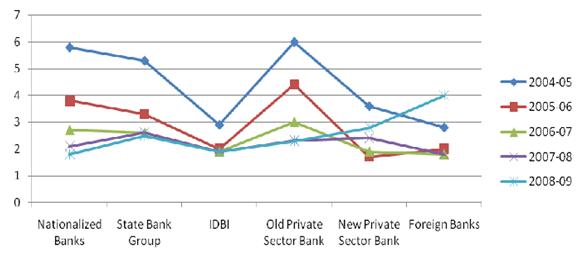
Non-performing assets as percentage of advances showed a declining trend for nationalized banks, state bank group, IDBI and old private sector banks.

There was overall decline in the NPA. The NPA was more for non-priority sector during the year 2008-09. The NPA for public sector loans were least. The analysis category wise showed that NPA were more for new private sector banks and foreign banks. The NPA as percentage of total assets for nationalized banks there was a slight increase in NPA. The impact analysis proved that NPA had negative impact on net profit where as for NPA and total advances there was positive impact (Dickin Goyal, 2010)

Macro perspective behind NPA:

A lot of practical problems have been found in Indian banks, especially in public sector banks. For example, the government of India had give a massive wavier of Rs 15,000 Crs under the prime minister ship of Mr. V.P.Singh, for rural debt during 1989-90. This was not a unique incident in India and left a negative impression on the payer of the loan.

Poverty evaluation programs like IRDP, RREP, SUME, SEPUP, JRY, PMRY, etc, failed on various grounds in meeting their objectives. The huge amount of loan granted under these schemes were totally unrecoverable by banks due to political manipulations, misuse of funds and non-reliability of targets.


What are the causes of non-performing loans in the banks?

a)      There may be different causes for non-performing loans which vary from bank to bank. Some of them are improper verification of the customer’s background, recklessness in the process of giving loans, lack of recovery steps taken by the Management etc. 

b)      More likely corruption role is not only encountering from outside it is involved inside as well before we misguide entire situations. Most reasons are dishonest proceedings, pending files, careless work, higher level demands, political plays from inside and outside, negatively impacting the organizational environment.

c)      One of the most serious impact however is on commercial banks

d)     Poor corporate governance, poor general public, lack of transparency.

  1. What are the specific steps that should be taken by the bank mangers?

a)      Bank managers should verify the customer’s background perfectly and provide the loans for only genuine customers. They should take some measures in order to recover the loans.

b)      Despite sincere has to be taken to help them improve work performance. It is not working and they are increasingly proving to be NPA it may be time to fire such employee(s) but the organization must follow well defined legal and ethical steps in terminating their services.

c)      Avoiding wrong economic decisions and providing new financial services.

d)     Banks can exchange information on the bad borrowers which will be more convenient to track those borrowers.


  1. Can the value of non-performing assets be increased when compared to

Worldwide financial market?

a)      Yes, if the bank management does not follow particular methods or procedures then the value of non-performing assets will increase.

b)      Yes, but there are possibilities for having non-performing assets it might be world crisis, unemployment, economic downturns or unstable conditions.

c)      Yes, it might be possible in different ways.

d)     Not sure, but compare to current inflation rate yes.


  1. How to overcome the loan recovery problem?

a)      The bank management should maintain an efficient recovery team so that the customer’s details would be updated regularly.

b)      Banks must estimate loss given default that aims to reflect economic downturn conditions and perform adequate legal frame works to ensure that loan recovery is legal.

c)      Costs enough to overcome the effects on lender revenues of suppressed interest rates, providing loan recovery agents.

d)     Analyzing on country side financial status to invest money on booming sector.


  1. How to attract the depositors for the decrease in the value of non-performing

assets?

a)      Bank management should attract the depositors by providing them some benefits in the interest rates etc.

b)      Performing the competitive interest rates and focusing on customer needs and requirements

c)      By giving awareness of long-term goals rather than shot-term goals

d)     Offering promotions to absorb depositors mostly on agricultural sector in a country like India.

Sector Wise Non Performing Assets for MBA Students

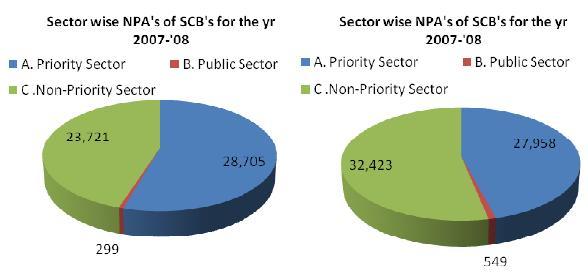
Banks mainly lend to three sectors they include priority sector, public sector and non-priority sector. The lending composition of Indian banks during the last two years is depicted in the following table.

TABLE NO: 1SECOR WISE NPA’S-BANK GROUP-WISE   (AMOUNT IN RS.CRORES)

Sector public sector             old private sector

2007-08  2008-09    2007-08  2008-09

Private sector

2007-08  2008-09

All SCB

2007-08  2008-09

A. Priority sector 25,287

(0.8)

24,318

(0.7)

1,338

(0.7)

1,233

(0.50)

2,080

(0.3)

2,407

(0.3)

28,705

(0.7)

27,958

(0.5)

i)agriculture 8,268

(0.3)

5,708

(0.2)

243

(0.1)

263

(0.10)

1,225

(0.2)

1,178

(0.2)

9,735

(0.2)

7,149

(0.21)

ii)small scale industries. 5,805

(0.2)

6,984

(0.2)

359

(0.2)

307

(0.2)

292

363

6,456

(0.2)

7,654

(0.2)

iii) Others 11,214

(0.4)

11,214

(0.3)

737

(0.4)

663

(0.3)

563

(0.1)

866

(0.1)

12,514

(0.3)

13,155

(0.3)

b.public sector 299

474

75

299

549

c.Non-prority sector 14,163

(0.5)

19,251

(0.5)

1,219

(0.6)

1,839

(0.8)

8,339

(1.1)

11,334

(1.4)

23,721

(0.6)

32,423

(0.6)

Total(a+b+c) 39,749

(1.3)

44,042

(1.2)

2,557

(1.3)

3,072

(1.3)

10,419

(1.40)

13,815

(1.7)

52,725

(1.2)

60,930

(1.2)

SOURCE: RBI report on trends and progress of banking in India 2008-09. Figures in bracket indicate percentage to total assets of the respective bank group. The analysis of the table shows there was NPA increase in rupees, the percentage of NPA to total advances was almost the same. The reason for this was the one-time loan restructuring measures adopted by RBI. The observation of the table further showed that NPA of all scheduled commercial banks (SCB) for non-priority sector was more when compared to other sectors during the year 2008-2009.

banking sector

The figures shown above indicate that NPA for priority sector and non-priority sector were more. Public sector loans had least NPA

Data Analysis in Banking Sector MBA Research Paper

In this chapter, researcher presents the evidence that was gathered through the respondents of the different banking sectors. Respondents views on the areas highlighted in the theoretical framework are presented in the following sections, as this research about finding causes of Non-performing assets and how they are effected on the economy levels and to make the data analysis more supportive researcher have chosen country wise analysis with other Asian countries but major part of analysis is based on managers who are mainly responsible for controlling factor of Non-performing assets.

Presentation of the banks and its employers:

Researcher has chosen highly qualified managers from banks which are in advancement of technology and the birth of competition these banks are in the race of becoming the best in the country with latest innovative ideas to bring customer satisfaction policy to reduce the hazards. Most of these banks are generating highest turnover on money lending practices which they can tackles highest ratio of Non-performing assets. Most banks from the list have introduced world ATM cards to make travelers across the globe and internet banking is the call of the day for the banks where researcher can get good quality of information. Sector of the banks that I have chosen are mostly covered government and private banking as I have noticed these are the banks dealing with high NPA levels and to give further little support foreign and commercial banks have played their role. 

Presentation of the main respondents:

This research is concentrated on the interview questionnaire have been very open and helpful in the study and have sought to develop their answers at the best they can. Below is a brief presentation of main respondents who shared their opinions and thoughts.

Sharanam shah, present manager for private banking sector in Hyderabad which is capital to Andhra Pradesh state in India, has become manager straight into the entry of organization with his higher qualified studies and has worked past three years for this organization.

Cristopher, present Business consultant manager for commercial banking sector in Hyderabad which is capital to Andhra Pradesh state in India, has worked part-time sub-advisor for six years until he finish his studies.

Pranav koushil, present general manager for head-quarters of government banking sector in Mumbai which is capital of Maharashtra state in India, has working more than two years and took the position of general manager through college internship on his first entry.

David, present manager for foreign banking sector in Delhi which is capital of India, he has worked his way up within the organization.

Ethical Issues in Research Projects

Introduction to Ethical Issues in Research Projects:

If there is any authentication process to be followed to gather the information from articles, case studies or books, I will follow them without abusing the requirements. I will follow all the ethical issues in the process of collecting the information for the research work in an honest way and in the qualitative research process.

while interviewing or conducting the surveys within the process of gathering the information from the individuals I will explain my main aim of this research and will make them to understand how important is there information to my research work without hurting them.