
Basic Network Setup to create MANET Using the OPNET Modeler

Basic network setup:

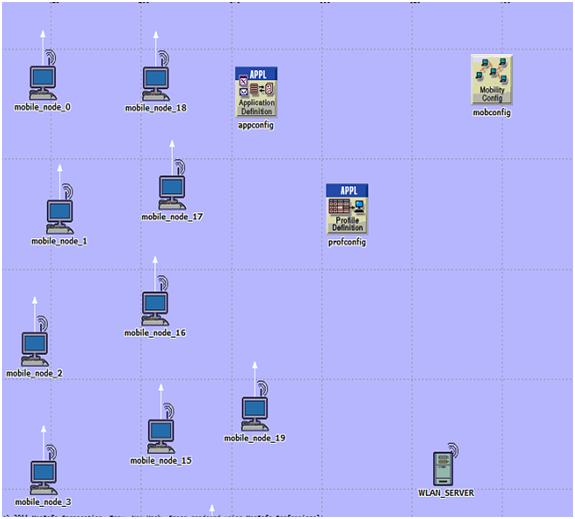
The explanation of the process that is involved in creating the basic network setup required for this particular scenario is done in this section.Using the OPNET modeler a MANET model is created and this is considered as the model family that is needed for the simulation. A campus that is simple is selected for creating the MANET and 1000X1000 square meters area is selected as the size of the network scale and the 10 mobile nodes considered are operated across the campus taken where the model family considered is the MANET for the model of simulation.

A blank scenario is established to create the campus network needed and this done by using 10 mobile nodes initially.These 10 mobile nodes are dragged from the object palette and placed on the work space these mobile nodes are considered as the wireless sensor nodes and in the time of the routing process these will nodes will move in random routes. These mobile nodes taken can be controlled using the sink node and a wireless LAN server node which is fixed is dragged from the object palette and dropped in the work space and this is considered as the sink node that can control all the 10 mobile nodes.

Then the network setup is said to be ready for supporting the traffic generation through the network but for this purpose an application is needed always, for this from the object palette an “application configuration node” is taken on to the work space for establishing the application needed. In this particular scenario three applications are created as they are required and the next section of this chapter explains the configuration setting required.

The applications created are supported by the profile definition and this necessary for the OPNET simulation and to create the profile a profile configuration node is dragged from the object palette and placed in the work space. In addition to these a mobile configuration node is also selected from the object palette in order to support the mobile configuration. The list of nodes selected from the object palette are listed below, all these nodes are very significant for the simulation procedure.

  • The sensor nodes needed are regarded as the mobile nodes and they are taken 10 in number.
  • One fixed wireless LAN server is taken as the sink node to control the mobile nodes.
  • An application configuration node is selected to create the application necessary.
  • A profile configuration node is selected for creating the profile definition needed.
  • A mobile configuration network is selected to apply mobility to all the mobile nodes.

             The further sections of this chapter explain the process of real configuration implemented for all the nodes selected.
Setting the Performance Metrics of the Secured Wireless LAN Configuration

Setting the performance metrics

As there are three applications in this project, following are the performance metrics used to evaluate the performance of the proposed secured wireless LAN configuration 

FTP 

Following are the performance metrics used for FTP application

  • Traffic received in bytes per sec
  • Traffic received in packets per sec
  • Traffic sent in bytes per sec
  • Traffic sent in packets per sec 

Voice

Following are the performance metrics for Voice application 

  • Jitter
  • MOS
  • Packet end to end delay
  • Traffic sent in byte per sec

Video

Following are the performance metrics used for video application

  • Traffic sent in bytes per sec

WLAN

Following are the WLAN metrics used

  • Delay
  • Network load
  • Medium Access delay
  • Load

The Performance of TCP across Dynamic Source Routing (DSR)

The performance of TCP

Generally the mobile nodes towards the MANETs are been communicated by making use of the radio frequency as well as in this specific situation the fixed infrastructure is not been preserved or maintained. In the recent times many research works are been carried out on the efficient routing of the MNAET but even though it is the topic of the research because of the high mobility of the nodes as well as the route volatility.

The performance of the TCP towards the MANETS is considered as one of the other important problem and it is been specified that the performance of the TCP is always los towards the infrastructure less networks such as the MANETS while comparing them with the other different types of the networks.

In general there are some solutions in order to manage this type of situations the first one is to pass the warning and offer the training to the TCP in order to overlook the different types of the packet loses but not to appeal the blocking control routines within the situation of the minor packet loses. As a result the performance of the TCP could be secured and saved the disadvantages within these packet losses could be easily decreased.

The other significant method to develop or improve the performance of the TCP is to assign the role or job to control or manage the packet losses towards the routing algorithm rather than appealing for the controlling routines that belongs to the TCP and by performing this process the performance of the TCP can be easily developed.

The Route Maintenance Process Literature Review

The Route maintenance process

In order to verify the current status of the topology changes towards the network the route maintenance process could be utilized. It is been noticed that the mobility of the nodes is very high towards the MANETS then there is more possibility for the changes within the topology as well as the changes towards the route is been preserved towards the cache by making use of the nodes.

The breaks to the links starting from one node to the other types of the hops must be detected through the individual nodes and basically there are several types of the existing standards in order to achieve or complete this particular function. In order to detect the link failures towards the routes the DSR will utilize the process of the passive response. Within the entire process if the source forwards the packets to the target destination then the intermediate nodes will detect the problems related to the link of the adjacent nodes then in the next minute it will send the RERR- route error packet towards the source node.

Simulation Steps Involved in Using ADOV Protocol

Within this first scenario the ADOV protocol is been utilized along with the 20 mobile nodes in order to produce the traffic. The different types of voice applications are used within this scenario in order to identify the service requirements of the quality by using this protocol. The different steps are followed in order to perform this scenario such as follows:

Steps to form basic network

The MANET- mobile Adhoc networks is widely used within this project in order to estimate the entire performance of the AODV protocol which is totally against the different packet losses which needs some important steps to be followed to create the network which is general. A single LAN along with 20 different types of mobile nodes are utilized within the simulation process in order to set the traffic upon the networks. The steps that are to be followed to create the network are explained below:

  • Initially the user should open the OPNET modeller simulation tolls and then the user should select the option to open new file in order to start the simulation process
  • The project name as well as scenario names should be created in order to obtain the new scenario
  • By selecting a specific option users can create the scenario which is employ in which the OPNET modeler can be utilized to load the different types of default scenarios that are totally inherent into the networks.
  • In order to select specific type of topology various options have taken place and then alternately in the simulation process the simple campus network is been selected to perform the topology functions
  • In the next step the campus size should be situated and then the simulation size of the campus should be set with size of 1000X1000 square meters
  • There is a necessity of new network model family for the purpose of simulation of MANET and within the entire available models the appropriate model is selected in order to perform the simulation process. By following the above mentioned steps the basic network which is required to perform the simulation process is explained and then the different objects which are considered from object palette will be utilized in the simulation process in order to get the expected results.
  • Depending on the requirement of mobile nodes 20 different types of wireless LAN mobile workstations are utilized which performs an activity as the main source in order to get the final traffic in which the actual real packet analysis process is performed
  • The single WLAN server is utilized which acts as an individual application destination along with a server as well as the 20 mobile nodes.
  • As discussed earlier the actual aim of this project is to evaluate and estimate the different packet losses towards the Mobile Adhoc networks which requires a traffic and source applications to perform the actions. The configuration is required to the applications in order to produce the traffic that is needed to analyze the entire data packet losses
  • The profile definition is been created for the purpose of application which is performed by making use of the profile configuration nodes which are gathered from the object palette.
  • The major and important step within the entire simulation process is to set the mobility towards the nodes by making use of the mobile configuration object which is there to perform the process with the object palette and then the finally by following all these steps the first scenario is obtained which is explained in the form of screen shot.

simulation steps

From the above proposed screen it can be identified that the total number of 20mobile nodes starting from mobile_node_0 to mobile_node_19 is been created with the individual WLAN server with different traffic definitions.

In order to set the definitions different types of configurations such as application configuration, mobile configurations as well as the profile configuration are used. The application configuration settings are explained in the further steps.

The Route Discovery Process Literature Review

The route discovery process

The total number of the routing protocols which are present in the MANETs should follow the route discovery process. The DSR will make an investigation regarding the current route towards the destination starting from the source that is required to forward few packets. In the entire process if it is identified and considered as the non expired route then the packets are been broadcasted towards the target by making use of the similar route as well as the communication process. And if the source is not able to identify any type of the current route then the DSR will raise the request towards the nodes for the purpose of the valid route .

Generally the route request is been transmitted as the packet which is called as the RREQ-route request packet as well as this particular packet is been transmitted towards the entire nodes which are present within the network. The major attributes such as the source as well as the destination IP address are been maintained by the RREQ through the single request id that is been situated through the sender.

In the entire process if at all the node identifies the fake route request then it will be immediately happened to be unnecessary and it will even verify that they belongs to the desired destination nodes or not. The unicast operation which is difficult is been carried out in order to forward the RREP messages towards the source rather than transmitting the message in order to finish the total network. Within the process of transmitting as well as the performing the unicast operation each and every node is capable of updating the route along with its route cache.

The Dynamic Source Routing Protocol (DSR) Literature Review

The dynamic source routing protocol (DSR)

The major function of the dynamic source routing is entirely based upon the terminology of source routing. The route discovery process which is been carried out within this particular routing protocol is entirely different from the current routing protocols. The dynamic information is been utilized in order to decrease the broadcast messages as well as the advertisements of the periodic routing. The routes determination is been carried out in a dynamic way depending upon the cache information which is accessible or else the routing information which is been obtained by making use of the requests related to the sources in the form of the broadcasts towards the total networks.

The initial step within the process of routing is that the sender will situate the entire information about the total nodes which are to be navigated through the packets. And this specific information is been identified upon the packet header before the process of actual routing is been done. One of the significant benefit of this routing is the information related to the routing preserved through the intermediate nodes is been excluded as well as the essential information for the process is been sustained within the packet header. By making use of this routing protocol the advertisements related to the periodic route could be totally excluded and the overhead control will be totally decreased. The general function of the DSR routing protocol is again divided into two different steps such as the Route discovery as well as the Route maintenance which are been explained in detail as follows.

The Reactive Routing Protocols Literature Review

The reactive routing protocols

The reactive or else the on demand routing protocols are some what different and are varied from the table drive routing protocols. It is already been proved that they will not sustain any type of the static routing information as well as they are entirely dynamic in nature relevant to that of the routing information. Depending on the specific demands the route towards the target is been constructed. The first and the major task of this routing protocol is they will verify the current routing information and if the information is similar then it will be utilized and if it is not same then it will ask for some requests towards the networks in order to implement the routes towards the destination.

The routing information which is been reserved with this particular protocols is not static and in the ongoing process if at all the route is identified to be inactive for some extent, then it will expire then the new routes are been implemented based on the requirements and then these specific protocols are been considered as the on-demand routing protocols. This protocols are if soft state which is been sustained all over the routing tables. The reactive routing protocols are having two different types of the routing protocols such as the DSR-dynamic source routing as well as the AODV- Ad Hoc on demand vector which are been explained in detail as follows.

The Optimized Link State Routing Protocol (OLSR) Literature Review

The optimized link state routing protocol (OLSR)

The OLSR is referred to as the optimized link state routing protocol which belongs to the proactive routing protocol in which the different types of the routes required for the purpose of the routing are always offered and available. In order to decrease the transparency which is happened because of the topological changes towards the network this protocol will make use of the MPR- multi points relays.

In the continuous process if more number of the topological changes takes within the networks then there is a possibility that the similar types of the message is been transmitted towards the similar area for several times which will leads to the typical situation called flooding. The multi point relays could be utilized for the purpose of reducing the flooding which is been happened because of the fake transmission. By means of the hello messages and by making use of the OLSR routing protocol as well as the Topology control, the information about the link status that belongs to the node could be identified and broadcasted towards the entire network in order to know the current status of the topology changes within the network.

Generally the hello messages are been transmitted only at the specific node level, whereas, the messages of the Topology changes are been transmitted all over the network in order to identify the changes that will take place because of the process of the mobility of the nodes which are towards the topology that is been built. The MPR- multipoint relays are been utilized for the purpose of forwarding the Topology changes messages and then this particular messages are been transmitted as well as forward in a periodic manner towards the network every time when there is the topology change that is generated in the network.

By making use of the MPR the information exchange which is towards the network could be easily decreased and it is even capable of decreasing the broadcast flooding. The OLSR is considered to be one of the developed and advanced version of the link state algorithm by which the link state information is similar to that of the equivalent nodes. By establishing the OLSR routing protocol in an appropriate manner there are more chances to decrease the size of the control packets as well as the information that belongs to the subset of the links is been sustained rather than the entire link information of the particular network.

By making use of the MPR the optimization aspect can be easily attained by which the control information is been optimized. Among all the existing routing protocols of the MANETs this particular protocol can be considered as one of the best protocol. In order to obtain the optimality each and every node will permit and subject the hello message in order to recognize the information about the adjacent nodes and then the by carrying this process the required numbers of the hop node is been recognized. Basically the Topology changes size is high and it is forwarded towards the networks and to complete this there is a necessity of having the required knowledge on the entire parts of the message in order to generate topology changes towards the adjacent nodes.

The Destination Sequence Distance Vector Routing (DSDV) Literature Review

The destination sequence distance vector routing (DSDV)

The Bellman-ford is considered as one of the general technique which is been established for the purpose of the destination sequence distance vector routing. The specific order is been sustained for the purpose of each routing entry that belongs to the routing table in order to indicate the particular information regarding the routing. Each and every node will include the different types of the routing tables which will maintain the general information such as the total number of the hops that are to be transferred towards the target node .

It will even maintain the information about the alternate hop as well as the destination series numbers. The table consistency which is towards the DSDV is been controlled in particular time as well as it will generate the updates that are obtained from each and every node in which the routing process is been carried out.

In the entire process if at all the configuration updates related to the networks are been utilized then the nodes will generate the updates and then the DSV will utilized these specific updates in order to uphold the route stability which is diagonally towards the network. The performance of different types of the protocols is entirely based on the reactions of the routing stability and in this process if the link or else the route breakdown is been detected towards the route then the infinity variable is been allotted for the routes and then the unique sequence number is been allotted by making use of the routing protocol of the DSDV.

Within the ongoing process if at all the node which is towards the route identifies the infinity metrics then it will immediately generate the updates. Then after the new route is been restored by means of the non-working route in order to sustain the routing stability of the network. Depending on the total information which is been received the updates of the routing table are been carried out that are starting from the new infinity metrics and then after they are compared by the current information which is already present in the process. Basically the updates related to the tables are been performed by considering the two different conditions such as above:

  • In the entire process if at all the packet is been received by using the greater sequence number then immediately it will be replaced by the current information.
  • Based on the similar sequence numbers the routing table is been updated.