The Two Tiered Client/Server Web Database in DBMS

THE TWO TIERED CLIENT/SERVER WEB DATABASE

With out any principal process totally the client talks openly with a server in the two-tier architecture. In the microcomputer-based LANs mainly we use architecture is two-tiered client/server architecture.  From the clients we get the post request, the user interface is managed by the clients, and the data which is entered by the user is authenticated, the connections are restricted, data integrity is managed,  database retrievals and the database what is updated is implemented.

                            Two-Tiered Client Server Architecture

                               Two-Tiered Client/Server Architecture

                   Independently we can expand the technologies that are web tools and databases. In any reason the web tools and databases are support on two-tiered client/server architecture.  Among the Web browser and a web server the separating of the functions is distinct. The HTML pages are distributed by the web server where as by understanding these HTML tags individual pages are presented by the web browser. Many dealers like to generate web browser because it is very consistency. It is individual with a small amount when we divide among the database client and database server.  Application programmers take the decisions regarding the separation of functions and the project requirements also controls the decisions. As a result there is no availability of consistency which means that there is a need for important programming effort in order to execute modifications to a database server and client.

   Two-tiered Client Server Web and Database Architecture

                       Two-tiered Client/Server Web and Database Architecture

     Any computer can act as either client or a server. Because there is a problem in price frequently the microcomputers are behaving like client and server. Normally the clients and servers are connected together.  With quite fixed rules the typical client-server architecture works well rather in all the same environments.  There is another client server architecture known as three-tier architecture where the rules are quickly altered by the mixed environments.

Components and Architecture of a Web Database in DBMS

For the execution of the web database application there is a lot of technologies. In this database we are developing the whole thing but we observe only small number of consistent group of software and architectures are rising.

By depending on the customers’ perspectives, styles, and priorities for the web database application we can choose the most excellent policy.

High Level Conceptual Data Modeling for Database Design in DBMS

High Level Conceptual Data Modeling for Database Design

For designing a victorious database application this conceptual modeling is playing a vital phase. This conceptual data modeling is playing higher level this will present the idea about the Entity-Relationship Model.

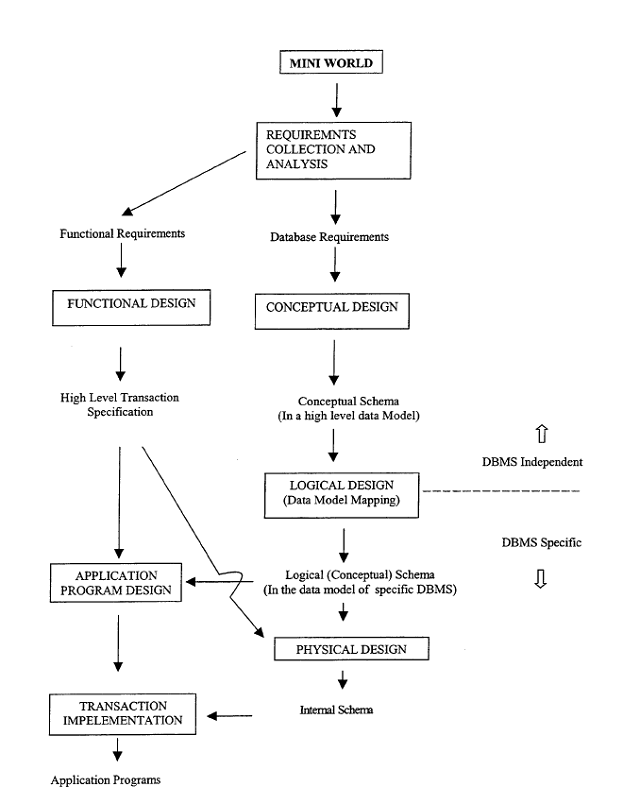
Conceptual Design Workflow

                                  Conceptual Design Workflow

               From the above figure we note that the first stride is requirements collection and analysis.  At some stage to recognize and the requirements are certified by the users that’s why the database designers are interrogate. At last the outcome of this step is the set of customer requirements are printed in a few words. When we are identifying the data requirements in parallel it is necessary to identify the functional requirements which we are acknowledged.  These user-defined operations include both retrievals and update.

The data flow diagrams, sequence diagrams are frequently used in the software design. And some of the functional requirements are identified. All of these requirements are examined together one time. And then by using a high-level conceptual data model then generate a conceptual schema in next step. The users’ database requirements are illustrated briefly in the conceptual schema the complete descriptions of the entity types, relationships and constraints are also contained.  By using a commercial DBMS the database is implemented really in the next stage of the database design.

                From a high level data model, the conceptual schema is changed into the implementation data model when the implementation of the data model is used by the current commercial DBMS in many ways.  This is known as logical design or data model mapping. The physical design phase is the very last step.  Individually the internal storage structures, access paths, and file organizations. 

Data Modeling in Data Base Management Systems

DATA MODELING

           In the process of data modeling, depiction and observation of the developers regarding the data is created and this data modeling is the main vital task in the growth of the effective database request. When the developers find that the view of data is signified improperly by the data model, then the developers find it very complicated to extend, incomplete and it is very provoking of applications.

For the improvement of the databases and their applications for all successive work the data modeling is the starting point.

 For the data modeling we have two types of approaches. They are

  • Entity relationship model
  • Semantic object model

Entity relationship model

      We have four fundamental elements in the entity relationship model.

  • Attributes
  • Identifiers
  • Relationships

 For these entities the attributes are behaving like assets. For an example the person is entity and the age of a person or name of the person is the attribute.

Individually for the particular entities we can identify these identifiers.

Between the two entities we are using the se relationships.

The Works in Relationship Set
                    

                                             The Works in Relationship Set

For the entities we are using the attribute known as relationship. This relationship is in different types.

  •  One-to-One relationship
  •  One-to-Many relationship
  •  Many-to-One relationship
  •  Many-to-Many relationship

Semantic Object Model

       In the place of entities we are using the semantic objects in the semantic object model. In the user environment with a quantity of the identifiable thing the semantic object is characterized. For a semantic object that the object must have sufficient attributes that is the reason the word ‘sufficiently’ is working as a major role.

           For the E-R model and in the semantic object model there is one of the main difference is in the E-R model the entities are the basic focus where as in the semantic object model these semantic objects are focus in the other model. 

                                   A Semantic Model

                                        A Semantic Model

          To signify the different types of data we are having variety of classes. Some of the necessary objects are Simple Objects, Composite Objects, Compound Objects, and Hybrid Objects.

Object Oriented and Object Relational Database Model

A programming language which is the latest method began to use in the year 1980’s known as Object Oriented Programming (OOP). As the established programming language OOP has exposed the important benefits. As a different way we can understand the database models when there is a change in programming it is called as Object Oriented Database Management System (OODBMS).

           With the object oriented capabilities the DBMS combine with the database capabilities essentially the DBMS is an OODBMS. As a programming language objects the database objects come out which are created by an OODBMS. For the real world, article objects are the software demonstration. Both attributes and operational characteristics are consisted in an object because to detain the features and ability of the real world.

For objects templates are classes. Encapsulation is one of the main features for the object oriented model. For an object oriented database the main ability is to add new objects. There is a flexible thing in the database level.  Base class means there is an existing object that can be distinct as a condition of the new objects in the object oriented model (OOM). To subsist in the subclasses the polymorphism allocates a number of versions who have the similar performance. 

Relational Database Model (RDM) in Data Base Management Systems

Relational Database Model (RDM)

In the year 1960’s, to hold the huge quantity of data Dr. E. F. Codd, a mathematician   appears a latest condition. Codd had some of the plan to explain various problems to relate disciplines and structures of mathematics to data management. But when it is planned for other database models it comes across unnecessary data and weak data integrity. In the year 1970, June the relational model of data is established by Codd.  On the two branches of mathematic the Codd support his model.

       The Codd does not get the concentration on the new papers but in the relational database concept the IBM became extra importance. For a System/R and a relational language to form a sequence of design documents the IBM is going to use their thoughts.

          The relational language is also called as structured query language. By using the SQL we can get back the data.SQL is one of the ordinary language by using this we can create, modify, and inquiry relational databases.

In the relational database model we can observe three essential components.

  1. Relational data structure
  2. The data structures association would be managed by the rules
  3. And in the data structures the operations are presented.

There are more benefits in the Relational Database Model.

  • Built in multi level integrity   

            To make certain that the records are not copied and to identify the values of primary key that is misplaced, we built data integrity into the model that is at table level.

  • Logical and physical data independence from database applications

When we put the applications together it will not badly affect for the logical and physical design of the RDM when some of the modifications made by the user.

  • Guaranteed data consistency and redundancy

Within the database the data can be forced when the data is exact and constant due to the different stage of integrity.

  • Easy data retrieval

                In the database level we can recover the data from a particular table or any correlated table which is controlled by users.

            To create, maintain and manipulate a relational database a software program known as Relational Database Management System is used. To produce the request the RDBMS is used and the data which is stored in the database should be work together with the users. For creating an extra and better mainframe RDBMS programs the various companies are using relational database model which are moved from the hierarchical database model and network database model. Oracle and IBM’s DB2 are some of the mainframe computers in RDBMS this improvement is seen in 1980.

Early Database Models in Data Base Management Systems

In the data base management systems to control and to continue the data generally we are using two types of data models. They are

  • Hierarchical Database Model (HDM)
  • Network Database Model (NDM)

Hierarchical Database Model

               The data is hierarchically prepared in the hierarchical database model. Without any difficulties we can imagine an inverted tree in this hierarchical database model. In this model the relationships are signified by a parent and child. In this HDM model as a root only one table is acting and the remaining other tables are acting as branches which are extending from this root.  Means the parent is a root and the child are branches. Means that the child table will have only one parent table and the parent table will have many child tables. These tables are connected clearly. In this model if we want to contact any documentation then the user first want to start from the root table from there onwards move through the tree to reach the object.

         For this type of database there is one of the benefits that is referential integrity which is built in and it is imposed repeatedly. For the record which is presented in the parent table the record of a child table is related. Suppose, in the parent table the records are deleted then the records which are connected in the child tables are also deleted.

         When we want to accumulate a record in a child table but it has the no relationship with the parent table then the problem occurs in the Hierarchical database model. In a parent table when the fake record is included that rules could be bend lacking of break.

           There is unnecessary data in HDM; this is one of the problems. In HDM we see many-to-many interactions but it is not sufficiently elastic that is the reason unnecessary data occurs in HDM. Mutually the data is repeating. In the year 1970’s by itself the hierarchical systems provide tape storage method which are using in main frames. And the companies used this systems turn into very popular.

            In many conditions the HDM was very helpful model because it is quick and we can access directly. Along with the data we are having unnecessary data and the complex relationships to address this we require a new database model.

                      A Hierarchical Database Model Diagram

                            A Hierarchical Database Model Diagram

Network Database Model

              In the hierarchical model we are having some of the problems to avoid these problems Network Database Model were extended. In the network database model the branches can be shared in many imagine trees. By sharing these branches the many-to-many connection problem is solved which is not executed in a HDM. The model of data definition and the data definition language are established in NDM.

                  Network Database Model Diagram


Application to evaluate the object and Relational features of Oracle 9

Aim

The main intention of the application is to evaluate the Object and Relational features of Oracle. Existing concept model of a current application is considered and the same is implemented in Oracle 9 and the extended SQL features are explored and compared with the standard SQL. The Oracle extensions to SQL can then be compared to the SQL standard’s extensions. 

Changed Aim

To evaluate the Object and Relational features of Oracle by developing an application with extended SQL features and comparing with any standard SQL application.

 Deliverable

Following aspects are derived while performing the research on the application.

  • A running application that demonstrated the comparative aspects of SQL with Oracle 9 with standard extension of SQL.
  • A database concept model with both the Object and Relational features of Oracle 9.
  • A rich user interface to explore the advanced features of Oracle 9.
  • A report to analyze the comparative results of Oracle 9 with standard SQL features. 

Research question(s) These are weak and need to be changed

  1. What are the extended SQL features of Oracle 9 and how they play an important role in deciding the Object and Relational model of the database?
  2. How to develop a concept model that explains the comparative differences between SQL extensions of Oracle with standard SQL extensions? 

Modified Research questions 

  1. 1.      What are the extended features of Oracle SQL and how they are related to Object and Relational model of a database?
  2. 2.      How to use the conceptual model of a database to develop an application?
  3. 3.      What are the object and relational model of oracle database?
  4. 4.      How to create an application that integrates with multiple database? 

Literature Review

In a typical data model, a pattern can be considered as set of objects or entities and their relationship and attributes. Proper customization of these entities could solve many design problems of many conceptual or logical databases .

A conceptual model represents the primary objects or entities of a database. Conceptual Data model of a database is initiated at the design phase of the project. A typical conceptual data model holds up to 10 to 20 data entities and their relationships . 

Oracle 9 has many object and relational models like user defined data types. It has introduced a special data type known as abstract or user defined data type, where user has a choice in creating the required data type and these data types behaves like simple objects. Below example demonstrate a typical example of abstract data type .

Create or replace type person_address as Object (Streetnumber NUMBER, Streename VARCHAR(30), City VARCHAR(20), State VARCHAR(20));

Oracle 9 SQL has many added features that can query the database in an efficient manner when compared to standard SQL (Naney Greenberg, 2001). OR model of Oracle can be found in PLSQL implementation.

In any typical object-oriented database management system (OODBMS), the modelling and creation of data is treated in terms of objects and thus this typical modelling of database management system is known as Object oriented database management system. This object oriented implementation includes the instances of the objects formally know as classes of the corresponding objects. All sorts of class properties like methods, subclasses, inheritance, polymorphism and abstraction. Relational database can make use of these object oriented concepts. An object-oriented database interface standard is being developed by an industry group, the Object Data Management Group (ODMG). Any object-oriented database system must satisfy few considerations as below.

The first and foremost criteria should satisfy the five features like persistence, storage management activities consistency and recovery, concurrency, ad hoc query management and query processing techniques.

Object-relational mapping can be used to map the corresponding object-oriented programming objects to the relational databases managed by any of the typical database management systems like Oracle, SQL server, Sybase and some other relational database managers (RDBMS). Typical aspects like problem solving over the object and relational model can be easily resolved by using this implementation and thus process can be used to evaluate the performance of different products and their related comparison aspects.

All the famous programming languages like C#, C++ and java can be used to implement these object oriented features of database and these OR features can be integrated with these programming languages. Database objects appear as programming language objects. Interface of any typical object oriented database can be directly imported to these types of object-relational mapping products.

Object-relational mapping can be used in variety of cases like implementing a database across the large enterprise databases and this can be used to measure the persistence of the database. Following are few transparent aspects where the RDMS is used widely.

  • Maintaining consistency across one or more Relational Databases.
  • RDMS can be used for both the technical and political reasons across the enterprise database.

Programming code can be reduced across any business logic by using this object-relational mapping model and this is accomplished by caching and introduction of embedded SQL features or JDBC-ODBC interface. Even the cost performance can be easily evaluated by using these object relational models by using the transparent features of the database .

 Research Method (Quantitative and qualitative methods need to be more specific)

Both qualitative and quantitative methods are adopted to implement the research method. All the latest features of Oracle 9i are scientifically investigated by a proper quantitative methodology. Large data sets are considered and queried based on the quantitative statistics. Behaviour of the database with the introduction of Oracle 9i SQL can be studied by the qualitative techniques and few issues related to why the conceptual model should be done with Oracle DBMS can be studied. A front end application is developed with proper database design and the performance of the application is measured with respective to the query processing speed.

A multiple set of queries are introduced on the database to typical database operations like data insertions and data retrieval. A statistical analysis is done on the query processing performance of a basic SQL queries and extended SQL features of Oracle 9 and the comparison results are used to evaluate the performance of the application. 

Following research methods are used to develop the application with the help of conceptual model of database and extended features of SQL of Oracle 9i

  • Developing simple database application with extended Oracle SQL and comparing with another simple  database application
  • Preparing a standard questioner to compare the features of standard SQL and extended SQL features of Oracle 9i
  •  Number of articles and journals are referred to understand the Object and Relational model of a database and to create a conceptual model of a database
  • Online articles and case studies of Oracle corporation are referred to create the database application with the extended SQL features
  • Metadata of different database are compared and analysed to list out all the comparison factors.
  • Technical aspects of the application like compression and hiding of the data and image processing techniques are evaluated with the help of online research. 

Evaluation

Evaluation can be done by considering a typical conceptual model developed in standard SQL and thus enhancing the same with introduction of Object/Relational model of Oracle 9. The results are tested across and query performance is evaluated. SQL extensions like user defined or abstract data types are applied on the existing conceptual model and thus evaluating the performance of the Database management system. These results can be compared across the standard SQL. The front end design of the application can be done with any of the popular programming languages like java and the backend can take multiple forms. A simple database application with standard SQL features like create, insert, modify and delete operations is developed with all the possible database operation like insertion, updating and deletion and at the same time the performance of the application is evaluated against the query processing speed and for achieving this any database with standard SQL operations like Oracle 8 or SQL server can be used.

To evaluate the performance of the application with introduction to the extended SQL operations of Oracle 9, the same application is modified such that all the extended Object and Relational features of oracle are integrated to the application and thus a comparison methodology is developed. The design of the application should be in a manner such that there should be a scope to implement all these features. Extended features of SQL are best evaluated at the conceptual model level and the same are implemented across the application and even XML features of Oracle can be best evaluated with this implementation. The comparison and evaluation process can be initiated at the conceptual database level and backend database design level.

Hardware/software needed

Software Requirements

Operating System : Windows XP or 2000 advanced server

Front-end  :  Java

Editors  :  Edit Plus or Net beans

Hardware Requirements

Processor : Pentium 80386 microprocessor or higher

Main Memory : 128 MB or higher

Hard Disk :  40 GB or higher

Object and relational model of relational databases

The first database developed in mathematical terminology is relational model database. Its basic assumption is that data can be expressed in mathematical n-array relations either as Cartesian product of n domains or in subsets. Object / relational database model add new object storage ability to the relational models at the foundation levels of modern information systems. Applying encapsulating techniques, complex analytical and data manipulation functions can be executed. As an emerging, technology, the object/relational (OR) approach has gained strong transaction and performance-management features of its relational ancestor and the flexibility of object-oriented . 

An object-relational database is a database analogous to the relational database. It also offers a middle ground between relational database and object oriented database. However, object oriented relational data base has additional features which support database schema and also the structured query language. Some of features include:

  • Encapsulation
  • Inheritance
  • Object
  • Class 

OR database is initially developed to bridge up the gap between data modelling techniques like entity-relationship diagram and object-relational modelling techniques that are used in programming C ++ and Java. Also, this type of database aims at raising the level of abstracting a problem domain.

  • Object oriented data bases are mainly developed for complex data types,
  • object abstraction (easier real-world modelling, better resolvability and reusability), encapsulation behaviour (Data objects and their respective operations and methods are considered together – close the gap between utilization of data in the and querying of data in the software)
  • For performing high presentation application programs . 

Special features of oracle 9i

Special features of oracle 9i:

Oracle 9i is the latest version of Oracle database which comes from one or two releases. It broadly explains functionality features and mounting the depth of the features of oracle 8i. Some of the most significant features of oracle 9i are:

  • Clustering real applications: Clusters pave one of the ways to spread oracle 9i database over multiple machines in a bunch of servers, with each having the source to scale and be available over the entire cluster.
  • Dynamic Memory groups: This feature helps to alter the size of memory pool without obstructing or restarting the server.
  • Data Guard: This feature grips standby databases from maintenance and failover automatically.
  • Automatic Undo Management: This feature provides the user to simply define an undo table space instead of defining and managing rollback segments.
  • Flashback Query: Flash back Query uses the same mechanism used in multi version consistency. It is one of the small features which permit the user to run a query against database and return the earlier similar results.
  •  XMLType: It eradicates the need to check the incoming and outgoing documents of the database. This data type permits to store XML documents in the database directly.
  • List Partitioning: It provides an added advantage of partitioning data on the basis of list of values. This feature becomes helpful while doing isolate maintenance operations.
  • Fast Start Recovery: Provides to specify the duration that is spent in recovering a database.
  • Zero Data Loss: This feature ensures zero loss of data by enabling standby database which is exactly the same state as in the active database, so that no data will be lost in the event of a failure .