A Study on Capital Asset Pricing Model (CAPM) with reference to selected Banking Stocks traded at BSE

 Project synopsis

RATIONALE OF THE STUDY:

The Study on the capital asset pricing model in equity shares of banking companies will be undertaken with the objective of getting an insight into the concept of investments, market risk, security market line, undervalued and overvalued stocks, the risks, and the returns. The study aims to determine the market risk involved in the investments and the factors affecting the market risk and to determine the required rate of returns. The other objectives of the study are to observe the security market line and the degree of volatility of the Banking industry and undervalued and overvalued stocks.

OBJECTIVES OF THE STUDY: 

  • To observe the risk-free rate and evaluate the relationship between risk and return involved in equity share prices of the banking industry.
  • To observe the significant risk of shares (market risk or systematic risk).
  • To observe the relationship between the security market line and the capital market line
  • To develop the inputs required for applying the capital asset pricing model.
  • To produce a benchmark for evaluating various investments and finding out whether the stocks are under or overvalued. 

RESEARCH METHODOLOGY

Method of data collection:

 The Historical data of share prices for the period of one year will be collected from the BSE index for the study.

Source of data

Secondary data will be collected from respective websites like Bseindia.com, Moneycontrol.com, and other financial Journals. 

Period of the study

The study will be done for a period of 30-40 days.

Data analysis tools:

Appropriate data tools like Beta, Mean, and Standard deviation will be used.  

LIMITATIONS OF THE STUDY

  • The study will be based on secondary data only.
  • The study will be limited to banking stocks only
  • The time for the project is limited to 30-40 days

SCOPE FOR FURTHER RESEARCH:

The study covers information related to the equities share of the banking sector. It also covers the systematic risk and unsystematic risks of banking companies. The study is confined to only one Sector i.e., the banking industry, and the entire study is based on their Stock prices for a period of the last two years. The present study gives an insight into this issue by analyzing the capital asset pricing model Analysis in Equity share prices of the Banking industry.

A Study on Consumer buying behaviour with reference to Amazon.in

RATIONALE OF THE STUDY: 

  • To study the consumer buying experience at Amazon.in in Hyderabad.
  • To identify opportunities and the interest of the buyers towards online retailing transactions at Amazon.in
  • To understand the offers and discounts provided by Amazon.in
  • To study the problems and dissatisfaction that may be experienced by the customers Amazon.in.

OBJECTIVES OF THE STUDY:

1. To study the consumer buying behaviour towards Amazon.in in Hyderabad

2. To know the factors that influences the Consumers to do purchasing from Amazon.in.

3. To find out the problems faced by young consumers in buying online retail products from Amazon.in.

4. To come out with suitable suggestions towards making online purchases at Amazon.in.

SCOPE OF THE STUDY:

The scope of the study is limited to the buying behaviour of consumers at Hyderabad who do online shopping from Amazon.in. The Main reason of the present study is to find out the online retailing experience of the consumers and their attitude and satisfaction levels. The study also focuses on factors that influence in doing online shopping at Amazon.in and the problems faced by them during placing the order and receiving the product.

RESEARCH METHODOLOGY:

a) RESEARCH DESIGN:

Both Descriptive and exploratory research will be used for this project study. The research of this study involves in both field survey& literature survey, to identify the scope & potential marketing challenges of purchasing from Amazon.in.

Nature of the Data: Primary & secondary data will be used in this project study

Primary data: The descriptive research will be conducted by using primary data which will be collected through the personal interviews using questionnaire as a data collection tool, to identify the scope of retail ecommerce business in India. The primary data is accurate & highly reliable in nature.

Field Study: Field study will be used to collect the primary data from the sample trough the interviews by using questionnaire as data collection tool.

Secondary data: The exploratory research will be conducted by using secondary data which will be collected from various published sources such as retail and e-commerce Journals such as International journal of electronic commerce, Indian Journal of retailing, Indian Journal of Marketing, E commerce magazines, Business Magazines Text books on Retail Management, E-commerce and websites on online retailing and Amazon.in.

b) SAMPLING DESIGN:

Sampling Frame: The Sampling frame will be taken from the population residing in urban Areas in Hyderabad.

Sample Size: The study will be conducted on a sample of 100 Consumers who are frequent buyers from Amazon.in from Hyderabad city.

Sample units: The sample units will be taken from among the 100 consumers residing in selected areas in Hyderabad. The Consumers who are making their online purchases from Amazon.in may be considered for the study.

Sampling Method: This study will be undertaken by using Convenience and Area sampling.

Data Analysis: Charts, tables and percentage analysis will be used for the study.

LIMITATIONS OF THE STUDY: 

  • The primary data will be collected only from online buyers. 
  • The survey will be conducted in only in Hyderabad city only. 
  • The data will be collected only from the urban consumers, who might be aware of the process of online transactions & have their own bank accounts.
  • The views and opinions of the respondents may change over the period of time.

DIRECTION FOR FURTHER RESEARCH: At present there is a lot of demand for online purchasing. The present study will focus on the purchasing behaviour towards Amazon.in and finding out suitable solutions to make purchasing more interesting and will be a torch bearer for future researchers and online retailing companies can benefit from such survey.

Focusing on the post-purchase experience is the next frontier for online retailers. Now, retailers are extending the customer hand-holding postpurchase with beautiful branded interfaces, delivery visibility, and personalized content. By streamlining customers’ paths to purchase and bringing them back directly into the loyalty loop, brands can convert one-time shoppers into lifelong brand advocates.

Latest CSE Python Projects on ML & AI – 2022

These are the Latest CSE Python Projects on Machine Learning, Deep Learning, Artificial Intelligence, Big Data, Blockchain Technology, Cloud Computing, Data Mining, Networking, Network Security, and Cyber Security domains.

Download the Projects List Here – Python Projects on ML & AI – 2022

Python Projects List – 2022

These are the latest Python Machine Learning & Deep Learning projects for the year 2022.

  1. Characterizing And Predicting Early Reviewers For Effective Product Marketing On Ecommerce Websites
  2. Semi-Supervised Machine Learning Approach For DDoS Detection
  3. 5g-Smart Diabetes Toward Personalized Diabetes Diagnosis With Healthcare Big Data Clouds
  4. Credit Card Fraud Detection Using Random Forest & Cart Algorithm
  5. Driver Drowsiness Monitoring System Using Visual Behaviour And Machine Learning
  6. E-Assessment Using Image Processing In ∞Exams
  7. Automating E-Government Using Ai
  8. Eye Ball Cursor Movement Using OpenCV
  9. Filtering Instagram Hashtags Through Crowdtagging And The Hits Algorithm
  10. Converging Blockchain and Machine Learning for Healthcare
  11. Suspicious Activity Detection
  12. Use Of Artificial Neural Networks To Identify Fake profiles
  13. Video-Based Abnormal Driving Behaviourdetection Via Deep Learning Fusions
  14. Crop Yield Prediction And Efficient Use Of Fertilizers
  15. Fake Images Detection
  16. Opinion Mining For Social Networking Sites
  17. Image Classification Using Cnn (Convolution Neural Networks) Algorithm
  18. Cyber Threat Detection Based On Artificial Neural Networks Using Event Profiles
  19. Analysis Of Women’s Safety In Indian Cities Using Machine Learning On Tweets
  20. Construction Site Accident Analysis Using Text Mining And Natural Language Processing Techniques
  21. Performance Comparison Of SVM ,Random Forest, And Extreme Learning Machine For Intrusion Detection
  22. Accident Detection System
  23. A Data Mining-Based Model For Detection Of Fraudulent Behaviour In Water Consumption(Standalone)
  24. Detection Of Lung Cancer From Ct Image Using Svm Classification And Compare The Survival Rate Of Patients Using 3d Convolutional Neural Network(3d Cnn)On Lung Nodules Data Set
  25. Automatic Facial Expression Recognition Using Features Extraction Based On Spatial & Temporal Sequences Using Cnn & Rnn Algorithm
  26. Facial Expression Recognition And Their Temporal Segments From Face Profile Image Sequences Using Yolo Object Detection Algorithm
  27. Cartoon Of An Image
  28. Bird Species Identification Using Deep Learning
  29. A Deep Learning Facial Expression Recognition Based Scoring System For Restaurants
  30. Seer Cancer Incidence Using Machine Learning With Data Analysis
  31. Loan Prediction Dataset Using Machine Learning With Data Analysis
  32. User-Centric Machine Learning Framework For Cyber Security Operations Center
  33. Recolored Image Detection
  34. Robust Malware Detection For IoT Devices Using Deep Eigenspace Learning
  35. Modeling And Predicting Cyber Hacking Breaches
  36. Image-Based Appraisal Of Real Estate Properties
  37. Heart Disease Prediction
  38. Crop prediction using machine learning
  39. Face mask detection using artificial intelligence
  40. Facial attendance system using artificial intelligence
  41. Skin disease prediction using deep learning
  42. Fruit disease prediction using deep learning
  43. Malaria disease prediction using deep learning
  44. Phishing email detection using convolutional neural network
  45. Type 2 diabetes prediction using machine learning
  46. Suicidal tweets detection using machine learning
  47. web community questions and answering
  48. currency recognize system using artificial intelligence
  49. Fake news Detection using machine learning
  50. Detection of fake online reviews using semi-supervised and supervised learning
  51. mobile price prediction using machine learning
  52. Vigorous malware detection for the internet of things devices using machine learning
  53. Estimating the price of houses using machine learning
  54. Predicting the strength of the concrete pillars used in industrial infrastructure
  55. Passive Aggressive Classifier for Detection of Encrypted VPN
  56. speech emotion recognition using mlp algorithm
  57. face emotion recognition system using artificial intelligence
  58. Data Analysis by Web Scraping using Python
  59. A Decision Tree-based Recommendation System for Tourists
  60. A Machine Learning Model for Average fuel consumption in Heavy Vehicles
  61. Density-Based Smart Traffic Control System UsingCanny Edge Detection Algorithm for CongregatingTraffic Information
  62. Image Classification Using CNN (Convolution Neural Networks) Algorithm
  63. Prudent Fraud Detection in Internet Banking
  64. Twitter sentimental analysis
  65. Android malware detection using Machine learning techniques
  66. Missing Child Identification System using DeepLearning and Multiclass SVM
  67. Emotion-Based Music recommendation system
  68. Stress Detection in IT Professionals
  69. Cryptocurrency Price Analysis with Artificial Intelligence
  70. Object detection using artificial intelligence
  71. Using Deep Learning to Predict Plant Growth and Yield in Greenhouse Environments
  72. Human Activity Recognition
  73. Deep Learning Model for Detecting COVID-19 on Chest X-Ray Using Convolutional Neural Networks
  74. Encryption And Decryption Algorithm Based On Neural Network
  75. FAMD: A Fast Multi-feature Android Malware Detection Framework, Design, and Implementation
  76. Image Super-Resolution using Convolution Neural Networks and Auto-encoders
    Lip Reading using Neural Networks and Deep learning
  77. Image Segmentation with Mask R-CNN
  78. Open Pose: Real-time Multi-Person 2D Pose Estimation using Part Affinity Fields
  79. Tuning Malconv: Malware Detection With Not Just Raw Bytes
  80. A Hybrid Fuzzy Logic-based Deep Learning Approach for Fake Review Detection and Sentiment Classification of Amazon Food Reviews
  81. News Text Summarization Based on Multi-Feature and Fuzzy Logic
  82. An Android Malware Detection Approach Based on SIMGRU
  83. Access Control and Authorization in Smart Homes: A Survey
  84. Spam Detection for Youtube Comments
  85. Animal Classification using Facial Images with Score-Level Fusion
  86. An Enhanced Anomaly Detection in Web Traffic Using a Stack of Classifier Ensemble
  87. Automatic Corpus Creation and Annotation for Natural Language Processing of Telugu
  88. Blockchain for Secure EHRs Sharing of Mobile Cloud-Based E-Health Systems
  89. CaptionBot for Assistive Vision
  90. A joint multi-task CNN for cross-age face recognition
  91. Cyber security Tools for IS Auditing
  92. Cyber Threat Detection Based on Artificial Neural Networks Using Event Profiles
  93. A Deep Learning Approach for Effective Intrusion Detection in Wireless Networks using CNN
  94. Digital Image Encryption Algorithm Based on Elliptic Curve Public Cryptosystem
  95. Toward Universal, Word Sense Disambiguation Using Deep Neural Networks
  96. An Expert System for Insulin Dosage Prediction
  97. An Efficient Gait Recognition Method for Known and Unknown Covariate Conditions
  98. Self-Diagnosing Health Care Chatbot using Machine Learning
  99. Machine learning Models for diagnosis of the diabetic patient and prediction insulin dosage
  100. An Improved Approach to Movie Recommendation System
  101. Efficient Privacy-Preserving Machine Learning for Blockchain Network
  102. Sentiment Analysis to Classify Amazon Product Reviews Using Supervised Classification Algorithms
  103. A Deep Learning Approach for Effective Intrusion Detection in Wireless Networks using CNN
  104. SE-Enc: A Secure and Efficient Encoding Scheme Using Elliptic Curve Cryptography
  105. Secure Image Transmission Using Chaotic-Enhanced Elliptic Curve Cryptography(JAVA)
  106. Predicting Stock Market Trends Using Machine Learning and Deep Learning Algorithms Via Continuous and Binary Data a Comparative Analysis
  107. Multimedia summarization
  108. Quality Risk Analysis for Sustainable Smart Water Supply Using Data Perception
  109. Android Permission Control App(ANDROID)
  110. Increasing the Performance of Machine Learning-Based IDSs on an Imbalanced and Up-to-Date Dataset
  111. Fake Image Identification
  112. Non-Binary Image Classification using Convolution Neural Networks
  113. Robust Intelligent Malware Detection Using Deep Learning
  114. Construction site accident analysis using text mining and natural language processing techniques
  115. Cyber Threat Detection Based on Artificial Neural Networks Using Event Profiles
  116. Data Recovery
  117. Context-Based Image Processing Using Machine Learning Approaches
  118. A Knowledge-Based Recommendation System That Includes Sentiment Analysis and Deep Learning
  119. Robust Intelligent Malware Detection Using Deep Learning
  120. Rossman Stores Sales Prediction
  121. A Driving Decision Strategy (DDS) Based on Machine learning for an autonomous Vehicle
  122. A Machine Learning-Based Lightweight Intrusion Detection System for the Internet of Things
  123. A Model for prediction of consumer conduct using a machine learning algorithm
  124. An automatic garbage classification system based on deep learning
  125. Detection of fake online reviews using semi-supervised and supervised learning
  126. Forensic Scanner Identification Using Machine Learning
  127. Use of Artificial Neural Networks to Identify Fake Profiles
  128. Analysis and Prediction of Industrial Accidents Using Machine Learning
  129. Credit Card Fraud Detection Using Random Forest & Cart Algorithm
  130. Identification of covid-19 spreaders using multiplex networks approach
  131. Object Tracking Using Python from Video
  132. Software Defect Estimation Using Machine Learning Algorithms
  133. MamaBot: A System Based on ML and NLP for Supporting Women and Families during Pregnancy
  134. Deep Texture Features for Robust Face Spoofing Detection
  135. Prediction of loan eligibility of the customer
  136. Using Deep Learning to Predict Plant Growth and Yield in Greenhouse Environments
  137. A Malware Detection Method for Health Sensor Data Based on Machine Learning
  138. Blood Cell Types Classification Using CNN
  139. Feature extraction for classifying students based on their academic performance
  140. Hazard Identification and Detection using Machine Learning Approach
  141. Effective Heart Disease Prediction using Hybrid ML Algorithms
  142. Noise Reduction in Web Data A Learning Approach Based on Dynamic User Interests
  143. Online Book Recommendation System by using Collaborative filtering and Association Mining
  144. Sentiment Analysis Using Telugu SentiWordNet
  145. Soil Moisture Retrieval using Groundwater Dataset using Machine Learning
  146. A Time-Series prediction model using long-short-term memory networks for the prediction of Covid – 19 data
  147. Detection of Cyber Attacks in Network using Machine Learning Techniques
  148. Duplicate Question Detection with Deep Learning in Stack Overflow
  149. Machine Learning Techniques Applied To Detect Cyber Attacks On Web Applications
  150. Performance Analysis and Evaluation of Machine Learning Algorithms in Rainfall Prediction
  151. A Machine Learning Model for Average Fuel Consumption in Heavy Vehicles
  152. Accident Detection
  153. BAT Deep Learning Methods on Network Intrusion Detection Using NSL-KDD Dataset
  154. Online Book store
  155. Data Poison Detection Schemes for Distributed Machine Learning
  156. Detecting At-Risk Students With Early Interventions Using Machine Learning Techniques
  157. Detection of Possible Illicit Messages Using Natural Language Processing and
    Machine Learning-Based Approaches for Detecting COVID-19 using Clinical Text Data
  158. Personalized effective feedback to address students’ frustration in an intelligent tutoring system
  159. Research on Recognition Model of Crop Diseases and Insect Pests Based on Deep Learning in Harsh Environments
  160. Smart contract-based access control for health care data vehicle Pattern Recognition using Machine & Deep Learning to Predict Car Model
  161. Analysis of Women’s Safety in Indian Cities Using Machine Learning on Tweets
  162. Analyzing and estimating the IPL winner using machine learning
  163. Characterizing and predicting early reviewers for effective product marketing on eCommerce websites
  164. Crime Data Analysis Using Machine Learning Models
  165. Detection of fake online reviews using semi-supervised and supervised learning
  166. Detection of Malicious Code Variants Based on Deep Learning
  167. Detection and classification of fruit diseases using image processing & cloud computing
  168. Grape Leaf Disease Identification using Machine Learning Techniques
  169. Effective Heart Disease Prediction Using Hybrid Machine Learning Techniques
  170. Missing Child Identification System using Deep Learning and Multiclass SVM
  171. Music & Movie Recommendation
  172. Network Intrusion Detection using Supervised Machine Learning Technique with Feature Selection
  173. Prediction of Hepatitis Disease Using Machine Learning Technique
  174. Skin Disease Detection and Classification Using Deep Learning Algorithms
  175. Spammer Detection and Fake User Identification on Social Networks
  176. Using Deep Learning to Predict Plant Growth and Yield in Greenhouse Environments
  177. Using Data Mining Techniques to Predict Student Performance to Support Decision
  178. Making in University Admission Systems

Latest CSE Python Projects on ML & AI – 2022

  1. An automated system to limit COVID-19 using facial mask detection in a smart city network
  2. Analysis and Prediction of COVID-19 using Time Series Forecasting
  3. Analysis and prediction of occupational accidents
  4. Analysis of Women’s Safety in Indian Cities Using Twitter Data
  5. Artist Recommendation System using Collaborative Filtering
  6. A-Secure-Searchable-Encryption-Framework-for-Privacy-Critical-Cloud-Storage-Services
  7. Authorship Identification Using Text Mining
  8. Automated word prediction in Telugu language using a Statistical approach
  9. Biometric Steganography Using Mid Position Value Technique
  10. Classification of COVID-19 Using Chest X-ray
  11. Covid-19 future forecasting
  12. Covid19 Social Distance Monitoring System Using YOLO
  13. Credit Card Fraud Detection
  14. Detection and Classification of Fruit Diseases
  15. Diabetic Retinopathy Detection
  16. Early prediction of Diabetes Mellitus using intensive care data to improve clinical decisions
  17. E-Certificates Issue Services Using Blockchain
  18. Face to Emoji using OpenCV and haar cascade classifier
  19. Facial Emotion Recognition using ML Algorithms
  20. Fake Job Recruitment Detection
  21. Fusion Approach to Infrared and Visible Images
  22. High-value customers identification for an E-Commerce company
  23. Image Caption And Speech Generation Using LSTM and GTTS API
  24. Image Deblurring
  25. IoT based Attendance System using Blockchain
  26. Malicious Application Detection Using Machine Learning
  27. Money Laundering Detection Using Machine Learning Methods
  28. Music Genre Classification using ML algorithms
  29. Object Detection and Alert System for Visually Impaired People
  30. Object detection and localization
  31. Offline Signature Forgery Detection
  32. People count on Surveillance Video
  33. Politeness Transfer A Tag and Generate Approach
  34. Prediction Analysis Using Support Vector Machine In Cardiovascular Ailments
  35. Product Recommendation System Using ML Technique
  36. Rice Crop Disease Detection
  37. Sign Language Translator for Speech Impaired
  38. Skin Lesion Classification
  39. StellarStudent Social Web Application for Colleges
  40. Survival of Heart Failure Prediction Using Feature Scaling
  41. Text Summarization Method
  42. Text to Image Generator using GAN
  43. Vessel detection from spaceborne images
  44. HR Analysis of Employee Attrition & Performance
  45. Analysis of Forest Fire Area Prediction
  46. Prediction of Chronic Kidney Disease Using Machine Learning
  47. Predicting the Resale Price of a Car
  48. Prediction Of Diabetes Mellitus
  49. Prediction of Exact Niche using Bank Data
  50. Prediction of Insurance Claims using Health Analysis
  51. Sales Prophesy in Business using ML
  52. Prediction Of Taxi Fare Using Exploratory Analysis
  53. Prediction of customer churn in the telecom industry
  54. Estimation Of Wine Quality Using Chemical Analysis Data
  55. The Simpsons Character Recognition
  56. IMDB Movie Review Analysis Using Bidirectional LSTM
  57. Pattern Recognition of IRIS Flower based on Artificial Intelligence
  58. Recommendation System
  59. Zomato Review System
  60. Drug Review Prediction
  61. Web Traffic Prediction
  62. Building a Model for MNIST Dataset using Convolutional
  63. Toxic Comment Detection
  64. Sonar Prediction
  65. Accuracy analysis using Fashion MNIST dataset
  66. Survival Analysis Of Diabetes
  67. Wine Quality Prediction
  68. Bank Churn Model
  69. Survival Analysis (Human Breast Cancer Prediction)
  70. Black Friday Sales Data Analysis Prediction
  71. Bank Marketing
  72. Breast Cancer Classification
  73. Company Turnover Predictor
  74. Pneumonia Prediction
  75. Employee Attrition Prediction
  76. Intelligent Album Creator
  77. Predicting The Readmission To Hospitals For Diabetic Patients
  78. Communication Through Gesture
  79. Twitter Sentiment Analysis
  80. Smart Security System Using Image Recognition
  81. Text Generation
  82. Crop Health Assistant using Artificial intelligence
  83. Air Quality Prediction
  84. Suspicious activity Detector
  85. Watch Bot
  86. Pneumonia Detection Using CNN
  87. Sentiment analysis of Twitter comments
  88. Motor Health Prediction
  89. Real or fake face Detection
  90. predicting simpson Characteristics
  91. The Sorting Hat
  92. Analysis of Airline reviews using NLP
  93. Heart Disease Prediction
  94. Cereal Analysis
  95. Fertilizer Prediction
  96. Turbine power prediction
  97. Kidney Disease Analysis
  98. Analysis of Accidents in 2017
  99. A Machine Learning Approach to Predict Crime Rate Analysis
  100. Advertising Based on Usage
  101. Life Expectancy
  102. Abalone Age Prediction
  103. Exploring the Bitcoin Cryptocurrency
  104. Predicting High Potential Employees and Employees at Risk
  105. Insurance Purchase Prediction
  106. MNIST Classification using CNN
  107. Vehicle resale value Prediction
  108. University Admission Prediction
  109. Automatic Challan Generation
  110. Smart investment Prediction
  111. Smart Security using Artificial Intelligence
  112. Bike Buyer Prediction
  113. Best Crop Prediction
  114. Taxi Fare Prediction
  115. Resale Values of Predicting Cars
  116. Power Consumption Prediction
  117. Health Insurance Prediction
  118. Health Monitoring System
  119. Crime Rate Prediction
  120. Assert Failure Prediction
  121. Adult Census Income Prediction Using Random Forest
  122. Smart Predictors
  123. Nutrition Analysis Using Image Classification
  124. Liver Patient Analysis
  125. Flood Prediction
  126. Customer Recommendation System
  127. Crop Protection Using Deep Learning Techniques
  128. Communication Using Gestures
  129. Car Performance Prediction
  130. Avalanche Prediction
  131. 3D Printer Material Prediction
  132. Income Prediction Using Random Forest
  133. Term Deposit Subscription Prediction
  134. Advertisement popularity Prediction
  135. Google Review of Places Certificates
  136. Blood Cell Image Prediction

Restaurant Management System Database Project using PHP, MySQL/MS Access

The aim of this project is to create a Restaurant Management Database (RMD) is an online application for restaurant management. This system wakes to provide service facilities to restaurants and to the customer. The services which are provided are food ordering, reservation of the table by the customer through the system online, menu information management, and report.

The main goal of this project is to make the customers satisfied to get the food from anywhere

  • To develop the online ordering and reservation system in restaurants.
  • To develop a user interface for an online restaurant management system to provide online menu information for customers to order

Project requirement

The basic requirement is to make the customers log in and order their favorite food online. To do so they need to look at the menu. Thus, there must be a menu with quantity and price options. Thus, these basic requirements are addressed for now.

Mission statement

The objective is to help the customer to order food online and get them delivered through an interactive application.

Objectives

  • The application should support customer registration
  • Registered customers should gain access through username and password
  • There must be an interactive menu with all details
  • Customers should be allowed to browse the menu
  • Customers can place an order by adding the menu item to the cart.

Interview Questions

  • What tables are needed for the system?
  • How will we ensure that there are no duplicate records in the database?
  • How will the customer know whether the item is available or not?
  • What navigational options are good for customers?
  • How do secure customer payment information and personal information?

ER Diagram

Tables

Product ID

Product name

Details

Status

Price

Int

char

char

char

Currency


user_id

username

password

address

mobileno

email id

int

char

varchar

varchar

number

varchar


cart_id

user_id

product details

product_id

quantity

price

int

int

char

int

int

currency


delivery_id

user_id

delviery status

duedate & time

int

int

varchar

date  time


Reservation_id

User_id

Name

date

table choice

time

int

int

Varchar

date

int

time

Output Results:

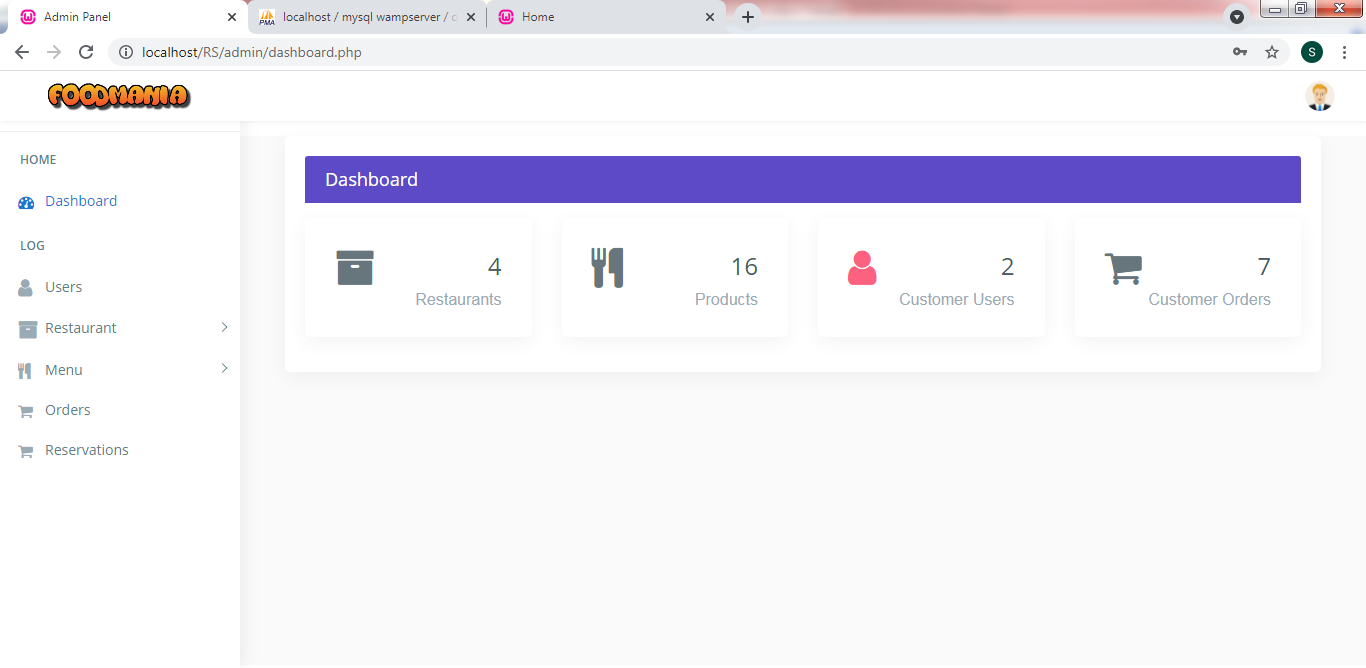
Admin Dashboard:

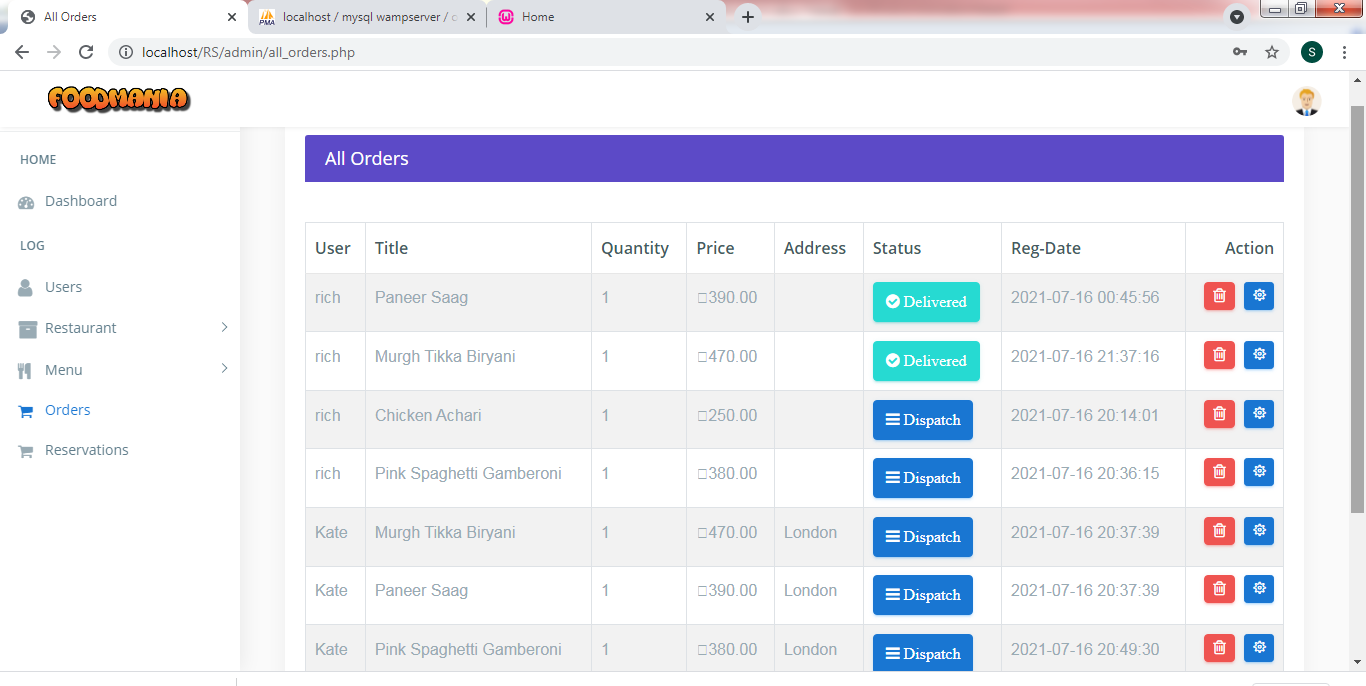
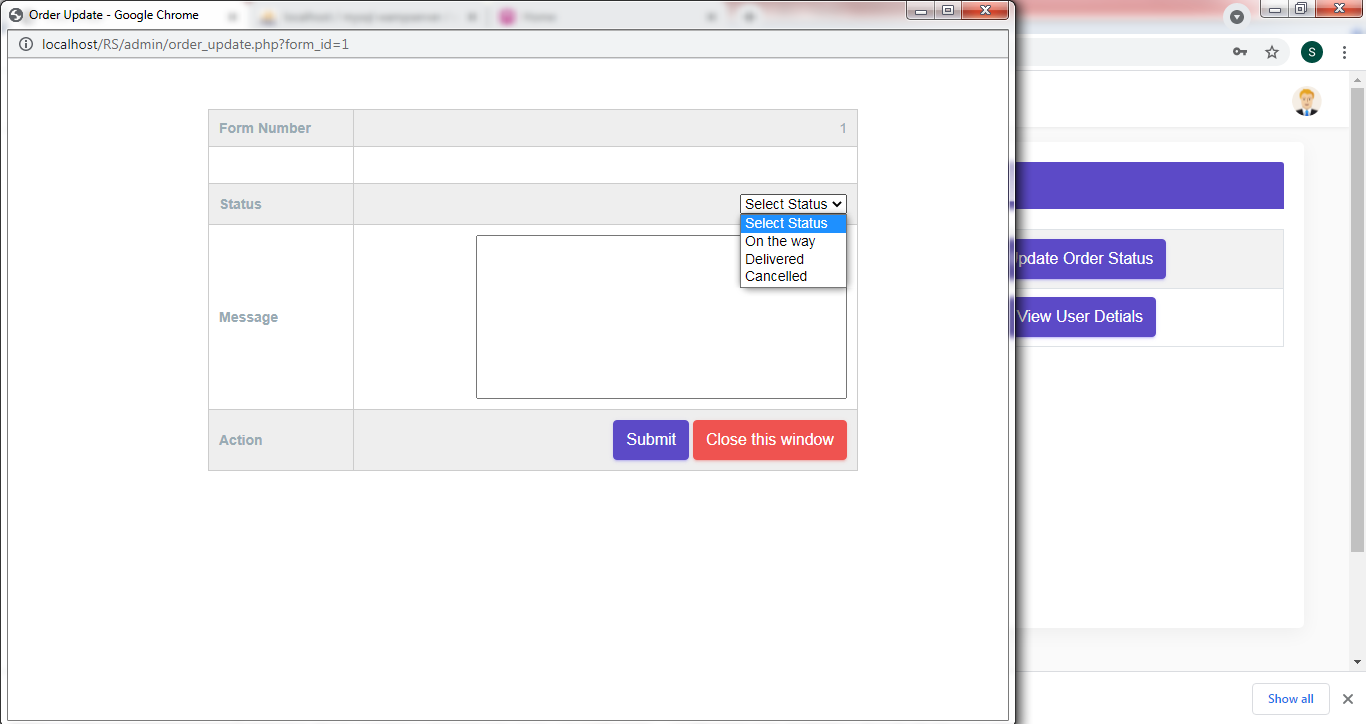
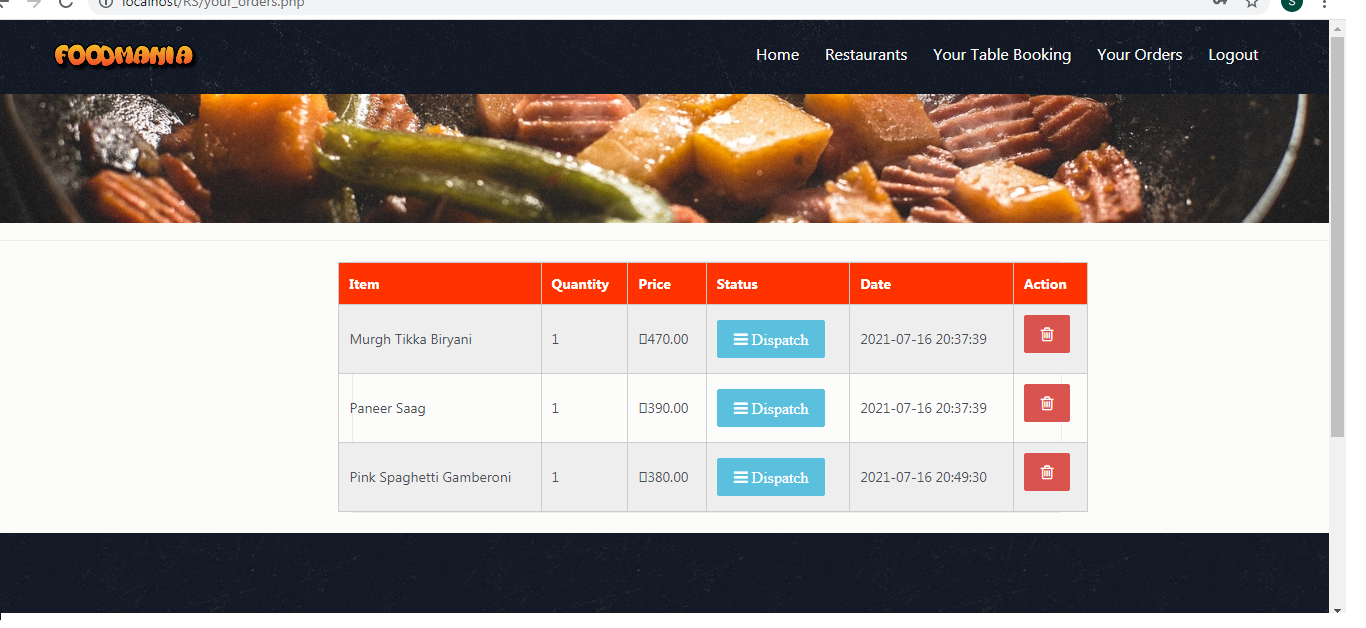
All Orders Details Page:

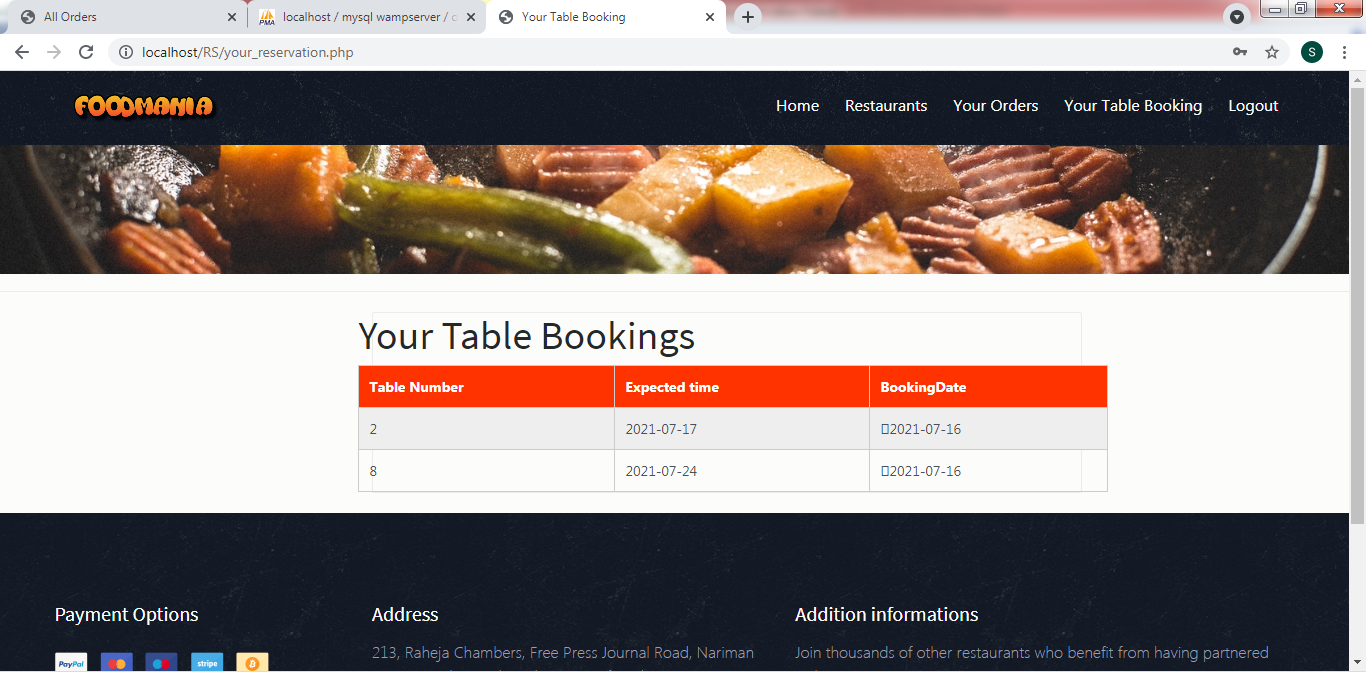
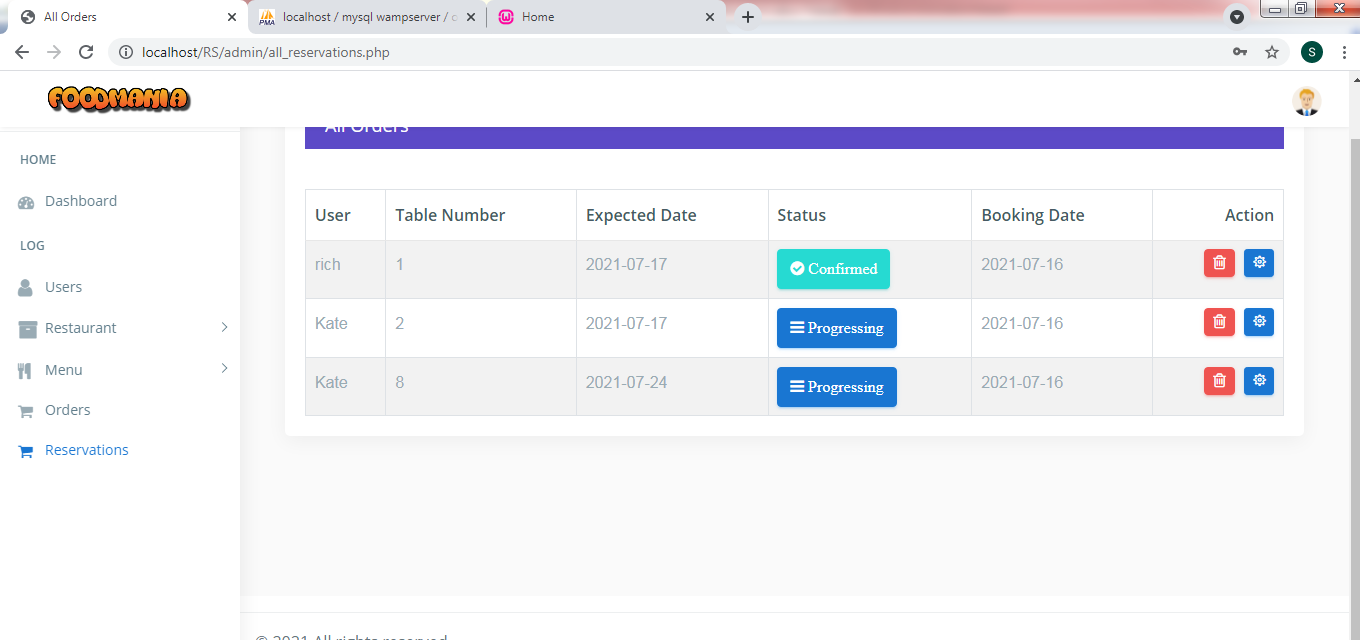
Restaurant Management Table booking Admin Page:

Popular Dishes Page:

Here you can freely download the complete Restaurant Management System project Source code with both MySQL and MSAccess database code, User Manual Report.

Library Management System Database Project using PHP & MySQL/MS Access

EXECUTIVE SUMMARY

Libraries are popular places where there are numerous books to keep track of. Not only books but the librarian is also required to keep track of users, books that were taken, due dates, etc. Making manual entries and keeping track of due dates is not easy when the user’s size is more. It becomes complex when there are numerous books and when the members of the library are increasing. Tracking members and books details become time-consuming and are prone to error. Thus, the objective of the project is to come up with easy to use and user-friendly database management application that helps the librarian with all the tasks related to efficient library management.

The application is expected to be a secure, user-friendly, and easy-to-use database application for library management, that is capable of performing library tasks like adding books, searching books, issuing books, returning books, and generating fines and reports. The application is expected to simplify the librarian tasks, reduce errors in bookkeeping, and make the task interactive and interesting.  

The project management and development shall be iterative and shall employ the RAD application development methodology. The rapid Application Development methodology is a fast way of completing a project prototype with more emphasis on the design phase and application development. With RAD in use, the application development shall be broken down into smaller tasks that are easily manageable and monitored.

At the end of the project, there shall be a live web-based application with an easy-to-use and rich navigational front end designed with JavaScript and PHP and a back end with My SQL. Both platforms are open-free and thus making applications cost-effective.

PROJECT PROPOSAL

1.     Statement of Work

1.1  Project Background

Database management systems have become vital for organizations to manage large databases and to perform transactions upon such large data. These database applications not only store data, but also manage them, synchronize them, and help in information retrieval without errors. They reduce manual efforts and enhance the quality of information retrieval services. Due to this reason, they are widely used in almost all sectors. Libraries are popular places where there are numerous books to keep track of. Not only books but the librarian is also required to keep track of users, books that were taken, due dates, etc. Making manual entries and keeping track of due dates is not easy when the user’s size is more. Thus, this work implements a library management system database application that helps the librarian manage all tasks in an efficient and user-friendly manner.

1.2  Vision

The project vision is to come up with a library management system database application that does the jobs of the librarian like maintaining book records, maintaining user records, due dates, fines, etc. efficiently and in a quick time without errors.

1.3  Project Objective

The objective of the project is to come up with easy to use and user-friendly database management application that helps the librarian with all the tasks related to efficient library management.

1.4  Project Scope

The project scope is:

  • To have a user-friendly and easy-to-use database application for library management.
  • To have an application that secures data records.
  • To have an application that generates reports on books, due reports, fine reports, etc. easily.
  • To have an application that can track the user activities and their records easily.
  • To have an application that reduces the errors and efforts of the librarian.
  • The application shall have a login and password for allowing only authorized users to access the application.

1.5  Value proposition

This application shall reduce the manual errors and efforts of the librarian. It shall provide the end-user with the abstraction of all the database details and thus simplify the task as a set of small activities. It shall enhance the quality of the services of the library. It shall keep better track of book availability, dues, fines, etc., and enhance the quality of response to the user by the librarian. 

1.6  Technical details

Existing system:

Currently, the library system in use is a mixture of both file-based and manual-based work. Excel files are used to keep records of books, library users, and library user transactions. With such a system the key challenges are

  • More duplicate records as there is no control on duplicity.
  • inconsistent records are more as there is no referential integrity control
  • Time-consuming tasks as a simple tasks may require extensive search and a lot of entries.
  • such a system is prone to errors due to inconsistencies in data
  • Lack of user-friendly GUI: the system lacks a GUI that facilitates the end-user by providing an abstraction of the back end. This abstraction of the backend makes the end-user efficiently do his or her job without worrying about other details.
  • Data loss risk: if the data is lost it becomes impossible to recover the data from excel files.
  • Generating reports of books or users with fines becomes difficult and time-consuming as it requires multiple worksheets to be navigated and used. Due to the cumbersome job, the accuracy of the reports is low.

Thus, it is proposed to come up with an efficient, user-friendly, library management system that makes end-user tasks easy, error-free, and fast. The system shall follow the norms of a database management system ensuring integrity, consistency, and no duplicates of data.

Thus, the system shall have a simple to use GUI as the front end. Database application shall be developed using My SQL. The front-end JavaScript & PHP. The operating system is Microsoft Windows 7 and above with either 32 or 63 bits configuration.

1.7  Challenges

The Key challenges the project development may face are as follows:

  • The existing data from excel can be imported to MY SQL database. But to ensure referential integrity of the data it is essential that the database follows norms of having the primary key, removing duplicates ensuring consistency, etc. Thus, it may require the excel data to pre-process, convert and then migrate it to MY SQL.
  • The end-user may be new to GUI and API usage. Thus, there may be a need to train the end-user with the application.
  • Issues may arise from front-end and back-end connectivity. This can be managed through proper coding.
  • The system development may face hurdles if its development process is not managed and monitored properly. It is essential to have a Gantt chart with proper milestones to monitor the activities.

1.8  Organization of the proposal

This project proposal is divided into sections. The first section was a background of the project giving details on its vision, value proposition, objectives, and scope.

Sections 2 to 6 details are as follows:

  • Section 2: This section gives in detail the project methodology and the implementation plan. In this section the database design principles and methodology employed is elaborated, the way the application is developed is defined and the key areas of the application along with key features and functionalities are explained through various diagrams. It shall also contain the test plans for the application.
  • Section 3: This section defines the key deliverables from this project. It thus gives details on what the project shall give for a specified set of inputs and how the result is used.
  • Section 4: This section defines how the application project management shall be carried out. It shall give details of the milestones to be achieved and details on project monitoring and evaluation.
  • Section 5:This section gives details on the project team and their roles
  • Section 6: This section is about the tools and the supporting platforms that make the application implementation possible.

2.     Methodology and Implementation Plan

The database design and implementation process shall be done on the MySQL database management platform. The project management and development shall be iterative and shall employ the RAD application development methodology. The rapid Application Development methodology is a fast way of completing a project prototype with more emphasis on the design phase and application development. With RAD in use, the application development shall be broken down into smaller tasks that are easily manageable and monitored. With regular communication and feedback among the team, the application development becomes faster and more efficient with RAD. The key phases of application development thus are as follows:

  1. Requirement analysis
  2. Application Design
  3. Rapid construction & Testing
  4. Going live

2.1  Requirements Analysis

This is the first phase of the application development lifecycle. The objective of this phase is to gather the end-user requirements and the expectations of the stakeholders from the library management system. These are listed in the form of functional and non-functional requirements.

Functional requirements

  1. Login/logout: The application should provide user-based login and logout mechanism. Thus authorized users can login into the system.
  2. Add book: This shall allow the librarian to add the book record into the database.
  3. Manage book: This shall allow the librarian to edit or delete any book record in the database.
  4. Search book: This shall allow the user to search for a book through book name, author name, or both.
  5. View book: This shall allow viewing all the books, new books, old books, damaged books, lost books.
  6. Issue Book: This shall make an entry of the member with the books browed and the due to return.
  7. Accept Return book: This shall enter the return date and ensure that the book is successfully returned.
  8. View issued books: This shall list the books that have been borrowed with their member name and due date.
  9. View returned books: This shall consist of lists of returned books.
  10. Add member: This shall help the librarian to add a new member and categorize them.
  11. Manage members: This shall make changes in the member record like deactivating them, deleting them, and editing their information.
  12. Search member: this shall help in searching the library member record
  13. View fine details: This shall generate a fine for those borrowed books with member details that skipped their due dates.
  14. Generate report: this shall allow the system admin to generate user reports, book reports, borrower reports, fine list reports, etc., and download them.

Non-functional requirements

  1. Security: the application should endure data security and user access security.
  2. Navigational requirement: The navigational options of the system should be user-friendly and easy to use.
  3. Database requirements: The database should be accessed by only secure and authorized users. The database should be available, consistent, have no duplicate entries, and should give error-free output.
  4. Performance requirement: the system should be responding with a proper message thus giving an idea to the user of the interactions.

Use case diagram

Following is the use case diagram of the system

Figure 1: Use case diagram

Activity diagram: Consider the process of adding a book record

The steps of adding the book record to the database are as follows:

Figure 2: Activity diagram

1.1  Conceptual Design

ER diagram for the Library Management System

Figure 4: ER Diagram

1.2  DBMS cost/benefit analysis

The technology that shall be used for the proposed system is the MySQL database management system. It is used because it is simple to use, supports a large database system, and has compatibility with various programming languages that can support the front-end design.

The front-end technology relies on JavaScript and PHP. These are selected as they offer good design options, navigational options, making the user interface interactive and more appealing. Thus, with consideration to having a good and user-friendly interface, these technologies are selected.

The other options were to use the Oracle database management system and MS Access database management system. But MS access system was ruled out due to its failure to support large databases and its difficulty in providing front-end connection to programing and scripting languages like PHP. Oracle was ruled out as it is tough to use and is costly when compared to MY SQL which is free and open source.

Product

Cost

Option 1 Oracle

Standard Edition One – $5,800 per unit (sockets)

Option 2 MS Access

$109.99 per license

Option 3 My SQL

Free


Front end option 1 Java and swings

Free but requires programming expertise

Front end option 2 PHP and Javascript

Free requires scripting expertise

Front end option 3 ASP.NET

Free requires scripting expertise


Based on the above and the available expertise, the project is built using MY SQL, PHP ad Java Scripts is selected.

1.3  Logical Design

The main tables proposed for the system are as follows:

User table:

User_id

Username

password

firstname

Lastname

Primary key int

Varchar(100)

Varchar(100)

Varchar(100)

Varchar(100)

Book table

book_id

Book_title

Author

Book_copies

Book_pub

Publisher_name

Isbn

Copyright_year

status

Category_id

Primary key int

Varchar(100)

Varchar(100)

int

Varchar(100)

Varchar(100)

Varchar(50)

int

Varchar(30)


Borrow

borrow_id

Date_borrow

Due_date

Member_id

Primary key int

Date

date

Int

Member

member_id

Firstname

lastname

Gender

contact

address

type

Status

Primary key int

Varchar(100)

Varchar(100)

Varchar(100)

Varchar(100)

Varchar(100)

Varchar(100)

Varchar(100)

Return

Return_id

Book-id

Borrow_id

Borrow_status

Date_return

Fine

Primary key int

int

Int

Varchar(100)

Date

int

1.4  Physical Design

The proposed system shall have a user interface form designed and developed using JavaScript and PHP scripting languages. The key issue in this design is the special emphasis on navigational options, proper usage of arrows and icons so that the user can operate the system without any hurdles. The user navigation should give control freedom to the user. It should not be complex and should be user-friendly.

The database backend is designed and developed using MySQL. It can be problematic to establish front and back-end connectivity while using the application. Thus, in such a case proper commands for the connection must be established.

1.5  Prototype

A sample prototype is as follows:

Front end admin login screen

Front end admin login screen

Back end book table

Adding books

Adding members

1.6  Performance Evaluation

The Project is successful only if it is capable of giving expected results. Thus, the application is to be tested to ensure that it is executing as per expected objectives. The proposed application shall be using black-box testing wherein test cases shall be built and executed. The test cases shall test the user interfaces and each use case. If the expected results are achieved the application shall be assumed to be error-free and ready for launch. Otherwise, the test result recommendations shall be implemented.

2.     Expected Result

At the end of the project completion following things shall be expected:

  • A back end designed and developed in MySQL with tables for users, members, books, return records, borrowing records, searching capabilities, and report generation.
  • A front end that is user-friendly, rich with icons, and is appealing to use. The front end shall be designed so that the user can perform the actions without any issues.
  • A fully functional application with both front end and back end connectivity capable of doing all the said tasks of use cases.
  • An application manual describing the ways to use the application
  • A cost-benefit analysis describing the feasibility of the product in economic terms.
  • A requirement analysis documents and work breakdown structure.
  • A complete coding and scripting file
  • A test project report giving details of project implementation and test results.
  • Final project document

3.     Project Management Approaches & Milestones

The objective of project management is to ensure that the project development is planned well and executed properly to ensure quality and timely delivery.  For proper management of the application development, the project development process is broken down into small tasks. Each task is grouped as milestones. For each milestone, a deadline is assigned and an expected outcome checklist is prepared.

Once a milestone is reached, the checklist is evaluated and the reviews are done with the team members. The outcome of the checklist evaluations and the review are recommended and implemented to ensure that the project is meeting its quality standards.

To ensure the tasks are executed on time a Gantt chart is used. The Gantt chart for the project is as follows:

Figure 4: Gantt Chart

Here you can download the entire project source code, User Manual Report.

Student School Record Keeping System Application Database Project

Project Background

Efficient management of student-related information becomes challenging for any educational organization when the volume of data and operations over that data increases. Information systems and database systems are the needed tools that help in the efficient management of such large volumes of data. These systems not only manage the data but even help in the easy retrieval and processing of useful information.

Vision

This project work vision is thus to come up with an efficient database management system that is capable of maintaining student records for an educational organization.

Project Objective

The objective of designing and implementing such a database management system is to manage the student records in a proper and organized manner, enable data flow and information flow among various activities related to student information processing, and secure the student data.

The project scope is as follows:

  • To come up with an efficient database management application for student record management.
  • The application shall help to add student records like their personal information, fees-related information, scholarship-related information, course-related information, and marks-related information.
  • the application shall allow to edit or delete any student record based on authorized permission
  • The application shall allow generating reports like marks statistics, feed duellist of students, etc.
  • The application shall have access based on authorization and role-based authorization shall be enabled for read and write processes.
  • The key information like payment, and a password shall be stored in encrypted form for security purposes.

Value proposition

This database application shall help the educational organization to keep track of all the student records and manage them in a more efficient manner. It shall reduce the number of manual errors, do the student record processing task in quick time and thus reduce human effort. It shall enhance the student and teacher experience in generating reports and getting key notifications.

Technical development plan

The existing system makes use of excel based records. These are file-based systems. The biggest challenge in this system is that there are more duplicate records due to the lack of any control mechanisms that control duplicates. Database management system makes use of a primary key that is unique and it is capable of identifying any unique record. Thus, it is a way of eliminating duplicates.

The existing system is not user-friendly to use as they lack user-friendly APIs. With supporting scripting languages like PHP, CSS, and Java Script it is possible to come up with an interactive GUI. Such GUI helps the user to do the tasks in a more efficient manner.

Thus, the proposed system shall make use of the following:

Front end: PHP

Back end: MySQL

Web Server: Wamp server

Operating system: Windows 7 and above.

Development Methodology

The application development shall adopt the Rapid application development methodology and develop the application in a small set of tasks. The objective shall be to come up with a rapid prototype and iterate it as per the testing results. The development process shall begin from starting from system requirements, system design, coding, testing & debugging implementation & maintenance. It shall be an iterative process.

The development tasks shall be small manageable tasks. This shall make project monitoring and management easier.

Requirements Analysis

The first functional requirement of the project is to have an application capable of adding and managing student records.

Thus, the application should allow Admin to do the following

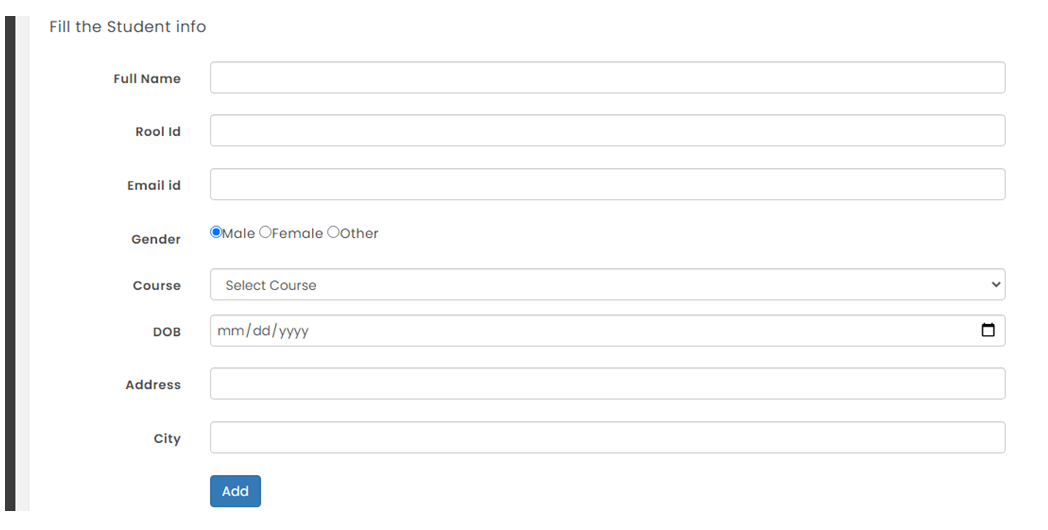
  • Add student: to should allow the admin to add student details like name, enrolment id, contact address, course enrolled, subjects, date of birth, address, gender, and other details.
Activity diagram depicting adding or deleting student

Figure 1: Activity diagram depicting adding or deleting student

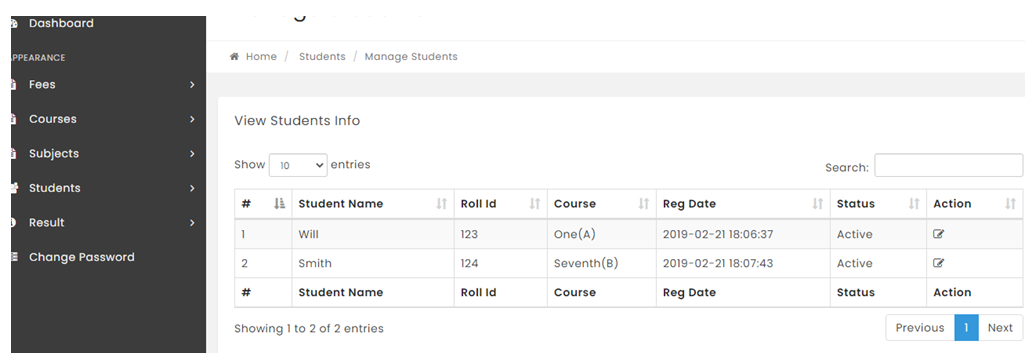
  • Manage student: to allow the admin to view student records, delete existing student records, and edit or update any existing student records.
  • The application should allow the admin to add marks, manage marks and generate a result
  • The admin can add subject or course details.
  • The application should allow the admin to generate lists of students who have not paid fees and those who have availed of scholarships.
  • Manage user records and change passwords

Students can do the following:

  • The application should allow students to register,
  • view result and download result

Conceptual diagram

Student record system overall architectural diagram

Figure 2: Student record system overall architectural diagram

Tasks of Students and Admin are explained in the figure below:

Figure 3: Task in detail

Interview Questions

With front-end designer:

  • What entries are needed for a student form wherein details can be entered?
  • What entries are needed for the resulting form so that admin can add marks for the students?
  • What entries are needed for the course and subject form?

With back-end designer:

  • What columns should be used for a student table, result-in table, course table, user table, and fees table?
  • Which column should be the primary key to help in unique row identification?
  • How to connect the front end and back end?

Tables

Student table:

Student_id

first name

last name

gender

age

Date of birth

Contact no

address

City

CourseId

email

Password

Primary Key Varchar (10) Unique

Varchar (30)

Varchar (30)

Varchar (30)

int

date

int

Varchar (100)

Varchar (30)

Varchar (30)

Varchar (30)

Varchar (30)

Course table:

Course_id

Course name

Subjects

Primary Key Varchar (10) Unique

Varchar (30)

Varchar (30)

Subject table:

Subject_id

Subject name

Course_id

Primary Key Varchar (10) Unique

Varchar (30)

Varchar (30)

User table:

User_id

username

password

role

Primary Key Varchar (10) Unique

Varchar (30)

Varchar (30)

Varchar (30)

Result table:

Result_id

Student_id

first name

last name

Course_id

Subject_id

Marks obtained

Total marks

Grade

Primary Key Varchar (10) Unique

Varchar (30)

Varchar (30)


Varchar (30)

Varchar (30)

Int

int

Int

Student Record System Application Manual

Software required: Wamp Server, MS Access, ODBC driver, and Windows 7 or above operating system

  1. Extract the Zip file as an SRS folder.
  2. Install Wamp server
  3. In the www folder of the Wamp server Copy and paste SRS complete folder
  4. Open the Wamp server and start all the services
  5. The SRS folder has a database file named srms.mdb file.
  6. Open odbc driver by clicking on data sources.
  7. Click Add and select Microsoft Access Driver .mdb and accdb.
  8. Enter the Data source name as srms and select the folder path where the srms.mdb file is i.e. C:wamp/www/SRA/srms.mdb
  9. Click finish and see that the srms.mdb is listed as the new database.
  10. Now open a web browser and type URL localhost/SRS

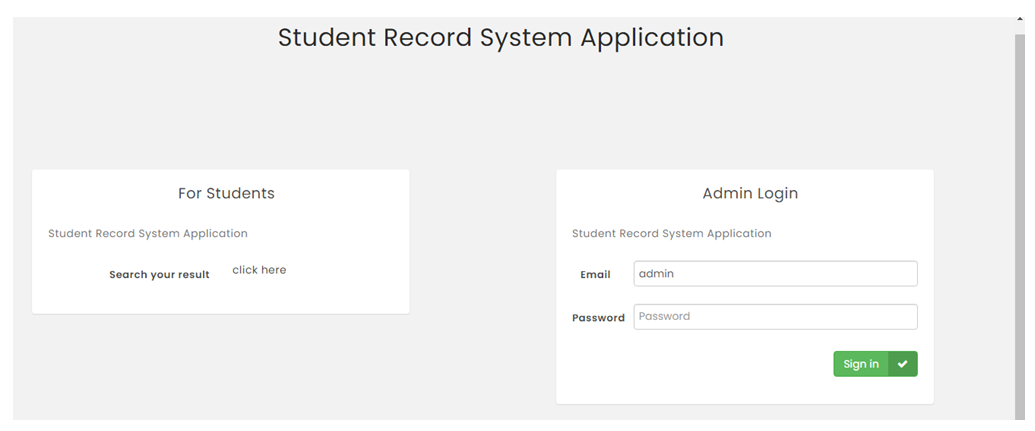
This shall open the home page

  1. The admin can enter the application through username and password as admin and admin

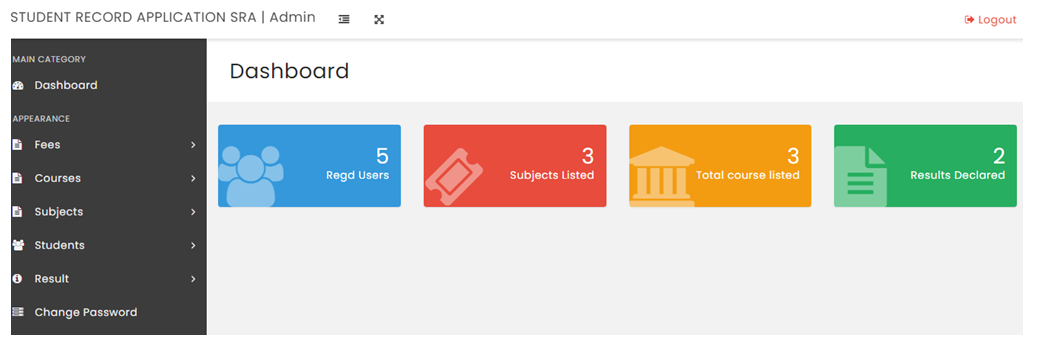
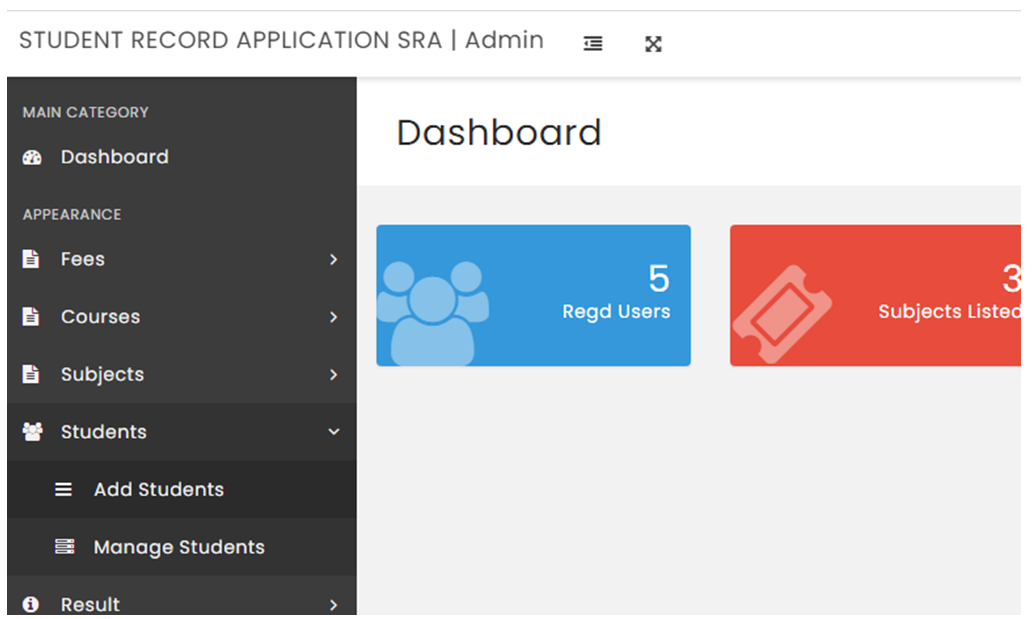
  1. From the dashboard the admin can navigate to any sections like course, fees, subjects, students, results, etc.

For example Admin wants to add a student

  1. The student form opens wherein the student details can be entered.

In this way results, courses, subjects, etc can be added and updated.

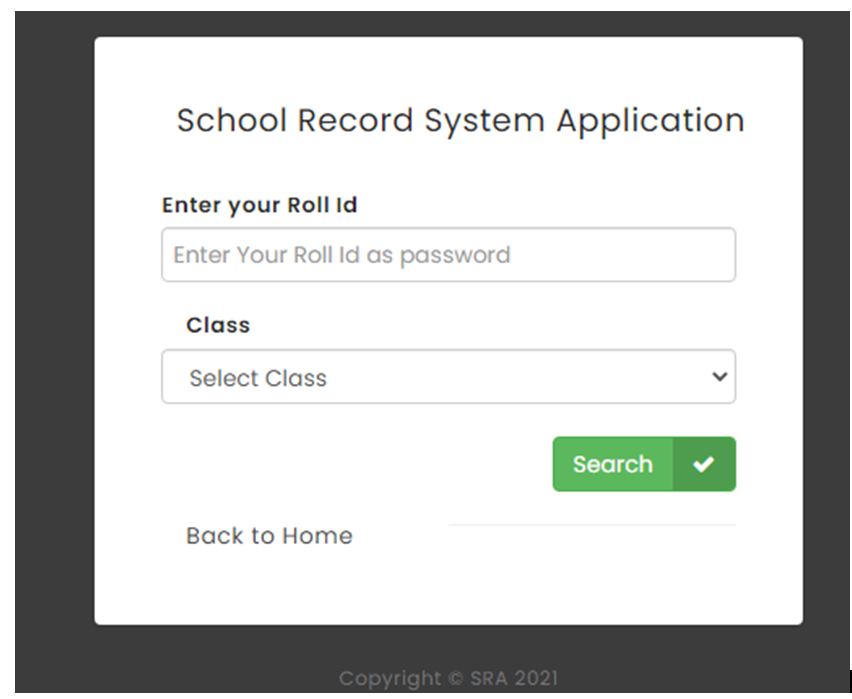
On the student end, the student can enter the application through the Roll number as a password and select the class from the dropdown list.

  1. On entering details if the results are not ready you get

Otherwise

From where the result file can be downloaded.

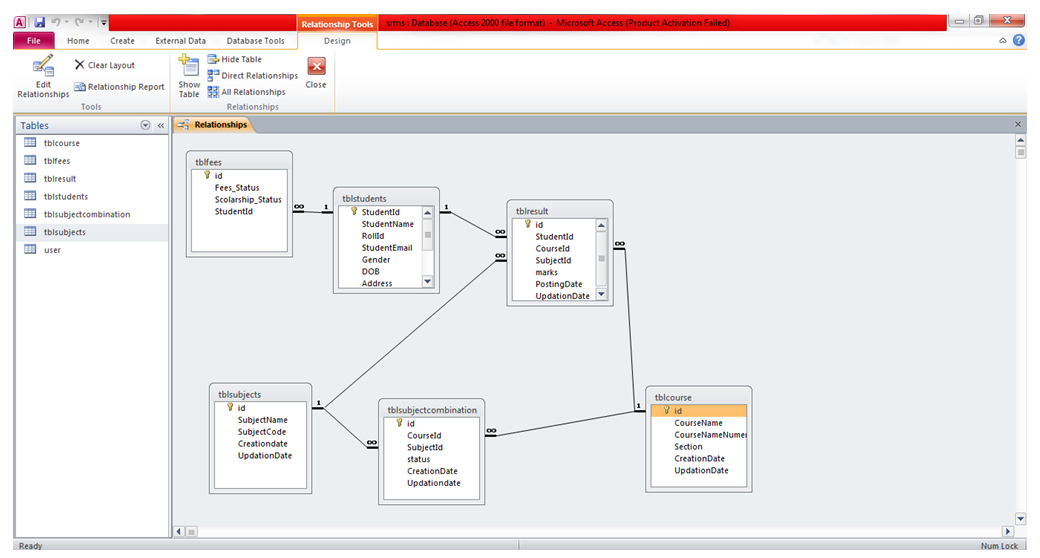
ER DIAGRAM

Download Student School Record Keeping System Application Database PHP, MySQL, and MSAccess Project Code and Database.

Teachers Tracking system using Android APP

Nowadays there are many cases of teachers leaving school by signing in registers. Faking attendance is becoming common practice for teachers all over the country. Officials are not provided with a proper solution to solve this problem. This project explains an android application that is used to track the teachers working in schools and colleges. This application works on android mobile. The android application is based on GPS and SMS services in Android mobile.

The GPS service is used for tracking the exact location of the teacher. The GPS-based systems are used to track the location of teachers where GPS services are taken from google maps API. This application is divided into two modules admin and teacher, each module will have an android app with different features.

Admin can set location details for each teacher which are the location of school boundaries longitude and latitude values. When the teacher reaches that location admin will receive a notification on the android app. In this method, the admin can track each teacher’s position and improve efficiency in managing teachers in the govt education system. 

Project objective:

  • Developing an android application that can help govt education department to manage teachers in colleges and schools more effectively by tracking and getting notifications of each teacher when they leave school or college and improve education standards. 

Existing system:

  • Colleges and schools use attendance books as proof knowing if teachers are attending schools or colleges regularly based on this data employee’s salaries and other factors are calculated. But most of the teachers are manipulating attendance by signing records and leaving schools and colleges. 

Disadvantages:

  • Attendance books with signature data are only considered as proof for teachers which can be manipulated in various ways.
  • Employee tracking data is not managed in a database for further reference.
  • There is no proof for teachers tracking information.
  • Existing applications are developed for tracking family members or tracking children and finding the destination of the user based on longitude and latitude values. 

Proposed System:

  • In the proposed system, two applications are designed one for admin and one for teachers. Both of these modules will use Google GPS services from Google Maps. Live locations are always tracked in the teacher’s module where a notification system is available for admin. Admin sets locations for each teacher (school or college boundary locations) based on these values every time teachers’ longitude and latitude values are tracked and compared with existing values in the database. If longitude values are matched then the notification is sent to admin. 

Advantages:

  • Easy to track with proof of each teacher who is leaving school or college.
  • Teachers’ attendance can be increased.

SOFTWARE REQUIREMENTS: 

  • Operating system:           Windows 7.
  • Coding Language:           JAVA
  • Tool:           Android Studio
  • Database:           SQLite 

Detecting Impersonators in Examination Centres using AI


Detecting impersonators in examination halls is important to provide a better way of examination handling system which can help in reducing malpractices happening in examination centers.  According to the latest news reports, 56 JEE candidates who are potential impersonators were detected by a national testing agency. In order to solve this problem, an effective method is required with less manpower.

With the advancement of machine learning and AI technology, it is easy to solve this problem. In this project we are developing an AI system where images of students are collected with names and hall ticket numbers are pre-trained using the KDTree algorithm and the model is saved. Whenever a student enters the classroom, the student should look at the camera and enter class, after the given time or class is filled the student’s information will store in a  video file with the student’s name and hall ticket no. The video will have a user with a hall ticket no and name on each face. If the admin finds any unknown user tag on the face admin can recheck and trace impersonators. 

Problem statement:

Detecting impersonators in examination halls is important to provide a better way of examination handling system which can help in reducing malpractices happening in examination centers.  According to the latest news reports, 56 JEE candidates who are potential impersonators were detected by a national testing agency.

Existing system:

Information given in the hall ticket is used as verification to check if the student is the impersonator or not.  Manual security checks performed are not perfect and sometimes students can even change images from the hall ticket.    

Advantages:

Manual verification methods are used for checking personally for each student which is not possible to check each student personally.

Chances of changing images from hall tickets are possible which doesn’t have a verification method.

Proposed system:

  • In the proposed system initially, images of each student are collected and each dataset consists of 50 images of each student. These images are trained using kdtree algorithm using the image processing technique and the model is saved in the system this model can be used for automatic prediction of students in exam halls from live video or images. 

Advantages:

  • The student verification process is fast and accurate with the least effort. Reduces impersonator’s issue with live verification.
  • The time taken for prediction and processing is less and prediction is done automatically using a trained model.
  • A trained model can be used to track live video and automates the process of detecting students at exam centers and display them in the video.  

SOFTWARE REQUIREMENT: 

  •  Operating system:           Windows XP/7/10
  • Coding Language:           python

  • Development Kit             anaconda

  • Library:     Keras, OpenCV

  • Dataset:   any student’s dataset

Movie Character Recognition From Video And Images Project

Live tracking of characters from movies is important for automating the process of classification for user-friendly information management systems like online platforms where characters in a movie can be seen before watching the movie. At present manual method is used which can be automated using this movie character classification method. The objective of this work is to collect a dataset of any movie characters and train a model which captures the facial features of all characters and the model is saved for prediction. 

For testing purposes, a real-time live video can be used to track characters. This application also works for images where users can give input as images of trained movie characters and get results with character names on the image as output. In this project for training dataset KDTree, the algorithm is used which takes images from a given folder and trains each image and saves the model into a dump file in the system. In the second stage using this trained model input image or input video is predicted with the model and the result is shown as a video or image.

Problem statement:

Classification of characters for each movie manually is a time taking process and the database should be managed.

Objective:

The objective of this project is to develop an automatic classification of characters after training from the dataset. If the one-time model is created it can be used for prediction at any time from images or video

Existing system:

In the existing system movie characters are managed in the database and which are used for displaying when required in this process database is the important to the time taken for processing is more.

Disadvantages:

  • The time taken for processing is more and the database should be managed and integrated with the required system whenever required.
  • This method includes the manual process of data collection and updating and deleting data. 

Proposed system:

In the proposed system initially, a dataset of respected move characters is collected and each dataset consists of 50 images. These images are trained using the KDDTree algorithm using the image processing technique and the model is saved in the system this model can be used for the automatic prediction of characters from live video or images.

Advantages:

  • The time taken for prediction and processing is less and prediction is done automatically using a trained model.
  • A trained model can be used to track live video and automates the process of detecting characters and displays on screens.

SOFTWARE REQUIREMENTS:

 Operating system:           Windows XP/7/10

  • Coding Language:  Python
  • Development Kit: Anaconda
  • Library:   TensorFlow, Keras, OpenCV
  • Dataset:  Any movie dataset

Canteen Automation System using NLTK and Machine Learning

The canteen automation system project is designed to select the food items from a web application with cost, time of cooking, and give rating for products. This application is designed to help students to order food items without giving orders to waiters or going to the counter and giving orders. Most of the colleges don’t have order-taking system students should directly reach the counter and give an order which is time taking process in order to solve this problem this online order-booking system is designed.

As there will be many students who will be giving orders from different departments as a web application is designed with multiple admins, each department will have one admin who will take request and process request. Another problem is best food from today’s canteen menu can be known by checking ratings given by other users based on that students can give orders. Students can also give reviews for each food item along with ratings. NLT is used to calculate the sentiment of each review by taking the yelp dataset and applying machine learning and NLTK to calculate sentiment and store it in the database.

Proposed system:

  • In the proposed system food ordering is done online and each department has its own admin who handles requests on daily basis, users can give a rating of food items which will help other students to select the food item from the list. Sentiment analysis using Yelp data set and NLTK and Machine learning are used to store the sentiment of each review given by the student.

Advantages:

  • Helps students to give orders from any location inside the campus and save time by reaching the canteen based on the given cooking time from the application.
  • Sentiment analysis is done for reviews using NLTK and Machine Learning. Sentiment and Rating are useful for students to select food items.

SOFTWARE REQUIREMENTS:

 Operating system:  Windows XP/7/10

  • Coding Language:  Html, JavaScript,  
  • Development Kit:  Flask Framework
  • Database:  MySQL
  • Dataset:  YELP
  • IDE:  Anaconda prompt