
A Study on Facebook Audience Insights MBA Digital Marketing Project

Title: A Study on Facebook Audience Insights MBA Digital Marketing Project

Purpose

  1. Learn how to use Facebook Audience Insights for market research.
  2. Identify the experiences of people using Facebook Insights for their business or Pages.

Restrictions

This study focuses on Facebook Audience Insights in social networks. Due to the limited time of the investigation, the researcher was unable to conduct the investigation on other social networks such as YouTube and Instagram. When it comes to research, one limitation that cannot be ignored is the research population. The sample size is limited for the research, so we cannot say that the result can be accurately applied to others.

Research Methodology

Basic information is collected by sending out an online questionnaire and contacting users from any Facebook audience who use it to promote your business or Page. Secondary research is carried out using articles and books that can be found on web resources. The theoretical part explains the main theories and opinions of various authors about Facebook ads.
Sample size – 70

Recommendation

Valuable feedback from respondents

  • Create a FB plan and do your research before you start advertising. It may seem easy and straightforward, but there are many ways to optimize it and get better results. Also, do a split test to see what works best for the results you’re trying to get.
  • Don’t worry about where the posts are, just understand that you will reach your customers and it doesn’t matter where they are, but if they see your ads.
  • Create and store multiple custom audiences through Facebook Audience Insights. Some of them prefer to do this than use the local audience tool inside the builder.
  • Experiment a bit before starting any major campaign. You can see how useful this can be if you have a larger organization, but that’s generally not a good thing. This can be useful if your goal is to learn about just one brand, but in most cases, it’s a pain for the user.
  • If you’re using Facebook Business Manager and Ads Manager, Facebook Audience Network is the only way to go. This saves all audiences and there is no other way to create ads without using this program.
  • Creating local or targeted ads using the Facebook Audience Network is great. This will allow you to create targeted content that will target your audience and increase your visibility, ultimately ensuring that your money is spent efficiently.
  • Take the time to research your network and observe the location. If your audience is very small, your ads may only show on third-party websites.
  • Try it on a limited budget. Do not use website clicks with this post; you will get more clicks. Don’t put too many actions on the average cost per click, because an apple cannot be compared to an apple.

Conclusion

Facebook Audience Insights provides access to valuable demographic and behavioral information that allows you to learn more about your audience and potential audience using the information they provide to Facebook. Using this information to not only target your advertising campaigns more effectively but also to build personas and communicate content marketing ideas, should be an important part of ensuring your strategy is informative. As a result, we can show our products or services to more relevant people and make them easier to lead and sell.
While there is no single way to conduct market research and determine if there is a real need for your product, Facebook Audience Insights, and Ads Manager are useful for their unique demographics or user behavior focus.

Download A Study on Facebook Audience Insights MBA Digital Marketing Project
BI Tools: A Synergetic Opportunity for Quality Decision Making and Organizational Growth in IT Organizations

The challenges of the study are to understand the impact of the BI tool on improving the quality of decision-making in IT organizations and how quality decision-making based on the BI tool can help improve organizational growth (business performance) in the IT industry. organizations

Objectives of the study

The objectives of the study are:

  • Study the impact of business intelligence tools on organizational growth (business performance).
  • To study the impact of quality decision-making and decision categories (operational, tactical, and strategic) on the basis of BI tools.
  • Study the use of different types of BI analysis in IT organizations.

The scope of the study

Powerful transaction-oriented information systems are now prevalent in every major industry, effectively leveling the playing field for corporations around the world. However, to remain competitive, analytical systems are now needed that will change the company’s ability to retrieve and use the information it already has. Business Intelligence (BI) has evolved over the last decade to rely more on real-time data. BI systems automatically initiate systematic actions based on rules and context to support various business processes.

These analytical systems derive insights from the large amount of data available, providing convincing, fact-based and actionable concepts. Today, business requires fast results. Therefore, today it is important not only to conduct business analysis, but also to take action to analyze the results and immediately change the parameters of business processes.

Teaching methodology

The study aims to describe the relationship between the BI tool and its impact on decision-making quality and organizational growth in information technology organizations using secondary data. Basic information is collected through a questionnaire survey. Secondary data is collected from various articles and annual reports of IT companies. Various numerical methods, such as percentage analysis, Freudman quadratic test, paired t-test, etc. are used to analyze data using the MS Excel tool.

Hypotheses

H10: No improvement in organizational growth (business performance)
After the implementation of the BI tool compared to before the implementation of the BI tool. (µ1 = µ2)
H11: There is a significant improvement in organizational growth (business performance) after the introduction of the BI tool compared to the implementation of the BI tool. (µ1 ≠ µ2)

H20: There is no difference in the preference of IT companies to use BI tools with reference to the decision-making categories in the organization.
H21: There is a significant difference in the preference of IT companies to use BI tools with reference to the decision-making categories in the organization.

H30: There is no difference in the priority of application areas for BI analysis.
H31: There is a significant difference in the preference for areas of application for BI analysis.

Limitations of the study

The research is limited to IT organizations that provide services and software in the field of information technology and does not include organizations that provide BPO, BPM, ITeS, hardware, data center, engineering design, education, and training services.

Research is limited to IT organizations that use BI tools for research reporting, analysis, and decision-making.

Download the complete project report on BI Tools: A Synergetic Opportunity for Quality Decision Making and Organizational Growth in IT Organizations.

Nearby Hotels Python Web Application

This is a simple web application that can be used to search hotels. This application will help in searching nearby hotels and also give weather reports of that place such that they can know the weather details priorly to near that hotel in order to travel. A currency converter is included with which everyone can view hotel prices in their desired currency. Additionally, discount coupons are included, which will help user to access the cheapest hotels nearby.

API’s to be used:

Google maps:

The google maps API fetches the data from google e.g. here Maps API is a server that returns information about a place, an establishment, a geographical location, or a prominent point of interest using an HTTP request. Methods are available for place search, details, and autocomplete queries.

The place API returns in JSON format.

Currency converter:

Planning to use online currency converter API web services. This API allows covering the currency to whatever the users needed.

This API returns data in XML format.

Weather API:

This API forecast the weather near the hotels, which uses information from the Rapid API: this API has all the information like temperature, humidity, wind, etc..

This API returns data in JSON format.

Discount coupon:

Planning develops discount coupon API, which gives what best hotels are available nearby with the best discounts possible.

This API returns data in XML format.

Technologies used:

  • JavaScript
  • HTML
  • CSS
  • Nodejs
  • Python

Car Parking System Python Project

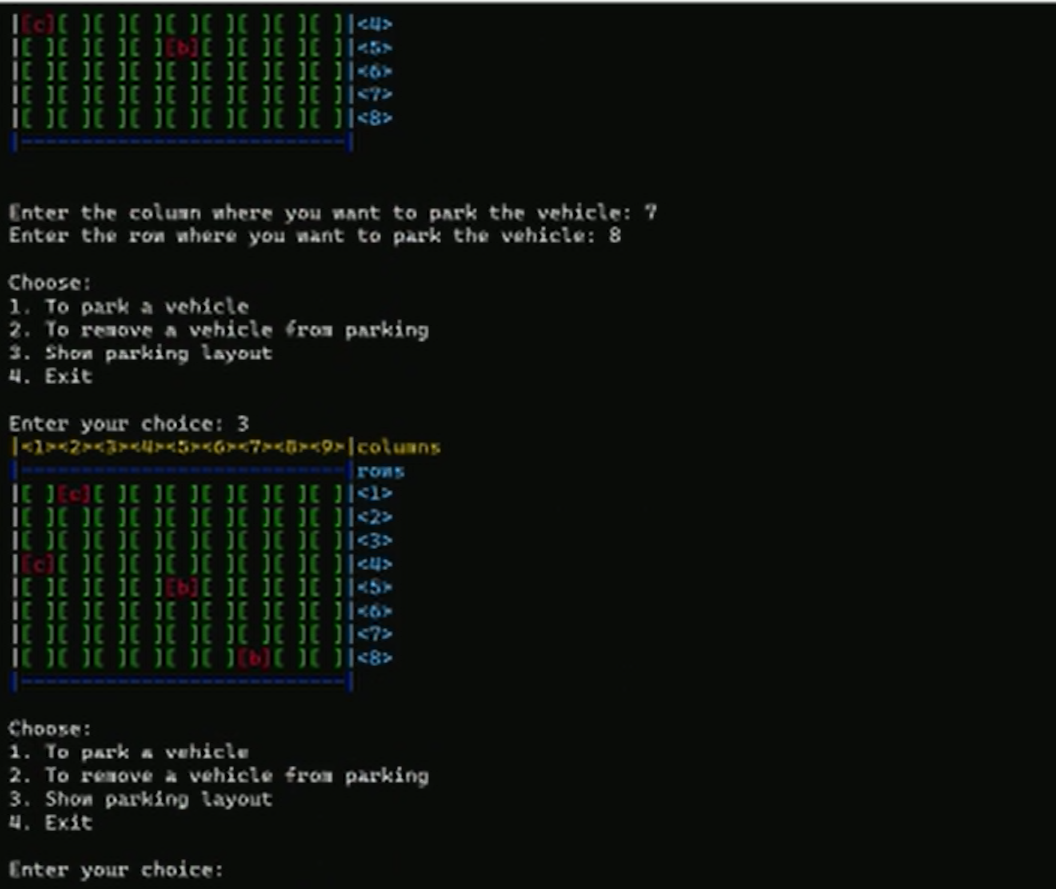
The python program should make a car park where it’s a 8×9 grid using [square brackets], the parking space should be filled with colours, and letters to signify its availability and which type of car is parked. For example bikes, trucks, cars, sports cars… etc.

Objectives of the Project:

  • Here the car parking needs to be a code which will make a car parking area.
  • There should be red and green light to indicate if it’s vacant or occupied.
  • [square brackets] should be used to show each parking spot
  • Use different letters to show what kind of vehicle is in the spot. For example car, truck, bike, cycle..etc.

Source Code:

import colorama

from termcolor import colored

options_message = """
Choose:
1. To park a vehicle
2. To remove a vehicle from parking
3. Show parking layout
4. Exit
"""


class Vehicle:

    def _init_(self, v_type, v_number):
        self.v_type = v_type
        self.v_number = v_number
        self.vehicle_types = {1: 'c', 2: 'b', 3: 't'}

    def _str_(self):
        return self.vehicle_types[self.v_type]


class Slot:

    def _init_(self):
        self.vehicle = None

    @property
    def is_empty(self):
        return self.vehicle is None


class Parking:

    def _init_(self, rows, columns):
        self.rows = rows
        self.columns = columns
        self.slots = self._get_slots(rows, columns)

    def start(self):
        while True:
            try:
                print(options_message)

                option = input("Enter your choice: ")

                if option == '1':
                    self._park_vehicle()

                if option == '2':
                    self._remove_vehicle()

                if option == '3':
                    self.show_layout()

                if option == '4':
                    break

            except ValueError as e:
                print(colored(f"An error occurred: {e}. Try again.", "red"))

        print(colored("Thanks for using our parking assistance system", "green"))

    def _park_vehicle(self):
        vehicle_type = self._get_safe_int("Available vehicle types: 1. Car\t2. Bike\t3. Truck.\nEnter your choice: ")

        if vehicle_type not in [1, 2, 3]:
            raise ValueError("Invalid vehicle type specified")

        vehicle_number = input("Enter vehicle name plate: ")
        if not vehicle_number:
            raise ValueError("Vehicle name plate cannot be empty.")
        vehicle = Vehicle(vehicle_type, vehicle_number)

        print('\n')
        print(colored(f"Slots available: {self._get_slot_count()}\n", "yellow"))
        self.show_layout()
        print('\n')

        col = self._get_safe_int("Enter the column where you want to park the vehicle: ")
        if col <= 0 or col > self.columns:
            raise ValueError("Invalid row or column number specified")

        row = self._get_safe_int("Enter the row where you want to park the vehicle: ")
        if row <= 0 or row > self.rows:
            raise ValueError("Invalid row number specified")

        slot = self.slots[row-1][col-1]
        if not slot.is_empty:
            raise ValueError("Slot is not empty. Please choose an empty slot.")

        slot.vehicle = vehicle

    def _remove_vehicle(self):
        vehicle_number = input("Enter the vehicle number that needs to be removed from parking slot: ")
        if not vehicle_number:
            raise ValueError("Vehicle number is required.")

        for row in self.slots:
            for slot in row:
                if slot.vehicle and slot.vehicle.v_number.lower() == vehicle_number.lower():
                    vehicle: Vehicle = slot.vehicle
                    slot.vehicle = None
                    print(colored(f"Vehicle with number '{vehicle.v_number}' removed from parking", "green"))
                    return
        else:
            raise ValueError("Vehicle not found.")

    def show_layout(self):
        col_info = [f'<{col}>' for col in range(1, self.columns + 1)]
        print(colored(f"|{''.join(col_info)}|columns", "yellow"))

        self._print_border(text="rows")

        for i, row in enumerate(self.slots, 1):
            string_to_printed = "|"
            for j, col in enumerate(row, 1):
                string_to_printed += colored(f"[{col.vehicle if col.vehicle else ' '}]",
                                             "red" if col.vehicle else "green")
            string_to_printed += colored(f"|<{i}>", "cyan")
            print(string_to_printed)

        self._print_border()

    def _print_border(self, text=""):
        print(colored(f"|{'-' * self.columns * 3}|{colored(text, 'cyan')}", "blue"))

    def _get_slot_count(self):
        count = 0
        for row in self.slots:
            for slot in row:
                if slot.is_empty:
                    count += 1
        return count

    @staticmethod
    def _get_slots(rows, columns):
        slots = []
        for row in range(0, rows):
            col_slot = []
            for col in range(0, columns):
                col_slot.append(Slot())
            slots.append(col_slot)
        return slots

    @staticmethod
    def _get_safe_int(message):
        try:
            val = int(input(message))
            return val
        except ValueError:
            raise ValueError("Value should be an integer only")


def main():
    try:
        print(colored("Welcome to the parking assistance system.", "green"))
        print(colored("First let's setup the parking system", "yellow"))
        rows = int(input("Enter the number of rows: "))
        columns = int(input("Enter the number of columns: "))

        print("Initializing parking")
        parking = Parking(rows, columns)
        parking.start()

    except ValueError:
        print("Rows and columns should be integers only.")

    except Exception as e:
        print(colored(f"An error occurred: {e}", "red"))


if _name_ == '_main_':
    colorama.init()  # To enable color visible in command prompt
    main()

A Study on Small Business in Cloud Technology with reference to IT Industry

STATEMENT OF PROBLEM

Cloud technology can bring long-distance businesses to large global markets and improve their prospects. Contribute to a more commercially secure business environment; identify and raise awareness of security, regulatory, and legal considerations related to cloud computing adoption; and increase the confidence of small businesses in the use of cloud computing in particular, and the digital economy in general

Objectives of the project:

Project studies address these objectives:

1. Internationalization of small businesses in the era of cloud services.
2. Know the benefits of cloud technology for small businesses
3. Identify criminal, regulatory, and legal risks to small businesses caused by cloud computing.

Conclusions:

Based on the discussion of the answers received by the companies surveyed, it can be concluded as follows:

  • It can be concluded that companies are not very aware of the use of cloud computing, but some of them do use local and branded ERP. The concept of cloud computing is new to India and has not received momentum till now
  • Company Cloud servers are in different locations, data privacy and security are considered major threats for both types of manufacturing industries.
  • Legal action on data leaks by host companies and their uninterrupted access is a gray area for cloud steers to address.
  • Manufacturing companies have accepted that cloud applications are cheaper than ERP installed on construction sites and that the quality of service steers the cloud is considered superior. Surprisingly, SSI has interpreted that the implementation of IT-Solutions increases costs.
  • The majority of mid-scale industries voted in favor of Clousteer-IT improving overall business performance and enriching the bottom line, while small-scale industry respondents opposed this revolutionary step.

Download the A Study on Small Business in Cloud Technology with reference to IT Industry MBA IT Project Report.

A Study on Pricing Strategies and Its Impact on Customer Purchase

Customer preference is an important element for all businesses in most industries. The retail industry has several types of preferences depending on the product. This study was conducted to get a better understanding of the preferences and satisfaction levels of Chennai silks. Chennai Silks branch gives a variety of collections, varieties, brands, etc., people only predict the success or failure of my project.
After a thorough review of the related literature, a questionnaire was developed to determine customer preferences and satisfaction levels. The questionnaire was distributed to customers inside the showroom and around the Hosur area.
Statistical tools, including percentages, chi-squares, and ANOVA analysis, are used to identify customer preferences and satisfaction levels. Based on the analysis and interpretation, conclusions for this research are formulated.

OBJECTIVES OF THE STUDY

Primary objectives:

Analyze pricing strategies and factors that affect customer preferences when buying.

Secondary objectives:

  • Determine customer buying behavior.
  • Define customer expectations.
  • Analyze advertising and promotional activities.
  • Monitor overall customer satisfaction.

SCOPE OF THE STUDY

  • To calculate the proposed objectives, the questionnaire is designed for people
  • The scope of this project is up to the customer’s preferred study of Chennai silks, such as varieties, collections, quality, brands, services.
  • The scope of research is limited in Hosur and surroundings.

LIMITATIONS OF THE STUDY

  • Many respondents are not willing to fill out the questionnaire and few are in a hurry.
  • Another problem that I faced is that people are hesitant to give information about their views freely.
  • Surveys are conducted only in Hosur, so results may vary in other parts of the city.
  • Sample size is limited to 300.

CONCLUSION

A survey of people has been conducted to find out the preferences of Chennai silks. It is observed that all the people prefer to buy Chennai silk than others. It is concluded that most people prefer Chennai silks for its quality, service, and atmosphere. Some people tend to like to shop with varieties, brands, etc.
Therefore, it can be concluded from the collected facts that most people refer to buying large packages of clothing of their choice, and sometimes some opt for small packages with the family.

Download the A Study on Pricing Strategies and Its Impact on Customer Purchase MBA Marketing project report

Brand Building of Heinz Tomato Ketchup in organized sector of India

Title of the Project: Brand Building of Heinz Tomato Ketchup in organized sector of India

Statement of the problem:

Heinz ketchup brand couldn’t be established in Indian ketchup market. After being in segment for last 16 year it covers very small portion of market size. Customers are less aware of the brand as a result customer base is also very small; Brand positioning is not effective, availability is limited which are the hinders to develop the brand

Objectives of the study:

This project is to find the market limitations of HTK, market opportunity, consumer base expansion & way to establish the goodwill among the customers.

  • This Project is to find the market limitations of HTK,

  • Market opportunities, consumer based expansions and the way to establish the goodwill among the customers.

  • To identify the consumer needs.

  • To know the brand image HTK

  • To measure the brand image towards HTK

  • To know the consumer attitude and demand towards the brand HTK

Explanation of the Method:

Basic methodology of primary data. Sample survey on consumers. Sample size will be minimum 50

Questionnaire (10 to 15 questions)

1. Name
2. Age
3. Contact No
4. Gender
5. Which part of India you belongs to
6. What kind of ketchup user you are
7. How the following factors influence your purchase decision making
8. Which Brand do you use
9. How familier you are with Heinz Kethcup Brand
10. Do you use Heinz Ketchup
11. Rate your overall satisfaction with Heinz Tomato Ketchup
12. How much you are aware of Heinz 100% natural feature
13. Have you ever noticed Heinz Ketchup Advertisement campaign
14. How effective the Advertisement campaign on the following parameter
15. Please specify your level of satisfaction of Heinz Ketchup on following parameters
16. Do you believe Heinz offers 100% Natural Ketchup
17. Are you ready to pay premium for 100% natural Ketchup
18. Would you try Heinz Ketchup

Chaptalization Scheme:

1. Heinz Tomato Ketchup overview
2. Ketchup market overview- Market size 1000 Cr
3. Major Brands in Product category
4. Market segmentation
5. HTK market share & opportunities
6. Marketing &Trade marketing
7. Distribution Expansion
8. Brand Positioning
9. Consumer Development
10. SWOT analysis
11. Brand Building
12. Data Analysis & Interpretation
13. Findings, Suggestions & Conclusion

Brand Auditing of Maruti in the Segment of Hatch Back Cars

The present study is aimed at understanding the Brand audit and preference towards Maruti Swift and Wagon R. The study is conducted to know brand preference for Maruti Swift and Wagon R. Both Descriptive and Exploratory Research has been used. This research is Descriptive in Nature partly because a well-structured questionnaire is used by taking the sample from  100 respondents for collecting primary data and  Exploratory by collecting secondary data using books, journals and other text material.

As the other competitors are entering the market with variant models with stylish designs and colors. There is the scope and potential for Maruti Swift and Wagon R to capture each segment with the majority of share by studying the behavior of the consumers at regular intervals with utmost perfection and coming up with solutions that enhance customer loyalty and satisfaction. It is suggested to the company to improve the sales of the product by increasing the brand image. It is also suggested that to improve the design, advertisements, and features of the product. Further, it is suggested to Maruti Swift and Wagon R come out with better promotional strategies in order to gain a considerable market share.

OBJECTIVES OF THE STUDY:

  • To study the brand preference towards Maruti Swift Cars.
  • To Study the brand preference towards Maruti Wagon R Cars.
  • To do a comparative study between the branding strategies and performance of Maruti Swift and Wagon R cars based on brand auditing.
  • To know the factors that influence in buying the Maruti swift and wagon R Cars.
  • To come out with suitable suggestions that may help in improving the brand preference of both the brands.

SCOPE OF THE STUDY:

The study focuses on the brand auditing of hatch back cars with a special focus on the Maruti Swift and Wagon R cars. The scope of the study is limited to the brand performance and preference of both brands. The study relies both on primary and secondary information related to the topic under study. The marketing variables will be considered understudy while studying brand auditing. The period of 45 days will be considered for the study.

RESEARCH METHODOLOGY:

Research Design:

  • The Research Design used in this Research is Descriptive and Exploratory Research.
  • This research is Descriptive in Nature partly because a well-structured questionnaire is used for collecting detailed research using a Questionnaire.
  • It is also exploratory as preliminary level research is to be conducted using Secondary data on the subject in hand.

 SAMPLE DESIGN:

Sampling Procedure:

 The Sampling Procedure used is Area Sampling.

Sampling Units:

All the consumers who have purchased Maruti Swift and Wagon R  form part of the Sampling units.

Sampling Frame:

The population for the study consists of Maruti Swift and Wagon R owners which were collected from the visiting Customers and the staff working in the showrooms.

Sampling Size:

The Sample Size taken for the study is 100 separately for  Maruti Swift and Wagon R.

 DATA COLLECTION SOURCES:

Primary Data:

The primary data was collected by Conducting Survey about the Consumer buying preference for Maruti Swift with the help of a structured Questionnaire in such a way that it was easily understood by the respondents.

The following is the list of dealers in Hyderabad from which data has been extracted:

Secondary Data:

The data was collected from various websites, the company’s literature, the Journal of Marketing, Automobile magazines, Articles from Business Newspapers like the Economic Times, Business Line, and other publications related to the subject under study. 

DATA ANALYSIS:

The Data analysis was done by using various data tools such as cross-tables, Charts, Graphs, and Percentages.

The study is aimed at finding out the consumer’s opinion towards Maruti Swift and Wagon R. The study would reveal the intensity of the gap between the company’s deliverance and the consumer’s expectation. The revelation of the study would keep the company informed about the consumer’s Buying Behaviour towards the four-wheeler segment and try to come up with solutions to the problems faced during purchasing and post-purchasing of Maruti Swift and Wagon R.

LIMITATIONS OF THE STUDY

  • The Research was conducted in Hyderabad City only.
  • The study is limited to Wagon R and Maruti Swift.
  • The sample size was limited to 100 respondents.
  • The views and purpose of respondents may change.
  • The Duration of the project is limited to approximately 45 days.

A Study of Cash Flow Analysis of Pharma Companies in India

The present study examines the Cash flow analysis of Pharma Companies during the period of 5 years. Financial ratios are applied in measuring the Cash flow performance and statistical as well as econometric techniques are employed in order to assess the behavior of the selected ratios. The study is done using the Balance sheet, Profit and loss account, and other financial information of the Pharmaceutical sector.

The analytical tools used for the study are ratio analysis and ANOVA for the five Pharmaceutical Companies. The financial information obtained was analyzed using the appropriate techniques and it was found that the Cash flow analysis level decreased in the year 2019 to compare the past years. The reason behind this is decreasing in inventories, sundry debtors, cash, and bank balance. The company liquidity ratio is more than the ideal ratio which shows that the company has no liquidity problem. The current Ratio was increasing and decreased from the year 2016-2020 the ratio was equal to the ideal ratio in the current year which shows the liquidity position of the company’s goods. Ideally, the quick ratio should be 1:1.

SCOPE OF THE STUDY:

In general, analysis of Cash flow analysis trends, the relationship of Cash flow analysis to sales, liquidity of Cash flow analysis, analysis of the management of components of Cash flow analysis, and the management of Cash flow analysis and working capital finance of five Pharma Companies in five years from 2016 to 2020.

OBJECTIVES OF THE STUDY:

To study the Cash flow analysis of the Pharma Companies.
To study the Current assets to total assets of the Companies.
To Analyze the Quick ratios of the Pharma Companies.
To analyze the Current  assets  and  sales Position  of the Companies
To provide suitable suggestions to improve the Cash flow position in the Company.

 METHODOLOGY:

The study is undertaken to study the analysis of Cash flow analysis and working capital requirements of Selected Pharma Companies such as Dr. Reddy’s, Cipla, Aurbindo Pharma, Sun Pharma, and Ranbaxy for Five years.

PLAN OF ANALYSIS:

The data is analyzed from the Financial statements of the Five selected Pharma Companies using  Ratio and ANOVA.

LIMITATIONS OF THE STUDY:

The secondary data was collected from the Pharmaceutical sector
The Study is limited to the Cash requirements of Pharma Companies

Studying the effective use of SAP-SRM Tool in Automobile Companies in Hyderabad

STATEMENT OF THE PROBLEM:

The purpose of the study is to know the effective use of the SAP-Supplier Relationship Management module which draws on the wider knowledge and procurement skills that are being used in Automobile Companies. The study will also help in consolidating the vital procurement activities of the SAP Supplier Relationship Management module by procurement managers, functional experts, and key users within the  Procurement and demand management departments of the Client which will help.

The Study is undertaken to find out the effective use and application of the SAP-SRM Tool in Automobile Companies. The study will also throw light on understanding e-procurement problems and measures taken to implement SAP-SRM Tool effectively.

 Objectives of the study:

  • To study the use of  SAP-SRM Tool in Automobile Companies.
  • To assess the SAP-SRM Tool software tools used by  Automobile Companies in Hyderabad.
  • To find the problems in E-procurement activities in Automobile Companies.
  • To know the effectiveness of   SAP-SRM Tool in solving E-procurement problems in Hyderabad.

SCOPE OF THE STUDY:

The study focuses on studying the effective use of the SAP-SRM Tool in Automobile Companies in  Hyderabad. The study will help in studying the problems associated with developing, Managing, and applying of SAP-SRM Tool.

RESEARCH METHODOLOGY:

 1) Research Design: 

  • Sampling frame: 
  • Sample size: 
  • Sampling Method: 
  • Sample Units: The staff working in the Procurement department of five selected Automobile Companies such as Nissan, TATA Motors, Mahindra & Mahindra, Toyota & Hyundai will form part of the Sampling units.

DATA COLLECTION METHODS:

  1. Primary data: Under Descriptive research design primary data was collected using a well-structured questionnaire that contains questions satisfying the objective of the Study. For this study Questionnaire was prepared.
  2. Secondary data: Under Exploratory Research, Secondary Data was collected from Journals, Textbooks, Websites, and Newspapers Articles will form part of the secondary data.

 DATA ANALYSIS:

Data collected from 100 respondents were analyzed through Tables, charts, and graphs and by using a suitable scale.