Seminar Report on PID Controller

Introduction to PID controller

Proportional-Integral-Derivative controller or PID controller are widely used in the industrial control applications. These are preferred due to its robust characteristics against changes at the system model. Unlike other controllers, PID controller can adjust process inputs based on the history and rate of change of the error signal, which gives more accurate and stable control.  There are many methods such as first order, second order and tuning methods. But, all general methods can be applied for control design of PID controller.

Brief into working of PID controller

The PID controller compares the  output value (y) with the reference set point (r) value . Then the error signal is generated. The error signal is then processed and the control signal is calculated such that the output reaches desired value. There are three parameters the Proportional, the Integral and Derivative values which are mainly involved in the calculation procedure.

The Proportional value is used to determine the reaction to the current error; the Integral value is used for the reaction based on the sum of recent errors, and the Derivative value for determining the reaction based on the rate at which the error has been changing. If these three parameters are not chooses correctly, then this leads to the instability.

To avoid these tuning methods must be applied. Manual tuning method is done if the system has to be online and this does not require any math’s, Ziegler Nichols method is the proven method and used when the system has be online.  Software tools method is the constituent tuning method, the system can be online or offline. Cohen-coon method is the offline method and can be used only for first order processes.

Download Seminar Report on PID Controller .
Adaptive Equalizer For Digital Systems

Introduction to Adaptive Equalizer For Digital Systems:

This project aims at reducing the effects caused due to multi paths in mobile communications. In non line sight communication the signal does not go in a direct path and it gets effected due to various factors as it under goes deviation. We propose adaptive equalization method for the reduction of multi path signals at the receiver. In this paper we will discuss the working model of adaptive equalizer.

Brief into working of adaptive equalizer:

Due to deviation in the signals the multiple copies are signals are received at the receiver so it becomes difficult to trace out the original signal, by which the accuracy of the signal gets reduced. By using an adaptive equalizer the received signal can be nullified so as to reduce the noise components. Channel response at the receiver is estimated by using a pilot carrier or a training sequence. Approximation inverse filter is used to isolate the distortions occurred in the signal. A matched filter is used to boost up the signal as it undergoes through various processes. Adaptive filter is always inserted in front of the channel so as to compensate the signal. To make the incoming response equal we will use a feedback supply for the channel.

Advantages:

By employing adaptive equalizer the accuracy of the system gets increased.  As the original signal can be traced easily we can increase the quality of the signal. This is an efficient technique for reducing the effects due to scattering and distortions. Thus we can conclude that adaptive equalization technique is the best method to overcome the multipath signals in mobile communication 

Download Adaptive Equalizer For Digital Systems .

Long Flashover Arrester Seminar Topic and Report

Introduction to Long Flashover Arrester Seminar Topic:

Long flashover arrester is a voltage control device which controls the voltage fluctuations in power lines when lightening occurs. This device is connected in the power lines poles so as to protect the power lines from the electric discharges occurred during lightening. In this paper we will discuss the causes of lightening and the working model of long flashover arrester.

Working model of Long flashover arrester:

Electric discharge occurs due to lighting and there are two possibilities for occurrence of lighting. In direct stroke the electric discharge occurs directly from the cloud to the overhead line. Due to presence of charged cloud electro statistically induced charges occur in indirect stroke. The long flash over arrester works on the principle of power arc flow. The long flashover arrester consists of two cables made of semiconductor material and they are arrested in such a way so as to form three flashover modules. To protect the power line from lightening the flashover is mounted and connected parallel to the insulator on the pole.

Applications and future scope:

This cost effective device for protecting the power lines from high voltages, the resistors are capable of arresting the voltage fluctuations in all the three phase lines. These voltage arrester can also be used in lager industrial equipment where voltage fluctuations occur frequently. If there are more number of voltage lines we can increase the flash over modules as per the requirement and it can operate at higher voltages.

Download Long Flashover Arrester Seminar Topic and Report .

Latest ECE Seminar Topics 2012 On SQUID

Introduction to super conducting quantum interfacing device Seminar Topic:

Squid is sensitive magnetometer which is used to detect extremely weak electromagnetic signals. The construction of squid based of the principle of Josephson junction. In this paper we will discuss the construction details and working model and applications of squid. It can detect signals which are 100 billion times weaker than a electromagnetic signals.

Construction and working of Squid:

The squid is made up of lead alloy where a tunnel barrier is sandwiched between a base electrode and a top electrode of the lead alloy. A josephson junction consists of superconductors separated by a thin insulator which allows the electrons to pass through them. The josephson junction is mounted on the conducting ring so as to achieve superposition which makes the electrons to pass in both directions. The voltage changes occur between the ring and conducting when applied current with an external oscillator. These voltage fluctuations are measured so as to measure the values. Due to resistive property of the device we can measure the minute changes accurately.

Applications of Squid:

These devices are used in medical fields. MEG is device which is based on the principle of squid which is used to measure the minute neural changes in the brain. These are used to trace out the path of the drugs injected in the body. The devices are employed to take MRI of the body.  The squid devices are used in exploiting minerals and to find changes in the earth’s gravitation to predict the chances of earthquakes.

Download Latest ECE Seminar Topics 2012  On SQUID .

Bharath Heavy Electricals Limited Introduction

Introduction to Bharath Heavy Electricals Limited:

Introduction:

This paper elaborates the about the equipment manufactured in BHEL. This is the leading supplier for AC machines in our country. BHEL first started with the collaboration of UK based company in the year 1956. In this paper we will discuss about various equipment manufactured in BHEL.

AC motors and Alternators:

It is the leading producer for ac machines for the last four decades and the machines produced in this offer more efficiency and reliable and can be quickly installed and have low minimal costs. Annually BHEL produces 1500 machines per annum with a turn over of 100 millions.

Hydro turbines and generators:

It is the leading supplier for turbines and generators for all the power generation plants from the last three decades. BHEL offers sophisticated CAD and CAM facilities for the manufacture of turbines.

Heat exchangers:

BHEL develops various heat exchangers required for various appliances. They supply  heat exchangers required for air coolers and water coolers for both shell and tube type. The heat exchangers manufactured here are highly reliable and have long life time and can be maintained easily.

Feed water heaters:

BHEL manufactures feed water heaters required for power plants of range 250w. Here both high pressure and low pressure equipments. The feed water heaters are used in power plants for increasing the efficiency of regenerative cycle the extracted steam from the turbine.

Apart from manufacture of large industrial equipment other equipment required for various devices are manufactured. Other equipment like rubber expansion joints and flash tanks and storage equipment and control equipment are manufactured.

Download Bharath Heavy Electricals Limited Introduction.

An Advanced Approach for Minimum Vertex Cover Problem ECE Seminar Topic

Introduction to An Advanced Approach for Minimum Vertex Cover Problem:

Introduction:

This paper proposes certain techniques for reducing the minimum vertex problem so the selected vertices cover all the edges in the graph. There  are various algorithms to reduce the minimum vertex problem all of them follow heuristic based approach  we are not able to get optimal solution in the same manner. We can get near results for the optimal solution by using greedy algorithm. In this paper we will discuss minimum advance vertex cover algorithm to find the optimal solution for the minimum vertex problem.

Brief into algorithm:

The advance algorithm is to find small subset of vertices so that every subset has at least one endpoint. There will be at least three approaches for obtaining NP completeness. Suppose if the given inputs are small then the algorithm with exponential running will be the best approach. The second approach is to eliminate the important special cases that are solvable in polynomial time. Approximation algorithms are efficient in producing near optimal solution for the minimum vertex problem. In most cases researchers follow greedy  algorithm but it does not produces minimal optimal solution but is seems good at that point of time. By using advance vertex cover algorithm we calculate the time complexity  O(n²). this is obtained by making a list of the vertices and transverse vertices. By using transverse and searching connected vertex from transverse vertex we will calculate the time complexity.

Conclusions:

By using heuristic and greedy we may not get the near solution but by using advance vertex cover algorithm we can get near optimal solution by introducing simple O(n²) time complexity.  But by using O(n²) time complexity we can obtain the optimal solution for the minimum vertex problem.

Download An Advanced Approach for Minimum Vertex Cover Problem ECE Seminar Topic.

Overview of 8086 Microprocessor

Introduction to 8086 microprocessor:

This paper discusses the features and working of 8086 microprocessor. 8086 is a 16 bit device designed by intel in 1978. It has many advantages when compared to other microprocessors.

Features of 8086:

It has 16 bit registers. The general purpose registers can be used as 8 bit or 16 bit registers. The general purpose registers are used for holding data or for storing the intermediate results of the arithmetic and logical operations. When compared to 8085,  8086  has segmented memory of one byte divided into 16 logical segments. Each logical segment consists of 64 kb of memory. It has four segment registers for addressing the memory location in the code segment. To provide indexed and base addressing it has pointers and index registers. 8086 has 16 bit flag registers which are used for performing logical operations.

Addressing modes:

To address the present in the memory locations addressing modes are used by which the operand can be accessed. The 8086 microprocessor consists of 12 addressing modes. For direct accessing of operand we use direct or indirect addressing mode. For accessing the operands present in the registers we use register direct or indirect addressing mode. For the transfer of control to the segments we use intersegment direct or in direct addressing mode.

Instruction set:

In order to perform the arithmetic and logical operations we use these logical instructions. For making the program to wait of halt we use machine control instruction. For transferring the controls to the instruction we use branch instructions. We implementation of conditional and unconditional instructions we use loop instructions. Thus we can conclude that the 8086 processor is suitable device for embedded applications.

Download Overview of 8086 Microprocessor.

ECE Seminar Topic on A Simple Speed Control Method for Small Induction Motors Base on Phase Difference

Generally we have been using induction motor from several years. Actually induction motors have been using in industrial applications and household appliances. A single-phase induction motors are widely used in household appliances like Refrigerator, Washing machines, Fans, Air conditioners, Pumps, Freezers, etc as well as in industrial applications. Because, it is very easy applicable, low cost as well as strength and high performance. Actually in previous years, for calculation of speed purpose we used speed sensors for induction motors. But the age of advanced technologies we have to calculate the speed of induction motors by using without speed sensors. So we have to take one of simple speed control is needed without requirement of pulse code and DSP.

Because the stator current and variation of current of small induction motors are very small. In the before used system detecting of stator current and variation of stator current is difficult, noise of inverter is very large, variation of phase difference is easy when load is fluctuating. But all these defects are overcome in this project and also we have some of advantages.

                         To get these advantages we have a control system. In this system we can use PWM Inverter, Filters, Detection circuit of phase difference, Counter, Microprocessor, D/A converter.

                        The PWM Inverter is used for control the voltage/frequency to maintain not to vary a ratio. O/P of PWM is given to filter which is used for reducing the noise of stator current signal and stator voltage signal. O/P of filter is given to detection of phase difference which is used for find the phase difference between stator voltages and currents which is equivalent to the time difference. O/P of this is given to microprocessor which is used for storage of data table having a the relation between operating frequency and phase difference. It calculate the industrial frequency which is given to D/A converter. It converts digital to analog because PWM inverter needs only analog signals. So to control the speed of the induction motor we have to estimate the torque for that power factor is required.

 Download ECE Seminar Topic on A Simple Speed Control Method for Small Induction Motors Base on Phase Difference .

Electronics Based Seminar Topics on Aluminum Honeycomb

Introduction to Aluminum Honeycomb:

     In this project we learn about aluminum honeycomb, its dimensions, advantages and its applications. First we have to know what aluminum honeycomb is. In this aluminum honeycomb both aluminum alloys and honey comb cores are used. Aluminum is a anti-reflection metal, which is widely used to engineering designing for almost everything to aircrafts. It is also used as gold because the development of aluminum by the engineers. It exhibits extremely standard strength with low density and light weight. Our engineers increasing the demand of aluminum to further weightless and strengthens in the applications of ship building, aircraft designing.

This is to achieve only by using “Alloys”, is nothing but developing a new materials by adding other materials, but both material properties are altered. That’s why aluminum alloys are used. Honeycombs are available in different types of materials. It has low strength and stiffness, So it is used in domestic internal doors in the form of papers and cards. It is also used in less weight things of aircrafts. It made to compound curves without excessive mechanical force/heating.

                  Aluminum honeycomb is one of the highest standard/weight ratios of all structural materials. It is lead to variety of geometric cell shape like hexagonal. It is low of cost so used in some applications like large marine structure, in salt-water corrosion problem occurs because of the potential. Another problem is it has no “mechanical memory”.  

Honeycomb has two plates are faceplate and base plate. Honeycomb is manufactured by using corrugated process because it is the most common for high density honeycombs. It has six types of cell configurations are hexagonal core, OX-core TM, Reinforced Hexagonal core, Flex-core (R), Double-flex TM and Tube-core (R).

Aluminum honeycomb material is CRIII. Aluminum honeycomb has 4-types of alloys , aerospace grades 5052 and 5056 alloys and commercial grades 3104 and 3003 alloys. Different honeycombs like aluminum, polyurethane, carbon, fiberglass, and amid fiber. Additional properties of honey comb are Acoustical, Air/Fluid Directionalization and pressure drop. It is also applicable for automobile.  

 Download Electronics Based Seminar Topics on Aluminum Honeycomb.

GPS Navigation Robot Final Year Mechanical Project

Positioning Sensors Used To Navigate On Rough Terrain:

Global Positioning Sensor:

Constructional Working of GPS:

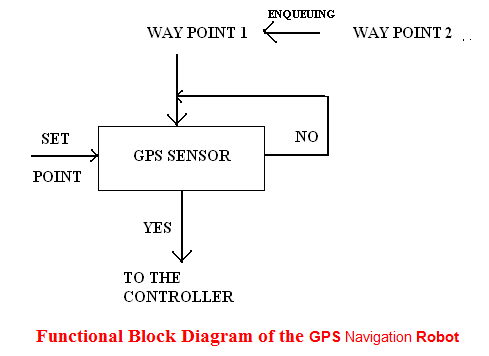
GPS sensor for Navigation Robot is used to navigate the bot reach the fixed destination. Here we use differential gps system, where the carrier frequency is very high even at low signal status certain adaptive methodologies to reach our destination. The functional block shows how the operation is performed by our bot. 

Functional Block Diagram of the GPS Navigation Robot:

 Functional Block Diagram of the GPS Navigation Robot

The block diagram of Final Year Mechanical Project clearly shows the functional working of gps that is here the set point (current position) is compared the first waypoint. Once the destination is reached the program memory enqueue the second way point and so on. If the designated waypoint is not reached again it checks till the destination is reached. 

Performing the Navigation Using GPS and Camera:

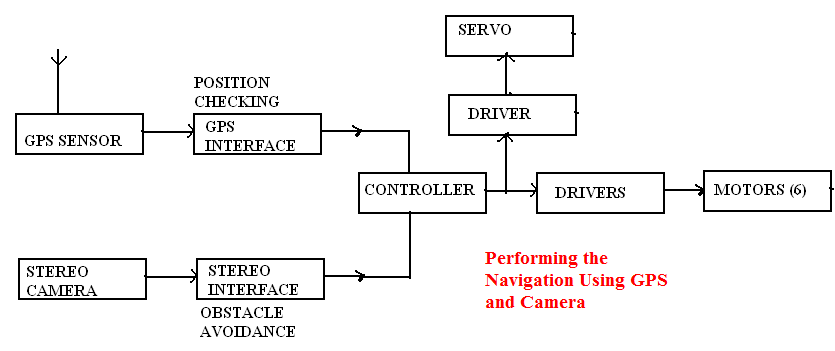
The effective way of using adaptive robotic technology is performing the complex operation simultaneously to do the desired operation. Similarly we have performed the simultaneous operation by performing both obstacle avoidance and positioning using stereo camera and gps sensor respectively. The main advantage of performing this GPS Navigation Robot operation is maximum nearness error can be avoided that is created during real time positioning. The block diagram clearly shows how the navigation is performed.

 Performing the Navigation Using GPS and Camera

e-Stopping:

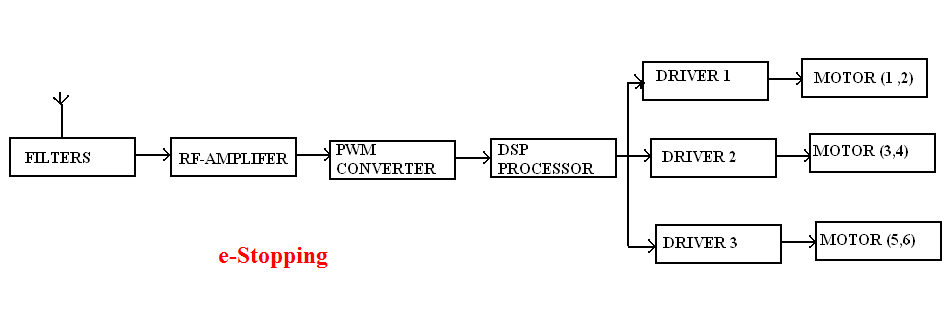
we perform the e-stop operation by providing stop signal to the driver .this we attain by converting the availabe frequency (crystal frequency) to PWM signal by using PWM converter .this signal is fed to the motor driver to stop the bot it is be. The block diagam shows the operaton of e-stopping.

e-Stopping