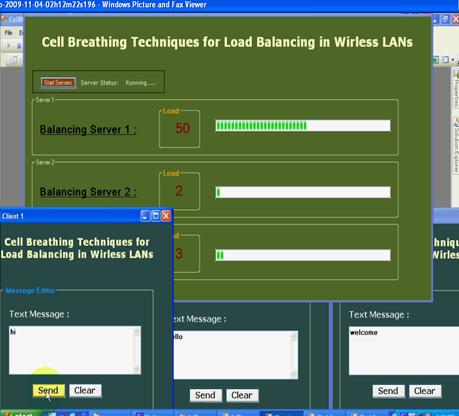
Cell Breathing Techniques for Load Balancing in Wireless LANs

In future we can introduce this Cell Breathing Techniques for Load Balancing in Wireless LANs in internet connection mainly in WIFI technology. Already in this project we proved that by using this method we can avoid the network traffic or overload on APs. If we apply this technology on WIFI connection means, we can increase the speed of the internet and get connection continuously without any interrupt. Definitely in future cell breathing method would occupy the major part of the communication field.

                          We are going to develop a novel scheme for optimal load balancing in IEEE 802.11 WLANs. We provided rigorous analysis of the problem and presented two algorithms that find Deterministic optimal solutions. The first algorithm minimizes the load of the congested AP(s) in the network, and the second algorithm produces an optimal min-max (Priority) load balanced solution. These optimal solutions are obtained only with the minimal information which is readily available without any special assistance from the 748 IEEE TRANSACTIONS ON MOBILE COMPUTING, VOL. 8, NO. 6, JUNE 2009.In this Project, we can assume only the control on the transmission power of the AP beacon messages. The simulations show that even a small number of power levels, e.g., between 5 and 10, is enough to achieve near optimal results.

Cell Breathing Techniques for Load Balancing in Wireless LANsApplication:

  • In mobile networks nowadays using cell breathing technology for roaming purpose to avoid overload in home network
  • Cell breathing method which finds deterministic global optimal solutions for providing fairness to get the digital voice clarity.

Hardware Specifications:

PROCESSER                   : Pentium IV 2.4 GHz

HARD DISK             : 120 GB

RAM                          :  4 GB

Software Specifications:

OS :- Windows XP Pro

Front End  : – Visual Studio 2010.

Programming Language      :- Visual C# .Net 4.0

Database                   : – Sql Server 2008

Download Cell Breathing Techniques for Load Balancing in Wireless LANs Final Project Documentation

Final Project Report on Power Billing System

Final Project Report on Power Billing System Modules Description:

Login

This module is considered only when there is a requirement of safety and security by the customer. Only after the login process, the rest of the application is made available to the user. 

In order to log in, the user has to first register by providing desired user-ID and password. Provided user-IDs and passwords by the users are maintained in a database. Oracle database is used to maintain a database.

Then the user logins into the application by giving user-ID and password provided during registration process. JDBC is used to connect the application with the database.

 User Login Sequence will be as follows:

  • User registration by providing user-ID and password(credentials)
  •  The user will be prompted to enter user credentials.
  •  If the user enters correct credentials then he gets access to the application.

 Consumer Management

To design front-end forms according to consumer specifications it was like Addition of new consumer, deletion, modification of consumer, processing bills, journals, debit respectively. This module deals with consumer information details.

 New Consumer Acquisition

The proposed software allows the end user to add the new consumer with his personal service (meter and Deposit) details. It generates a unique consumer Identification number based on the DISCOM, Circle, and division, Subdivision, Section and Distribution to which he belongs.

 Modification of Consumer

If any particulars have modified with consumer details, this sub-module is used to modify the consumer details.

Deletion of consumer

If any consumer disconnects the connection then we have to delete the consumer related information from the system. This module is used to delete the consumer. Deletion is made is based on some rules like the payment details will be nil.

Message is displayed as do you want to delete the record.  This deleting record is first entered into watch table. Then this record is deleted from Cons table, Bill, Meter part, deposit tab, calculator and PMTTAT tables.

Query Consumer

When ever we need to see the details of any particular consumer then this sub module will invoke the details and will display on the screen.

Meter Change

Every consumer is having meter for reading details. If meter will change then the meter details will be change in database. This sub module is used to update meter details.

Meter part Change

If any changes occurred in meter particulars then this sub module is used to update. The difference between Meter Change and Meter part Change is when ever Meter will change Meter Change sub module will use and Meter will not Change but Meter Characteristics will change then Meter part sub module will use.

Online Receipt

This sub module is user to online bill payment receipts. It will provide the entry fields to accept payments. It will show the consumer bill details and based on that we will know the bill details which were belongs to consumer whether consumer is having arrears or not. It is done on the spot when the consumer comes to pay bill. This is used by the persons, who know the RC (Revenue Collection) password.

Offline Receipt

This sub module is user to offline bill payment receipts. It is also same as online receipts, but it is used when consumers will pay the bill at general counters. It will show the consumer bill details and based on that we will know the bill details which were belongs to consumer whether consumer is having arrears or not. It is done after the consumer paid the bills offline. This is used by the persons, who know the RC (Revenue Collection) password.

Receipt Cancel

This sub module is allows the user to correct the mistakes done in using online receipt and offline receipt. It will provide the entry fields to cancel the payment receipts only. It will show the receipt details, which was done still by particular RC Counter. This is used by the persons, who know the RC (Revenue Collection) password.

Billing & Accounting

Journal Entry

Journal entry done when a consumer had any debit, credit amounts to pay .To that bill if any additional charges, electricity duty, interest on electricity duty levied on particular consumer no.

In this lccode should present in journal. If we enter consumer no corresponding name should be displayed and rest of the fields we should enter.

It should be updated to Journal.

Cancellation of Journal

If we want to cancel that particular person cancels any journal. It should check LC code, voucher number should match LC code, voucher date should match LC code, voucher no and then date field is selected. Then fields we are selected into corresponding text boxes. This journal is cancelled with field Jtcancelid+=y. Now the field is cancelled from journal.

Change RC Password

Every ERO is having RC Counters to receive online payments. Each RC Counter is hiving RC Code and RC Password. This sub module is allows the user to change his Password for security purpose.

Security requirementsUsers are provided with a login page which contains a user-ID field and a password field. Users are requested to register before using the application. Then, the registered user is asked to provide the password and log-in user-ID in order to access the tool. This ensures security by allowing only authorized users.

Power Billing System Project Report

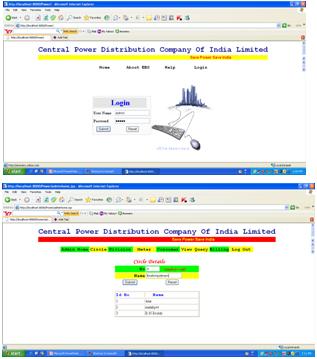
            The Power Billing System Project Report basically deals with the billing system. Since it’s a web application the problems of single tier could be solved using this application. Customers can lodge a complaint or deal with new connections just by logging into the system.

             The application basically starts by asking the user to sign in by choosing the CIRCLE ID and ERO ID. Later username and password of the employee option is provided. Validating the username and password, the user is directed to the homepage were in he has various options like consumer management, revenue collection,  billing and accounting, generating the report. Regarding the modification, constraint is provided wherein the access is limited to the administrator. The statuses of the requests are updated at the earliest. The rectification information will be again updated for the knowledge of the employee. The employee can check the status of the requests before accessing the computer, which will speed up the disposal of the request. Thus, improving the overall efficiency of the organization.

Scope:

             This application is basically written as a solution to the drawbacks of existing system. This application can be used as a real world application and by any organization. It’s could be used as a general application with few minor modifications.

Purpose:

                        The purpose of this application is to develop “EBS”  (Electronic Billing System), which is a web application which provides a service to all the customers and employees of A.P.S.E.B to deal with the transactions online.

             The company is presently dealing with the transactions using Oracle.  The problem with D2K is that there exists heavy network traffic either in two tier or three tier architecture. Here the cost to develop the project will be less but the reliability will be degraded. Thus this application provides a solution to problems of single tier. Customers can lodge a complaint or deal with new connections just by logging into the system and do the transactions online.

Power Billing System Project ReportProblem & Existing technology:

             In the traditional system files were used to maintain the database which was done manually. This existing system consumes a lot of time. This time consuming evaluation coupled by the huge maintenance problem and may also lead to erroneous results. The various operations performed on these files like sorting, adding, modifying and deletion of the records are very tedious. Moreover these manually maintained files have the possibility of getting worn out. Thus, less durability is achieved.

 Thus the demerits of the existing system can be summarized as follows…

  • There is no consistency as the data may not be updated on time.
  •  Feasibility is reduced
  •  Less reliability
  •  Security is not provided and any one can access
  •  Prioritization of records is difficult.
  •  More erroneous
  •  Difficult to maintain
  •  As every thing is done manually its slow process
  •  No timely acknowledgement service

             Taking the demerits into consideration, an alternative system which uses Oracle as both front end and back end was used. In front end, retrieval of the data from the database is done through SQL queries i.e using D2K forms. This is not a web application and the data is not distributed as only a single system is used. As it is confined only to a particular system, scope is limited and there is a hindrance to the reliability if the system fails.

The demerits of this alternate system are…

  •        Only single system used.
  •        If the system crashes then the data is lost
  •        too overburdened
  •        not reliable
  •       slow processing
  •       less flexible
  •       not so user friendly

Proposed system

             The proposed system is developed based on the client server architecture,  a request-response paradigm and is implemented with the help of advanced java using the tomcat web container. The employees can maintain and do the transactions online.

             The application starts by asking for user name and password which provides authentication. This system provides high security where the unauthorized users cannot access the data.

 Later we have different options for the employee like

  •  Consumer Management
  •  Revenue Collection
  •  Billing and Accounting
  •  Reports
  • Meter Details
  • Ledger Process
  • Journal Details

The objectives of the proposed system are as follows:

  •   Easy to use, effective and efficient
  •   Accurate results.
  •   Easy maintenance.
  •    Fast access
  •    More feasibility
  •    More secure.
  •    Provides high consistency.
  •    More reliable

Project on Monitoring Online Tests through Data Visualization

This Project on Monitoring Online Tests through Data Visualization project presents an approach and a system to let tutors monitor learners’ strategies during online tests. The approach exploits data visualization to draw the data characterizing the learner’s test strategy, in order to trigger the tutor’s attention and to let him/her discover previously unknown behavioral patterns of the learners and conceptual relationships among test items. In this way, the tutor is provided with a powerful tool that lets him/her review the whole assessment process and evaluate possible improvements.

 Future Enhancement

  1. The Test can be conducted to the whole class at a time.
  2. The other behaviors of the user can also be monitored.
  3. The test can be used for other environment such as aptitude test in interviews, Stress analysis test etc.

 Advantages

1) No need for the examiner to move from one place to another for monitoring the user behavior.

2) Reduce over time of the examiner.

3) The question pattern can be easily altered based on the admin requirement.

 Applications

Monitoring Online Tests through Data Visualization is used in academic environments, as well as in combination with other assessment means, providing tutors with powerful tools to submit different types of tests in order to assess learners’ knowledge.

Monitoring Online Tests through Data Visualization Project

 Monitoring Online Tests through Data Visualization Project Final Year Project having the below Modules:

1. Admin Module

2. User Login Module

3. Test (Client) Module

4. Database (Server) Module

5. Analysis Module

6. Data Visualization

Admin Module

In this module, first it Checks whether he is the authorized admin and once authorized, the admin can able to view the number of registered users for the online test. The admin have the right to Add, Delete or Update the questions with the third party.

User Login Module

In this module, it creates the login for the user by getting their personnel details including their Email, Address etc.After the completion of registration process; they are directed to attend the Online Test.

Test Module

The test module includes the test pattern for the user. The questions are selected from the database, based on respective technique. Once the Registered users entered, they are undertaken by the given questions.

 Database Module

This module contains the questions with the correct answers. The user selected answers are verified with the correct answer.

Analysis module

The analysis of the user behavior is monitored with the user’s answer, time taken for each individual answers, question type, etc. The mark is given as per the user’s answer.

 Data Visualization

  Graphs are plotted according to the user’s mark, and their individual performance. This gives the clear representation of the Users performance.

Monitoring Online Tests through Data Visualization

Old System:

In the past, several experiments have been carried out to track learner’s behavior during tests by using the think-out-loud method, learners were informed of the experiment and had to speak during the test to explain what they were thinking, while an operator was storing their words using a tape recorder.

 Disadvantages of the Existing system:

  • Monitoring online test using simple methods.
  • They didn’t plot any graph according their results
  • Complexity of identify their performance
  • lack of identify their behaviors.

Proposed system

In this Monitoring Online Tests through Data Visualization Project, we are going to present a solution enabling the Recording of learner’s habits during online tests without informing them of the underlying experiment and consequently, without asking them to modify their behavior, this potentially yields more realistic results.

Advantages of Proposed system:

  • Monitoring online tests through data visualization
  • Find their performance and behaviors depend on the test and item.
  • easily identify learners’ results and quality.

Hardware Requirements

  • ARCHITECTURE                   : Pentium IV 2.4 GHz
  • HARD DISK SPACE                        : 80 GB
  • RAM                           : 512 MB

Software Requirements

  • OS       :- Windows
  • TOOL                         : – VS.NET 2005
  • Programming Language          :- Visual C# .Net
  • Database                        : – SQL Server 2000

Admission Control in PeertoPeer Design and Performance Evaluation Project

The goal of the Admission Control in PeertoPeer Design and Performance Evaluation Project is to evaluate different admission control approaches: centralized and distributed. In centralized request processing, the proxy server simply forwards the media request to the media server and at the same time forwards the cached blocks to the client if the prefix is available. The central media server, upon receiving a media request, performs admission control and batched patch algorithms. To study the effect of distributed integrated approach, we compare the distributed scheme with a deterministic centralized admission control algorithm, the centralized instantaneous maximum (CIM) algorithm. A deterministic admission control algorithm should ensure that the total required bandwidth at any time is less than the disk retrieval capacity MinRead, which is defined as the maximum number of blocks the media server can guarantee to retrieve from the disk during each service round. When a client issues a request for a stream, the server creates a block schedule which contains the number of blocks required to be read in each time slot for the continuous stream playback. The CIM algorithm summates all the currently admitted block schedules and keeps the sum of the required media blocks during each time slot in a table. To make an admission decision for a new request, the server adds the block schedule for the requested stream to the table. If the number of required media blocks during any of the time slot is greater than MinRead, the new request is rejected, otherwise it is accepted. In the experimental study, we consider a centralized, integrated request processing (CIRP) scheme, in which the media server performs the CIM admission control algorithm together with batching and patching techniques.

We also compare the distributed approach with two other distributed admission control algorithms proposed in to study the effect of integrated request processing. First, we consider a simple distributed admission control (SDAC) where the proxy servers simply perform distributed admission control and prefix caching. Each proxy agent reserves some amount of server disk bandwidth according to its demand and admits client requests based on the reserved bandwidth. However, since the agents make admission decisions independently, some agents may use up all allocated bandwidth while some other agents may under-utilize their reserved bandwidth. To improve the overall bandwidth utilization, we also consider an aggressive distributed admission control (ADAC) policy where each agent may admit more requests than its allocated bandwidth. When an agent reaches the bandwidth limit, it still may admit a new request with a certain probability.

A real media server may contain thousands of different media files, but for simplicity, the media files in our experiment are generated by randomly selecting a segment of a MPEG compressed video file “Star Wars”.

We have discussed the disk bandwidth issue in Section 3.6 for a media system with multiple servers geographically distributed over Internet and concluded that the optimal solution can reduce almost a half of the average transportation delay. In a system with multiple media servers, we can compute the total bandwidth of all servers, and then allocate the total bandwidth to the agents. After disk bandwidth allocation, the distributed scheme works in a similar way to the single server system except that requests may go to different servers. Hence, in the experimental studies, we only consider systems with a single media server.

In our experimental studies, we take into account the Internet dynamics by using NIST Net emulation package, which can provide a controlled, reproducible environment for running live code and emulating a variety of critical end-to-end performance characteristics such as packet delay, bandwidth limitation, and network congestion, etc.  First, we set up a single Linux box with kernel version 2.4.18 as a router. Then, the NIST Net emulation package is installed on the Linux router.  All the traffic among the media server and proxy servers goes through the NIST Net emulator. The packet delay from a proxy server to the media server is set up by averaging the round trip time of ping packets during three hours. Since current streaming media applications in the Internet primarily use UDP transport, we use this protocol in our experiments.

The requests are generated at the 10 proxy servers according to Poisson distribution. The arrival rate l at a proxy server varies from 0.05 to 0.4. The user access pattern, such as file duration, file encoding bit rate, and file popularity, etc, is generated by a publicly available streaming media workload generator – MediSyn. We generate 10 groups of access log files for 10 proxy server. Totally 7000 requests are generated and each run of the experiment ranges from 2 hours to 3 hours according to different arrival rates.

Employee Attendance Monitoring System Project

Finally, after the code is implemented the result is analyzed. According to this project “Employee Attendance Monitoring System,” the result can be analyzed in a very efficient way.

This is done supposing, when an employee logs into the website, he then gets a home page that is a login page which includes a welcome form, admin form, add form, and update form for updating details, delete the form, and finally the reports.

The welcome form gives the date, task, and hours of an employee. Admin form is only for the administrator who can update the employee details. Add form is used for updating or giving the login and password about the employees.

The updated form is used for updating the new details. Delete form is used to delete the employee and finally the report is used for giving the report of a particular employee giving the aspects like efficiency, his working hours, and the capacity to finish the work in time.

The output screens give a clear view of the result that has been analyzed.

The above-stated forms played and the update form can be used only by the administrator.

The implementation and results of the Employee Attendance Monitoring System project have been mentioned above in detail with the help of screenshots and database tables. Thus in the conclusion, we have proved that the project is implemented and all possible screens have been displayed. 

The web-based time tracking system is a web-based application that is used to give detailed working hours and helps the management in determining the efficiency of an employee.

Thus in the conclusion, the implementation and results phases give us the details about the preparation of the data sheets of an individual employee’s working hours. The resultant outputs are also displayed in the above screenshots.

Employee Tracking System Project in Java

Here in this Employee Tracking System Project in Java the employees when enter in to an organization he starts working on a project or starts doing his task then he gives his detailed time to time work he has done on that particular day to the administrator who in turn prepare the reports of a particular employee and then submits to the project manager, then he analyzes the capability of an employee and he will finally prepare the final reports which include the aspects of an employee are as follows:

1.  The reports will give the significant amount of time and effort invested by the employees time to time, by helping the management to know about their employee’s capability.

2. The employee can immediately know his capacity and the working hours weekly once or when the task allotted to him is finished.

3.  Achievement/target report employee wise.

4. Performance indicator for an employee.

5. Determining the efficiency and the task completed by the employee

   Finally I conclude that this project plays an important role in tracking the timings of the employee and how much time he is working and the entry time and exit time   when a employee cross the gate number of times. And maintain like a small database about the timings of the employee.

              Employee Tracking System Project in Java The developed employee reimbursement system project has been successful in automating all the functions of employees and various departments of 1000Projects Software Solutions. The proposed system has helped the department to reduce its time spent on various data maintenance tasks, reduced the time spent in report generation, and helped it in providing better and user friendly services to its employees.

  The produced System also provided various metrics to analyze the employee performances to the department. It helped the department to dynamically add questions to the database. It provided a mechanism through which the administrator can save the existing database to file about the performance of an employee.

              The management is now able to select best employees in a better and efficient way and judge the employees in a better way

Online Web Based Project Management and Tracking Project

Online Web Based Project Management and Tracking Project plays an important role in tracking the timings of the employee and how much time he is working and the entry time and exit time   when a employee cross the gate number of times. And maintain like a small database about the timings of the employee.

The developed Online Web Based Project management system  has been successful in automating all the functions of employees and various departments of  Spoorti Software Solutions the proposed system has helped the department to reduce its time spent on various data maintenance tasks, reduced the time spent in report generation, and helped it in providing better and user friendly services to its employees.

The System also provided various metrics to analyze the employee performances to the department. It helped the department to dynamically add questions to the database.

It provided a mechanism through which the administrator can save the existing database to file about the performance of an employee.

The management is now able to select best employees in a better and efficient way and judge the employees in a better way.

FUTURE ENHANCEMENT:

  • Development of application in public IT.
  • Addition of some more categories
  • Globalization of Site

Globalization of Site:

We may globalize the site.

Addition of some more categories:

Addition of some more new categories may take place.