
Localized Sensor Area Coverage with Low Communication Overhead

The project explains about many localized sensor area coverage protocols regarding heterogeneous sensors. Every sensor has been mentioned along with its arbitrary sensing and transmission radii. The every single sensor consists of some limited time cycle that can receive messages from the specific nodes only in the limited time which has not completed.

After the due time of expiry it will not receive or hear any messages. The sensor node which is not completely surrounded sensing area i.e., or partially surrounded with some group of active sensors still active for some required time informing it by giving out message before become inactive. Our project makes this sensor to remain active till the sensor   active or not surrounded.  The covered nodes will be in the dormant stage by some time generating a leaving message to the sensor about its situation. Depends on the other sensor response the inactive sensor takes decision to be covered or still remain active. 

The Existing System 

The existing system has demerit of not having status links with other sensors. Because of the improper interaction between sensors the competition and data missing occurs. The cause of this demerit is improper use of the source. The affluent network is unable to surround the place of linked groups of active nodes. Therefore the nodes are not judging about the particular communicating node. 

The Proposed System 

The presented project overcomes this problem of improper communication between sensors. The sensors now posses the figure of the communicating device at the same time. So every sensor has ability to communicate or interact with other sensor or whole network. The less life time sensor with coverage, observes other sensors availability and given the job to the specific sensor. This system is very working and vigorous as it covers more area by using the limited active sensors and also the longstanding connection. However it may loss some messages. 

The Proposed system can be operated in Window XP. The software programs required for the application development are Microsoft Visual Studio.Net 2005 for the front end and Visual C#.Net for the Coding language. It requires Pentium III 700 MHz processor, 40 GB hard disk drive and 128 MB RAM.

 Download  Localized Sensor Area Coverage with Low Communication Overhead.
In Flight Wireless Communications Assignment topic

In Flight Wireless Communications Assignment topic

Detailed Requirements

This coursework consists of research work on some specialised topics in Wireless, Mobile and Computer Communications that will not be covered during this module. Main emphasis will be on (but not limited to) topics in mobile communications and computing.

Deliverable:   A report of maximum 2500 words containing

–         Abstract of no more than 100 words summarizing the topic

–         Introduction written in own words on what is this about. Introduce the topic, how relevant is the topic, Where did you find the information?

–         Description of the topic from references (No direct copying! Collect and re-organise information from different sources).

–         List of references (at least two books or articles and four web sites) but the more the better!

Since this is a Master level assignment, the report MUST show professionalism in reporting. Cut and Paste from website will not be accepted. You need to gather information from different sources – categorise and analyse the information reported.

Copying and similarity check will be done on each assignment.

Use MS Word Times New Roman Font size 12.

State-full Packet Inspections

State-full Packet inspection is a software module that is designed for inspecting the packets forwarded. This software is configured in the operating systems of UNIX of windows PC firewalls, and are used for inspecting the packets that are received. The rules of inspection are configured buy the security officer in to the machine and the inspection of packets is done based on these rules only.

Using this software in the ISO model the inspection is done in all the headers of 7 layers and the data related to the packets in the headers are stored in the dynamic state tables, these tables will preserve the information related to the connection. Packet filters can be run in the dual homed computers as they are designed in the form of software, these can filter the packets but at various networks they cannot be routed.

A firewall is also sometimes called as a bastion host when it is placed in the layer 5 of Internet model and layer 7 in ISO model. It is also called as guardian system, application gateway and proxy server. The services that are offered by the application are filtered as a main aim of these firewalls. Then the consequent packets are evaluated on the consequent connection trails and same connections by using the information that is stored in the tables.

Despite the fact that when compared to the simple packet filtering routers, this technology is very much secure, but when compared to the application gateways these are not that much secured because the information in the application is not completely inspected. Yet when compared to the application proxies, this technology is performed very fast. When compared to the security guards the concept of state-full inspection is almost similar in asking the questions like “who are you”, “where are going” and then permits the users. 

Issues with Packet Filtering Routers

The most important and essential component of a firewall system are the Packet filter routers, and these are represented as the first among the defence because there are number of deficiencies and they are discussed as follows:

a)    The configuration of these packet filtering routers is difficult because there is a huge rule set that is to be followed file configuring and specifically when the services from the applications are available, the accuracy and consistency in the set of rules cannot be estimated because there is no automatic approach for verifying the rules that whether they are implemented properly in the security policy or not. In addition to this if the logging of calls is not supported by the routers then it is not possible to have an idea about the packets that are not allowed apparently that are passing through the rules are not.

b)    In an organization if some users among the employees have need specially for accessing the internet then their systems are added with new rules according to the requirement. This addition of new rules to the existing system makes the rule set more difficult to manage and so it becomes a complicated issue. Moreover, as the user is given permission to access the system it is considered as the wrong level of granularity. Here only the packets are verified but the users of the system are not authenticated.

c)    The TCP filtering or UDP filtering are not permitted by some of the routers that are mostly basic, and therefore implementing specific security polices is very difficult and sometimes impossible also.

d)    The packets between various ISO protocols that are running through the IP or TCP layers cannot be filtered. The process how ISO applications like X.400 and X.500 can run across the IP or TCP is specified by the RFC 1006. Conversely the RFC 1006 service will sit on the 102 port and so the ISO applications X.400 and X.500 are connected to port 102.

e)    Hence at last it is concluded that the packet filtering routers are not very much secure, because there is no inspection of the content in the packet and there is a chance for the passing of any malicious content through transferring of these packets. For example the packets may contain viruses, delete commands that unauthorized. Then finally no proper authentication is provided for the sender of the packets.

These deficiencies can be addressed and avoided by inspecting the content in the packets when it is forwarded from the sender to the receiver. Therefore checkpoint provides a state-full packet inspection module which is done at the application level firewalls.

Issues with Packet Filtering Routers

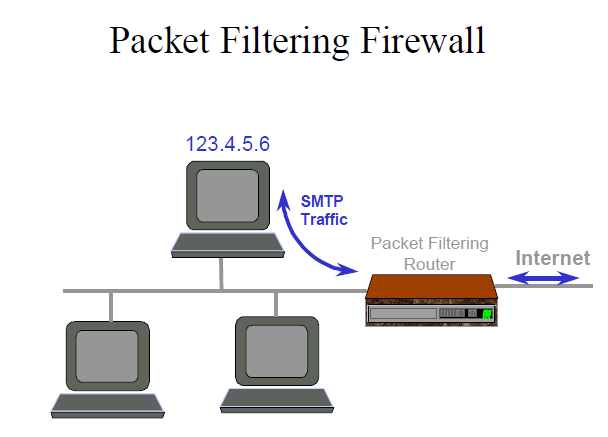
Packet Filtering Router

Packet Filtering Routers are a type of firewalls that are invented first. These are designed with a main aim of filtering the IP packets, and this filtering is done based on four fields and they are given below:

  • TCP source port/ UDP source port
  • TCP destination port/ UDP destination port
  • Source IP address
  • Destination IP address

The IP packets are filtered by these firewalls for the following reasons:

  • To block connections to certain ports
  • To block connections to certain hosts or certain networks
  • To block connections from certain ports
  • To block connection from certain hosts or certain networks.

                    Generally all the ports or the hosts can be specified while the routers are configuring in specific situations. The performance of the packet filtering routers will be fast because the content in the IP packets is not inspected before it is dropped or forwarded that means there port fields are also not checked before transferring the content. For the IP packets these packet filtering routers are the guards who may ask certain questions like “who are you”, “where are you going” etc. In this case the guard of a building allows a person enter in to the build when once he answered all his questions and in similar way these firewalls will also behave.

Firewalls and Layers, Models

In general internet is a 5 layer model and the model used by the ISO for making an Open systems interconnection is a 7 layer model. In ISO model, firewalls are placed in 3, 4 and 7 layers and in case of the internet model the firewalls are placed in the 3, 4 and 5 layers. These firewalls are used to protect a corporate system from the unauthorized accesses.

In simple it is said as protecting a network from the intruders and attackers. A firewall can be placed among any networks for instance a firewall can be placed between a R&D network and its corporate network related to business. Generally a firewall can be placed among the domains of lower security and higher security. The firewall system will be operating at various layers and firewall system operating particularly at layer 3 and layer 4 is sometimes called as screening router or packet filtering router. The main aim of these firewall systems is to filter the TCP ports or UDP ports and also to filter the IP packets and ICMP packets.

By depending on the filtering rules the packets are filtered as there are many ports at the router and these ports are available for routing. Packet filters can be run in the dual homed computers as they are designed in the form of software, these can filter the packets but at various networks they cannot be routed. A firewall is also sometimes called as a bastion host when it is placed in the layer 5 of Internet model and layer 7 in ISO model.

It is also called as guardian system, application gateway and proxy server. The services that are offered by the application are filtered as a main aim of these firewalls. If the firewall system is placed in the layer 2 then it is called as the link level and even it is able to operate in that link level also. For instance in order these particular assured packets are to be forwarded an Ethernet bridge is configured, which is not regular. The packets are inspected before they are transferred trough firewalls by an inspection module of checkpoint.

Disadvantages of Firewalls

Along with the advantages, firewalls also has some disadvantages, these disadvantages will indicate that firewalls cannot alone provide good security for the networks. The disadvantages are:
  • Intruders can easily make attacks by focusing on the firewalls they consider firewalls as the focal points for making some malicious activity. If once the intruder is able to break through the firewall then he can access the network of any corporate organization without having any restrictions.
  • Sometimes even the authorized users may face some problems using these firewalls because they may be interrupted in accessing the services provided by their organization. For example, if the users are away from the work place or if they are working from home then they are restricted to access the corporate network.
  • Firewalls also fail to protect the corporate networks from the back door attacks. Firewalls cannot interrupt the users entering or exiting through the back doors, and this is caused when the service interruptions are more enough. The users can enter into the corporate networks by the entrances like exporting and importing of floppy discs, by modems. There is a necessity for the security policies to cover all these factors also.
  • As all the connections in the network pass through the firewall system and so firewalls behave as bottlenecks for the throughput.
  • The intruder activities like smuggling cannot be interrupted by the firewall systems. Therefore the network cannot be protected by the firewalls. Firewalls can also export and import some material that is banned for example, material attached to the mails and the other games and programmes. If the users had download softwarefrom the outer official statement boards then there is a chance of smuggling in terms of some virus which can be considered as very important. Firewalls cannot avoid the viruses that are passed from the attachments of the e-mails for example the Melissa and love bug are the viruses that are smuggled through emails without any notice of the recipient. Particularly in this type of situations better security policies are required. This type of issues can be addressed using some software packages that are specially designed for identifying the viruses that are passed from the attachments of e-mails and they are scanned before they are downloaded. These software packages can remove the viruses that cause damage for the networks and systems.
  • Firewalls cannot protect the attacks caused by the inside attackers and this considered as the main disadvantage of firewalls. It’s a fact that most of the crimes in corporate companies are caused by the internal users of the company in this case firewalls are used to provide a little security but not a high level security. The internal users can send the sensitive information of the organization to other attackers using the email approach or bye copying those files into some floppy discs and then export them to intruders. So more concentration should be paid on firewalls in order to develop them in such a way that they can address all these disadvantages.

Advantages of Firewalls

There are many advantages for firewalls and they are discussed as below:

  • In order to insecure the services inherently, the incoming requests are stopped using the firewalls, for example, the services like RPC and rlogin such as the NFS can be denied by the firewalls.
  • The access of various services can be controlled by the firewalls and these services includes bar callers from assured IP addresses, both the outgoing and incoming service operations are filtered for example FTP writes are stopped, the information can be secured by permitting the users accessing the assured directories and systems.
  • Than securing all the hosts on the corporate network the firewalls are considered as most cost effective because only one firewall or few firewalls are allocated for concentrating the network.
  • When compared with the security provided to all the hosts the firewalls are self-secured because the software on the host is very complex and therefore there are more chances for appearing of security loopholes. But in case of the firewalls they don’t run the application software that are too complex and even the operating system they use is also simplified and there for can secure the no of hosts also.

Firewalls and Network Security

Abstract

Computer and network security has a wide range of applications and most of the applications need ample security and access to the network should be restricted from intruders and anomalies. Firewalls can be considered as the best choice this process and in general the firewalls provide some access restrictions to the incoming and outgoing traffic across a network. In this research, I have reviewed the importance of firewalls and the level of technical aspects across its implementation along with the disadvantages. Different types of firewalls are reviewed in this context and presented in the analysis part.

Firewalls

                        In order to interconnect the internet and some private network an internet gateway is required and that internet gateway must be very secure and the firewall is nothing but a secure Internet gateway. A firewall is made up of several components and they are discussed below in detail:

a)    The first among the components is the “Internet Access Security Policy” of an organization. This means that when the organization is connecting to the internet what was the expected level of security at high level. Without depending on the equipment that are used the security policy must have a life time because it is not based on the techniques and the technology that is implemented (Government of the Hong Kong, 2009). According to this statement, an instance for this type of security policy is a corporate network of an organization is not accessed by the external users that means they are not permitted use that network if not they have anauthorized authentication. If an organization require transferring its corporate information through the internet and if that information is not available in the public domain then the information is transferred in a confidential approach. And all the other external services will be banned and only the corporate users are permitted to send e-mails across the internet.

b)    The other component in making the firewalls is mapping of the security policy on the procedures and technical designs, these procedures and technical designs on which the security policy is mapped must be followed and implemented while connecting to the internet. During this process the configuration of the system will be changed and the information will be added as a fresh technology and so on. Theusage of one-time passwords can be taken as example for the technical design considering the authentication of an organizational network. Generally the technical designs depends on one security policy among the two polices. The two policies are allowing any service except it is denied expressly or deny any service except it is permitted expressly. The second one is the most secure among the two security policies.

c)    The third one is firewall system which is a combination of both software and hardware that means the both the software and hardware components can make the firewall. Generally a firewall system is made up of an “IP packet filtering router” and a host computer sometimes it is also called as application gateway or a bastion host which will run authentication software and application filtering.

                          All the above components are very important and necessary for making a firewall. A firewall is said to be not configured properly if there is no Internet access security policy. There is no value for the policy if that is not configured properly and also if is not enforced with worthy procedures. 

Attendance Analysis System .Net Project Report

Introduction to Attendance Analysis System .Net Project:

As the technology is developing in every field a novel software was introduced for attendance of students and this is called as Attendance analysis system and this was mainly developed for the attendance of students in educational institutions and now-a-days this software is being used in even schools as this helps in managing the attendance.

This maintains in accessing the information of the student in particular class and also helps in maintaining each students attendance. This software also helps the institution management for calculating the eligibility criteria of the attendance for particular student as in the present system it has become an essential part for working time of any student in either school or college. Now-a-days these are also been used in the places where there is a calculation of a persons working hours or days as this helps in calculating their wages. In even large companies this attendance analysis system is being used.

This software is designed with the visual studio 2008 and the software’s front end part is done with the C# and back end the information is stored through Microsoft Access by the application. This attendance application mainly contains two modules which is the user module and admin module. The admin module is managed by the management of the particular company or institution and they have the right to change or modify or create the space for novel batch. The other module is maintained or handled by the faculty or the person who handles the attendance and based on the gained information they generate the report.

The usage of this software is best explained in step wise initially a department has to be created and then in that class must be created and then subjects in that particular class must be created. Initially students and faculty members must register themselves and later based on the attendance a report must be generated.

The system requirements of Attendance analysis system is Operating System- Windows XP/Windows Vista, Microsoft .Net of latest version, MSOffice 2010.

Download  Attendance Analysis System .Net Project Report.