Remote Controlling Home Using Zigbee

Remote-controlling-Home-Using-ZigbeeIntroduction:                                  Remote controlling Home Using Zigbee embedded system project is used in  various home applications, such as home appliance controlling, security systems and automation etc are not very easy to do it manually with human interaction.             

            The fact is it is not possible to access these areas directly because of the some physical and technological problems. So it is better to employ some automated devices to monitor and control these devices or security systems.       

                  If it is a large housing colony, there will be a lot of   devices and security systems to monitor and control. Connecting different monitoring and control equipments in different houses are not possible. All the houses should be monitored and controlled with one master system and this is a best approach also. Inter connecting all houses with wires are also not practical. It should be wireless. A better way is a wireless network that can communicate in between houses and the main server. Here comes the importance of wireless home automation and monitoring system network based on Zig Bee.

 Abstract:                                  

  In this home automation and monitoring system, all the houses are fixed with sensors to capture different parameters and also with security systems. As the houses will be in different places we should do a wireless network to communicate with all the sensors fixed in different homes. For this wireless communication we use Zigbee protocol and technology to obtain a best result.     

        We use single board computers to collect sensor information and send to the master equipment. In order to maintain various parameters like pressure, vibration and temperature master equipment server is used.  Control different parameters will be done through communication between control equipment and control devices.                         For the prototype we will interface temperature sensors and vibration sensors and these data will be sending over radio (zigbee) to the server and monitor these parameters and relays to control different devices.

download Remote controlling Home Using Zigbee Embedded system Abstract.
Virtualization Security for Cloud Computing Technology

As Cloud computing offers virtualized resources as service over the internet, security

For these resources is important. As these resources are responsible for delivering

Services over the internet probability of resource getting maligned by virus are more.

As number of resources increases managing these resources expensive in terms of security.

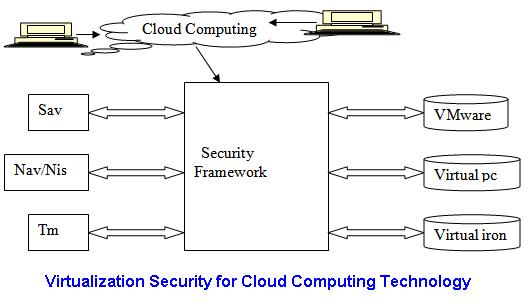
This Virtualization Security for Cloud Computing Technology paper describes about a framework which interfaces between various virtualization technologies and antivirus products and various ways in which virtualized resources are administered, by creating inventory list of virtualized resource and scanning them for virus/malware or spyware.

Virtualization Security for Cloud Computing Technology

This Virtualization Security for Cloud Computing Technology paper describes about various ways of deploying security agents in virtualized environment and maintaining the integrity of the virtualized resources.

Embedded System Project Abstract on Traffic Control System

Embedded-System-Project-Abstract-On-TRAFFIC-CONTROL-SYSTEMIn the proposed Embedded system Project On Intelligent traffic control system , the traffic signal lights are controlled by single board computers with the reference of vehicle density on the road. If the vehicle density is high then the interval of green signal will be faster than the default time interval. The four side single board computers will check the density and that information will send to the server that controls the traffic signals. So four side single board computers will be connected in a wireless network. The wireless network obtained with Zigbee wireless protocol  With this technique the passengers can save time at the traffic signals. 

Working principle

                              Normally the traffic signals will ON and OFF in an equal interval of time. But when the vehicle density increases on the road the interval of green signal and red will change. On the road there will be fixed with IR transceiver module and  it will be placed some distance apart from the  traffic junction. So when ever the vehicle density increases, some vehicles may stopped on the IR transceivers fixed on the road. The IR will detect the vehicle and check for certain time interval , if the vehicle is still on the same place after a certain time then the system will take it as vehicle density. According to the time intyerval of reflection of IR , the system will calculate the percentage of vehicle density and that information will be sending to the server over radio communication.


The server will collect all information from all the side single board computers and calculate which side road should show green signal and how much time green signal should be there.

download Embedded System Project Abstract on Traffic Control System.

Cloud Computing Engineering Seminar Topic

The Cloud Computing Engineering Seminar Topic Introduces Cloud computing, as the need of hour is a robust technology that has the capacity of integrating the global IT infrastructure and supporting billions of users over the surface of planet. As depicted by the literal ‘cloud’ the enormousity of such infrastructure is self-explanatory. Cloud infrastructure is built around the internet or private intranets including datacenters, high computing machines/server with help of a software abstraction layer that integrates huge hardware at distance

 The advantage of adopting Cloud-computing as a technology is of high value to end user as he need not get into hassles of procuring huge infrastructure on the fly. Also the synergic effect of integrating large set of machines and making them dynamic and ever expanding. Cloud-OS such as Microsoft Azure has practically made it possible to run applications under this Cloud, providing it as a service to extremely large group of people. The day is not far when we will see conventional applications residing over this cloud and available as a service to the user.

Cloud based solutions are going to be next big thing in the industry, and it will definitely impact the current software frameworks and development life cycles. With the fresh set of challenges and difficulties, we need to have completely different approaches for testing the new gamut of softwares. Two promising strategies, “Behavior simulation” and “Synthetic virtualization test environment”, discussed here will help us in addressing the unique requirements of testing in Cloud Scenarios. For us, as a global leader in testing industry, it is time to gear up for the new trends in quality assurance and a whole new world to explore and conquer.

Quantum Cloud Computing Technical Paper

The practical realization of cloud computing is fascinating and inevitable. But security is major concern in cloud computing. Traditional data encryption methods for security are unreliable in cloud computing. Strong security models which are unbreakable and practical are required to gain the confidence in cloud computing.

This is proposing one such model which uses the properties of quantum mechanics in a practical manner. This Quantum Cloud Computing Technical Paper proposes to merge the Cloud Computing and Quantum Encryption to bring out a new, permanently secured branch of cloud computing by the name “Quantum Cloud Computing (QCC)”. This Quantum Cloud Computing Technical Paper will discuss the model, its advantages, and its limitations and opens the model for discussion.The practical realization of cloud computing is fascinating and inevitable. Arrival of the cloud computing reduced the infrastructure costs to a grater extent and provided wonderful computing performance to its end users. The companies like Yahoo, Microsoft, Amazon, Google, and IBM already spent a huge amount of money and time in making the cloud computing more effective and secure.

But still the security is major concern in cloud computing. The traditional methods of data security can’t withstand the computing capability of cloud. The unbelievable computational capacity of the cloud computing brought new revolution and at the same time it posed the challenges on data security. The present methods of data encryptions are based on complex mathematical algorithms which will take considerable amount of time and computing power for ordinary computing systems to decode them. But decoding is highly possible in the context of cloud computing which has got a huge computational power. We have strong evidences for this.

The present work of this Quantum Cloud Computing Technical Paper gives an innovative, practical solution to this problem. This Paper is combining the elements of quantum cryptography with cloud computing. This paper gives a unique model to combine them together to make the cloud computing absolutely secure and coins the term “Quantum Cloud Computing”. This model solves the problem in more cost effective and practical way. It ensures all the users an absolute security of their data inside the cloud.

Key features of Cloud computing Technology

These are the below Key features of  Cloud computing Technology:-

1.    Cloud computing technology provides a more flexible and agile infrastructure at a low cost. It is important considering the fact that organizations have to often deal with business re-org, market fluctuations, resource resizing etc.

2.    Companies can significantly reduce their capital expenditure on IT by adapting to the cloud computing model. This can be achieved especially through utility based computing where the computing resources such as hardware, software, network bandwidth and other infrastructure components are rented from a third party service providers. So this way organization will have to only worry about the operational expenses from IT infrastructure standpoint. One other advantage of utility based computing is that IT skills required for maintaining the infrastructure will reduce drastically.

3.    Users can access the systems from anywhere in the world via internet regardless of where the infrastructure is located (third party service provider). All that is needed at the user end is a device that is internet enabled such as a computer, laptop or other handheld devices.

4.    Different companies can share the resources under a single cloud from a third party service provider. The benefit of doing so is as follows:

a.    Setting up a centralized infrastructure in a location where the cost of real estate and electricity is low.   
b.    Huge computing resource pool and a greater network bandwidth will increase peak load capacity.
c.     Using virtualization technology for setting up the cloud infrastructure will allow new host systems to be added or the existing systems to be upgraded with additional computing resources such as processor, memory, storage etc very

d.    easily without shutting down the systems thereby making the infrastructure extremely scalable.
e.    Optimized utilization of the systems that are often used only 5-10%.

5.    Cloud based application are easy to support and maintain as they are not installed on client machines. Any changes that are made to the application is available to the users instantly.

6.    Data is more secured due to centralized location of the infrastructure.

7.    Cloud computing resource usage can be measured and should be metered per client and application on a daily, weekly, monthly and yearly basis.

Download Key features of Cloud computing Technology

Brief Introduction to Cloud Computing

This Brief Introduction to Cloud Computing White Paper is intended to give a broad overview of what is cloud computing and how it can benefit the organizations in managing their IT. It also highlights the key features that the IT service providers can offer to their customers. The term ‘Cloud’ represents ‘Internet’. The cloud symbol is used in the telecom world to distinguish between the responsibilities of the provider to that of the user.

 Cloud computing is a paradigm shift from the client server model.  Cloud computing allows users in an organization to access shared resources, applications, servers, computers, etc over the internet on demand from a service provider. The provider can calculate the time bound resource utilization as per the service level agreement and bill the organization based on the usage. This is just like using the electricity from your provider and paying the electric bill based on the usage as captured by the meter. This will help the companies to optimize their utilization of IT assets thereby cutting down on any unnecessary IT costs. So this way organization can leverage on the cloud computing model to reduce the capital expenditure on IT.

Cloud computing technology is indeed a paradigm shift in IT infrastructure management thus providing significant cost savings and increased productivity to organizations. For IT service providers, it is an excellent opportunity to provide cost effective IT solutions to their customers with improved quality of service. However, it is imperative that more and more IT skills should be trained to maintain and support the cloud infrastructure.

There are certain factors that companies need to consider such as privacy of customers, compliance (PCI, SOX, etc) issues especially if it is a public cloud with a multi-tenant architecture.

Download Brief Introduction to Cloud Computing

CCRTD – Operating System (Cloud Computed REAL-TIME Distributed OS)

The main objective of this white paper is to emphasize the idea of using Cloud Computing concepts in Real Time environments. Since the idea is very generic and abstract so we have tried to come up with a case study, where there will be some level of implementation details.
We all know that when there is some level of implementation involved things get pretty easy to understand.  The use of technical jargons is very limited. As you read through this white paper you will find that the language is very simple and easy to understand.
The case study presented in the following few lines is not a fully fledged solution. It’s just an idea and its abstract implementation. We hope some good contributions will be made to this idea as it gradually grows.

Implementing Cloud Computing for RTC document contains the below Table of Contents

Abstract
Cloud Computing and Real-Time Computing
Is Cloud Computing concepts beneficial for RTC?    
Where and when does Real Time Computing come into picture?    
Why Cloud Computing inspired CCRTD-OS as a Case Study?    
Business Aspects of CCRTD-OS
Why not make Cloud Computing reach the common people?    
An Abstract Idea About The Implementation
CCRTD FRONT END    
CCRTD Architecture diagram    
Two Channels of communication
CPU-FAM, Machines, Service Machines or sun-machines    
Sixteen Machines and Control unit for CCRTD-OS    
Load Distribution Management Machine
Real Time SLA Monitoring Machine
Utility Calculation and Bill Generation Machine
Global Provisioning Service Machine (GPS)

Download CCRTD – Operating System (Cloud Computed REAL-TIME Distributed OS)

Paper Presentation on Cloud Computing

Suppose you want restructure your business application and reduce the cost of the software and its application. The special applications which are being used in current market are too costly and need highly skilled labor to maintain them. This business application requires huge data, they require big office space; maintain cost, electric power, bandwidth, network, servers and storage. Also they require complicated software and huge expert to solve configure and maintain them. Assume each servers remain stable they require upgrades or updates of software to ensure that business does not break. The chances of breaking the software application when there are any upgrades to the software. Assume to maintain a big application and it might require more software or business apps and to maintain it requires huge costs to acquire and maintain them.

The solution for the above problem, power computing is one of the better option to setup your own application which can run on their shared data centers which can be used as utility and can cost less. Example, Gmail which does not require servers and storage it uses cloud computing. When you use any application that can run on Cloud, you can login and customize the application

Advantages

  • Reduces hardware and software requirements
  • Reduces capital expenditure by purchasing software as service
  • Reduces IT infrastructure
  • Allows to increase or decrease computing by fly.

Disadvantages

  • Security Concern
  • Internet connection
  • Too many platforms
  • Location of servers
  • Time for Transition
  • Speed

Sample applications and services are available for cloud computing

  • Email Service
  • Human Resources Service
  • Project Management Service
  • CRM Service
  • Office applications Service
  • Backup Service
  • Storage Service

Download Paper Presentation on Cloud Computing

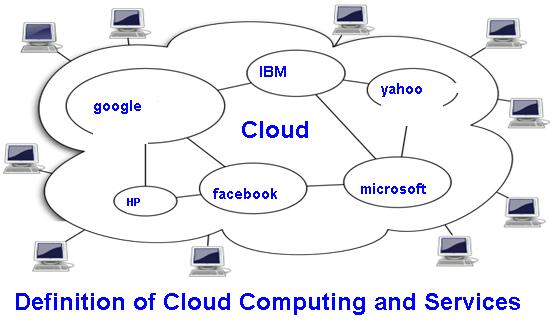
Definition of Cloud Computing and Services

The purpose of this paper is to introduce the fundamental information of Cloud Computing.  What Cloud Computing is about, Available Cloud Computing services and the key players, Cloud Computing benefits and the example, Cloud Computing challenge and the example are described. 

Definition of Cloud Computing and ServicesDownload Definition of Cloud Computing and Services