Design & Development of Student Database Management System PHP Project

The purpose of implementing the ‘Student Database Management System’ is for the ease of maintaining student-related data on an institution, our system does serve this purpose and also is a means of communication between the students/parents and teachers during times when physical contact is not possible or when it is necessary to convey an important message quickly, due to this system a lot of paperwork, maintenance, space, time are all reduced for the purpose of handling large student data.

The goals achieved by this project are:

  • Centralized Database.
  • Reduced paper works and Stacking of files.
  • Easier Searching, Updating, and Storing the Details
  • User-Friendly Environment.

Along with the existing features, additional features can be added in the future, Like:

  • Handling admission details in a more detailed manner by Adding a payment feature through our site.
  • Extension of the current system for the entire institution.
  • Better interaction between the parents and the teachers.
  • Storing the records of co-curricular activities.
  • Assigning and reporting the assignments and many more.

Output Results:

  • Welcome Page with Register and Login Page

Teacher View

  • Teacher Home Page
  • Admit, Update Student’s details for a Specific Class
  • Fetch or Search the Student Details Using the Student ID
  • Admit or Add new Student Details to the Specific Class
  • Add or Update the Subject with its Instructor’s Details
  • Announce Upcoming Events and Circulate the Same
  • Update Attendance for each student in the Class
  • Update Internal Assessment Marks for each student
  • Update Exam Marks for each student

Student View

  • Student Home Page
  • View any Recent Announcements made by the specific Subject teacher
  • View Subject Details and Contact information of the subject teachers
  • View Internal Assessment Marks for each Subject
  • View Final Exam Marks for each subject
  • View the Attendance details

SOFTWARE REQUIREMENTS

  • Database Support: MySQL 5.7
  • Web Browser: Google Chrome
  • Coding language: PHP, HTML, CSS, JS.
  • Server Deployment: Apache Server, MySQL Server.

Download & Deploy the complete Student Database Management System Project PHP & MySQL Code, Project Report, and Execution Steps readme file.


Development of Blood Bank Management System Java Project

Our Project “Blood Bank Management System” is a computerized system used to store and retrieve information related to Blood donations/inventory the project aims to expose the relevance and importance of Blood Bank Management Systems. The system allows the admin/receptionist to store and retrieve information like blood donor details, blood receiver details, amount of blood present in the inventory of the blood bank store, etc.

The Blood Bank Management System checks for the availability of a certain blood type like A+, A-, B+, B- etc. If the blood type is available, then the system allows the admin to further proceed with the procedure. Otherwise, it asks the admin to choose another blood type. The system asks the admin to enter customer details for further blood transactions. The main purpose of this Blood Bank Management System is to reduce the manual/paperwork involved in blood bank management and make it convenient for the admin/receptionist to store and retrieve data as and when required. The software supports the concept of modifications by admin and allows inserting, modifying, or deleting customer data.

Introduction

Considering the volumes of data that need to be tracked and accessed, it would be very difficult to manage the accuracy and quality of data manually and deliver them accordingly. It would be almost impossible to get the details required in case of manual maintenance of data. The BBM (Blood Bank Management system) is an innovative solution that helps in managing huge loads of blood bank data. The Blood Bank management system simplifies the manual work and allows smooth administration of the operations of blood transactions.

Purpose

This project is aimed to reduce the manual work involved in data maintenance in the Blood bank management system. This project is developed mainly to simplify the manual work and allows smooth administration of the operations of blood transactions. The purpose of the project is to computerize the administrative operations of a blood transaction and to develop software that is user-friendly, simple, fast, and cost-effective. It deals with the collection of Donors, Receivers’ Inventory information, etc. Traditionally, it was done manually. The main function of the system is to enter and retrieve these details as and when required, and also to manipulate these details meaningfully.

  • To ease the process of blood donation and reception.
  • To improve the existing system.
  • To develop a scalable system.
  • To be highly available

Scope

  • Ensure that all the functionalities of a manual blood bank are covered
  • To ensure proper contactable information.
  • Make sure the program is simple and easy to use.

Conclusion

The Blood Bank Management System is a great improvement over the manual system which uses lots of manual work and paper. The computerization of the system speeds up the process. This system was thoroughly checked and tested with dummy data and found to be very reliable. Thus, we have implemented a fully comprehensive and minimalistic efficient system for use by Admins/Receptionists without any additional training.

Limitations of the Project

The donor cannot modify/add/delete his details like address, and phone number. The whole project is done for an offline blood bank since there is no way to access the details online. Moreover, there is no feature to modify donor details.

Future Enhancements

The Blood bank Management System can be enhanced by including more functionality like allowing online access to the donor to modify the details if he has gone wrong while registering. Online implementation to the nearest blood banks may be implemented.

Visit Here or download the complete Development of Blood Bank Management System Java Project Source Code, Report, and how to run files.

Implementing a Blood Bank backend system.

An Individual Donor donates blood at the branch. The donated blood is tested for safe use. The Tested blood can either be kept as whole blood for ‘whole blood’ transfusion or can be processed into different components. The different components can be Red cells, Fresh Frozen Plasma, and Platelet Concentrate.

By using blood components, several patients can be treated with the blood from one donor, leading to optimal use of every unit of donated blood.

The system will be designed as a set of rest endpoints.

● Register a Blood Bank Branch with Address and Contact details.
● Register members who can donate blood or request blood or its components.
● Record blood donation details.
● Record Test results for a blood donation.
● Store request for donated blood unit either as Whole or as Component. Calculate Shelf life and update the inventory.
● Record blood or component requests and update the inventory.
● Search for blood or blood component active inventory across branches.
● Leader board – for top donors. By Period – by month, year, and By Branch or Across Branches.

Donation and Receipt Records can have the following information,

● Unique Transaction ID
● MemberID
● BranchID
● TransactionDate
● Quantity
● Tested
● BloodGroup

Inventory Records can hold the following information,

● Donor transaction reference
● Quantity In milli-liter
● Blood Group type
● Sub Type (Whole, RBC, Plasma, Platelet)
● Expiry Date
● Active

Note:

● Record blood test results, and mark the unit as unusable in case of a failed test.
● A Single donation by a donor can be fixed at 450ml for the assignment
● Interval of 90 days should be maintained between two donations by the same donor.
● Expired inventory should not be searchable.

Design & Development of Tender Management System Project

Abstract:

The Tender Management System was developed to enable the vendors to get all the tender details online and provide a facility to submit the tender. This Tender Management System project was developed & designed with Java & MySQL Database.

Existing System:

  • Contractors need to submit their documents by visiting the office or centers on time.
  • Contractors have to bid for a particular tender on time by applying forms and need to wait for an approval reply.
  • The Admin Needs to post the Projects or contracts as a poster or advertisements regularly.
  • It takes a long time to access tenders or vendors’ data access.

Proposed System:

  • User Needs to Have a Network Connection.
  • New User needs to register a new vendor on the website.
  • Contractors can log in and bid for some existing tenders.
  • They need to log in using their login-id and password which they used while registration
  • To reduce paperwork, and data that are available online, using this final decision can be taken by the administration and can contact directly to such suppliers.
  • Easy to access the tenders and vendors’ data.

Software Requirements:

Language: Java
Web technologies : J2EE (JDBC/Servlets/JSP)
Front-end Design : Html, CSS, JSP, Bootstrap
Database: MYSQL
Scripting: JavaScript , CSS

Application Work Flow

Modules:

Administrator

Uploading advertisement documents
Verifying projects and contractors by using their information
Accepting and Rejecting Bids
Maintaining data and confirmation of the final report.
Update Notice Board
Make some announcement
Block or unblock some vendors or company

Company

The Company needs to get registered to proceed.
The company can log in with a valid username and password.
Apply or releases new tenders and view the status of the tender.
Make Some announcements.
Change the tender details
Documentations

Vendor

Vendors are the key persons or contractors who look for new upcoming tenders on the website
Vendors’ Functionality includes:
New Vendors can register
Login using vendor-id and password
View and update their profile
See the new open tenders and their details
Bid for a tender with an amount greater than its base price
See the bid approval or denial status

After the tender status approval, they can view and submit the documentation
Vendors can look for the important notice in the notice section

Conclusion

Our Project Tender management System Successfully Created a user-friendly environment for the tender management process.
This Project is flexible and changes can be incorporated easily.
Easy for further Modification
Saves a lot of time by doing most of the processes online
It may lead to increase profit and improve the quality of a company.
Assigns the tenders and project in a good manner and optimal way to the contractors in less time with low-cost charges.

Download the complete Design & Development of Tender Management System Project using Java, MySQL, HTML, CSS, JavaScript, Bootstrap, and J2EE.

Development of Visitor Management System Java & MySQL Project

VMS also known as Visitor Management System is an interactive project which after considers the real-life examples of an institute dealing with daily visitors. It is designed from scratch using JAVA and Python and using a server-side language MySQL which is connected to the developer language JAVA using a JDBC connector.

The entire work of the Visitor Management System Java & MySQL Project is done on a local host which consists of the application using JAVA and Python involving the use of APACHE TOMCAT server and MySQL. The server side contains all the implementation related to setting up of database using MySQL, creating session models for joining different pages, and other transactions to be performed. It is responsible for picking up information from the database and displaying it on the client side which comprises a basic user interface built-in JavaFX as the software GUI.

Introduction

In this fast-paced world, where everyone is squeezed for time, it is very difficult for an institute with a large number of students and instructors to manage and have a smooth-going and organized way of entertaining visitors. Logistically, the visitor management system allows the security system of the institute to conventionally check and enroll each visitor efficiently inside the premises without the hassle of identity clashes and any other inconvenience.
It is therefore the task of institute administrators to optimally design a visitor management system where the security department could save time. 

Motivation

The motivation for designing this visitor management system is the keen observation of day-to-day problems faced by the security department, as the lack of info and medium among the teachers, students, and the administration of the institute such that there is difficulty in the efficient process of teaching and studying by the teachers and students respectively. Moreover, we value the recent learning about the programming languages as well as seeing how powerful and dynamic they are when it comes to designing system and database-based projects. The languages used to develop the project are extremely useful while working with the technologies at a workplace.

Aim Of The Project

This Visitor Management System Java & MySQL Project is designed to help students understand software design using programming languages from their basic capabilities to have a real industry-based client and service provider environment. This application helps the student to understand the basics of appearance and how a complete working application can be built from scratch. It also allows students to understand the concept of GUI-based applications and use it to embed MySQL and other programming languages. Further, it gives insight into how the client-side language interacts with the server-side language and finally with the database. This application is a server-based app so it involves the use of a particular institute server (in this case our localhost machines). The visitor management application is very versatile and can be enhanced by adding more functions and modified graphics for the use of the institute’s security department.

Project Perspective

The visitor management application is a web-based system.

User Interface & Characteristics

The two types of interface found in the visitor management system are as follows :

• User Interface: Officials of the security department can view the home page of the visitor management system. The officials can carry out a transaction based on deciding whether the visitor is a –
• New User
• Old User
The official also has options for “Checkout” and “Detail updating” of visitors adding to it he/she can also check the “Users not checked out”.

• Admin Interface: Along with other features the admin has superuser rights to –
• Report viewing
• Log viewing
• Entering the details of new cards

Design & Development of Smart Dustbin Project

Objective:

The Smart Dustbin Project comes under the domain of Environment, Health, and Hygiene. Through this Smart Dustbin project, we aimed to build a working prototype of a dustbin whose lid opens automatically, without any contact when a person comes near it (in the range of 2 – 30 centimeters) to throw the trash. Since the process is contactless it maintains public hygiene and sanitation. Moreover, there are many instances in public places where the dustbins overflow because of irregularity in the waste collection from the dustbin (which is usually done by the municipality sanitation workers).

To overcome this issue, our next target was to provide functionality such that when the dustbin is full, it will not open at all if the person comes near it to throw the trash. Now, a sanitation worker will need to open the bin to empty the contents irrespective of whether it is full. Therefore, to unload the bin in case it is full we provided a switch that when pressed will open the lid in any case. And in this case, the lid will continue to remain open until there is an object (hand) in front of the ultrasonic sensor in the predefined range.

This Smart Dustbin product can be useful in all the places where the dustbin is frequently used and minimal or no contact is expected from the user. For example, doctors can use this in an operation theatre, flight attendants can use it while serving food, it can also be used in public toilets, etc. In countries like India, where waste management is a crucial problem, it is important to work further on such products that provide methods to collect the garbage along with maintaining proper hygiene as well as contributing to the environment.

Outcomes:

Using a microcontroller-based system, we achieved the 3 functionalities at the end of this project that we had aimed for.

1. First, we were able to open the dustbin without any contact using the ultrasonic sensor (the side sensor). It is programmed to detect motion in the range of 2 – 30 centimeters in front of it and this will open the lid.

2. The second functionality is that when the dustbin is full (it reaches a level defined in the code), it will not open even if there is movement in front of the side sensor. This functionality is helpful to resolve the issue of the overloaded dustbins which are often seen in public places all around India. The level of the garbage inside the dustbin is sensed using another ultrasonic sensor (the top sensor).

3. Finally, the last functionality is to be able to unload the dustbin when it is full. This functionality is needed because when the garbage in the dustbin reaches a particular level, after that it can not be opened even with the motion in front of the side sensor (because of the second functionality). Therefore, in this case, to unload the dustbin for reusing we added a pushbutton in our circuit.

Components Used:

  • ARDUINO – UNO
  • 2 HC-SR04 Ultrasonic Sensors – One on the cylindrical surface (Side Sensor) and the other on the lid (Top Sensor)
  • Mini/Micro Servo Motor (9 gms)
  • 4-pin push button
  • Resistor
  • 9-volt power supply
  • Jumper wires
  • Breadboard code:

Visit Here to Download the Complete Smart Dustbin project code, report, Output Video Link, and any academic project help from the project developer.

Design & Development of Online Examination Management System Project

This project is aimed to reduce the manual work involved in data maintenance in Online examinations and automates the Online Examination Management System. This project is developed mainly to simplify the manual work and allows smooth administration of the operations of an Online Examination.

The purpose of the Online Examination project is to computerize the administrative operations of an Online Examination System and to develop software that is user-friendly, simple, fast, and cost-effective. It deals with the collection of, Subject, Test and Exam information, etc. Traditionally, it was done manually. The main function of the system is to conduct exams online and reduce the delay of results.

The Online Examination System is developed using HTML and MySQL fully meets the objectives of the system for which it has been developed.

Modules:

ADMIN: The admin is responsible for Exam conduction.

USER: The USER takes up the test by signing in and login in with his valid Login id and password.

SUBJECT: The user has options to take up a quiz on a particular subject on the list.

TEST: The user gives the examination for the subject he/she has selected. Formal testing often results in a grade or a test score.

QUESTION: The user selects the answers which he/she feels are correct and selects an option.

USER ANSWER: It stores all the correct answers to the questions which will be stored by the admin.

RESULT: It displays all the scoring made by the User after taking up the test.

Output Results:

ADMIN SIDE

  • The admin is required to enter their respective Login id and password for them to login into their respective portals.
  • Has the option to add subjects, add tests, and add questions.
  • Admin is provided an option to add a subject.
  • Admin adds test details.
  • Admin adds the questions.

USER SIDE

  • The student logs in with his valid log in ID and password.
  • The user has to Sign up before he has to log in.
  • The user takes up the quiz.
  • The user has the option to take up a quiz on a particular subject on the list.
  • The user gives the examination.
  • The user gets results based on his performance.
  • Shows the right answer.
  • Result sheet of all users.

Pharmacy Management System DBMS Project

Introduction

Pharmacies are an essential component of healthcare and handle the function of selling medicines. Even though the pharmacies do not seem different than any other shop, their functioning is very different due to various laws regarding medicines. For example, most of the medicines available in a pharmacy cannot be purchased without a prescription.

Even with a signed prescription, there is a limit on the quantity that can be purchased. Additionally, pharmacists can do a background check on customers’ medical history to ensure that they are not involved in medical abuse. In addition, there are other laws on the operations of pharmacies like a requirement for the safe disposal of expired medicine and the requirement of license for employees that mix/prepare the medicines.

Thus, preparing a Database Management System for a pharmacy not only requires a study of how things are handled from a customer or employee point of view but also the relevant rules and regulations.

With this Pharmacy Management System DBMS Project, we aimed to develop a comprehensive system that could deal with challenges faced in day to day operation of a modern pharmacy.

ER Modelling

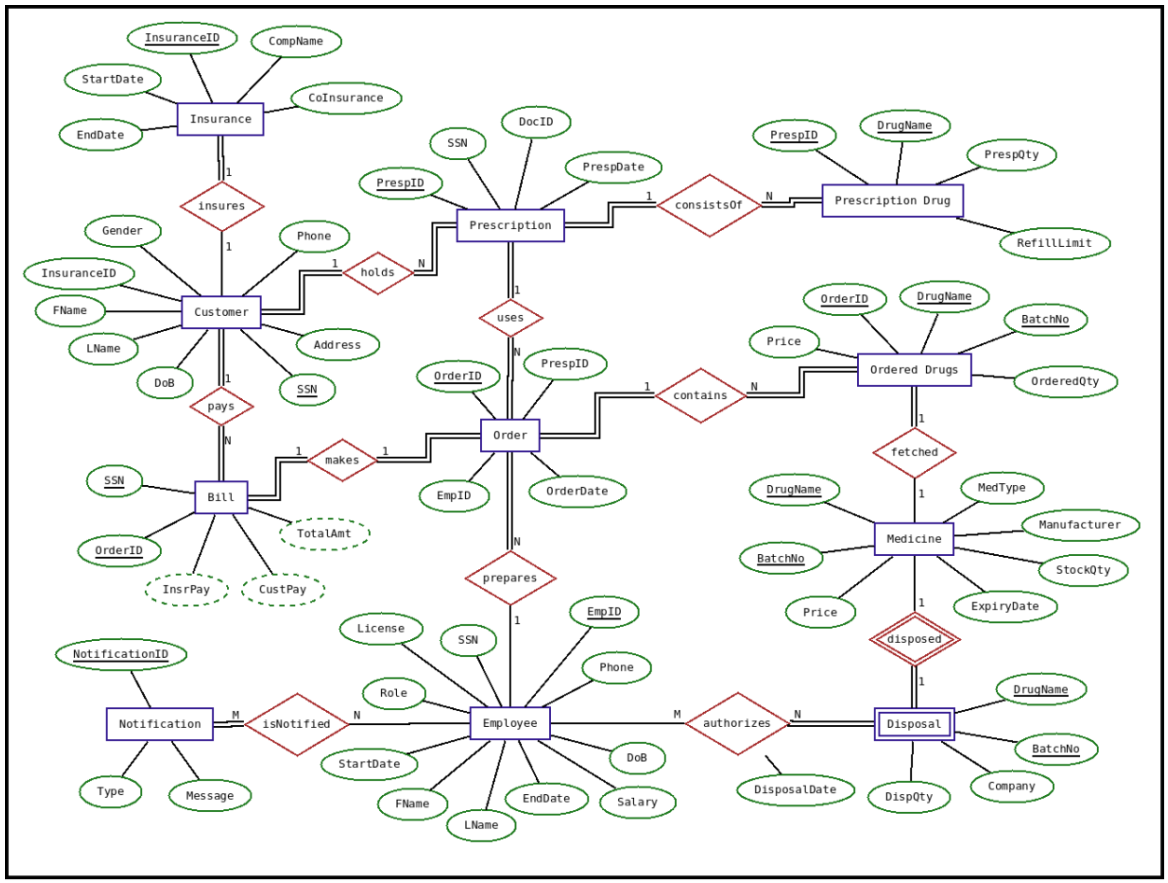
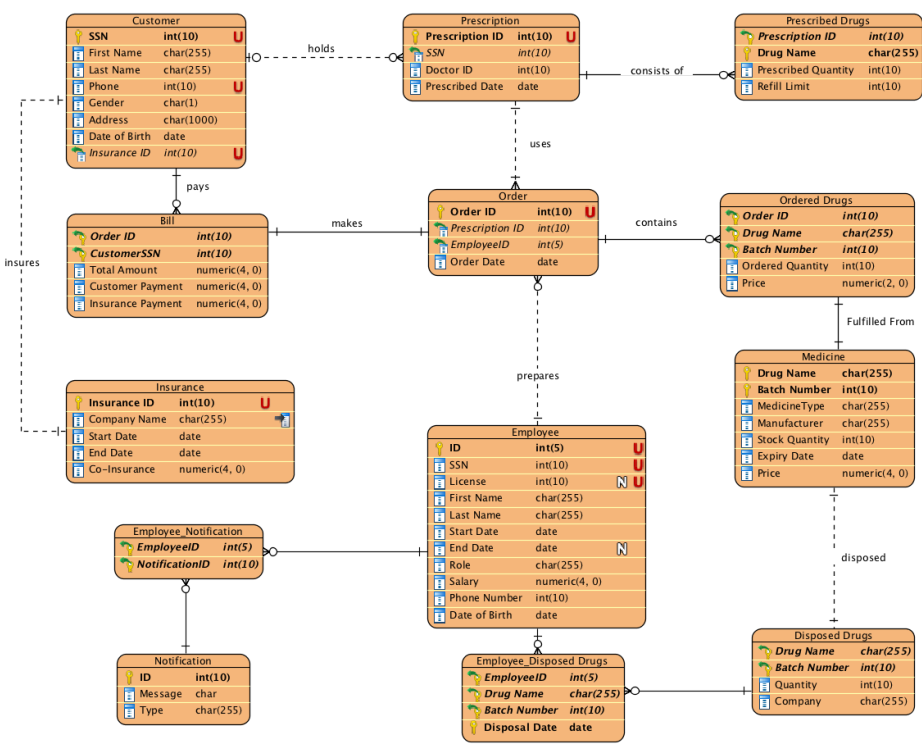
The final ER diagram and UML diagram are shown below with explanations.

ER Diagram

UML Diagram:

1. A single customer can have multiple prescriptions. Thus, the relationship between them is one too many.
2. A prescription consists of multiple medicines, so the relation is one too many. In the case of refills, a prescription can generate multiple orders. So, this relation is one too many as well.
3. A single order can contain multiple medicines, thus the relationship is one too many. One order, however, can generate only one bill. Thus, the relation between bill and order is one-to-one.
4. A customer can make multiple purchases and hence, the relationship between the customer and the bill is one too many. This is because every bill has only one customer.
5. In the medicine table (stock), the medicine’s name and batch numbers can uniquely identify every medicine we have in inventory. The batch number is assumed to be unique among manufacturers.
6. Disposed medicines are weak entities and use foreign key medicine’s Name and Batch Number as their primary key.
7. One employee can receive multiple notifications and one notification can be sent to multiple employees, thus the relationship is many to many.
8. Multiple employees can dispose of the same medicines. Similarly, one employee can dispose of multiple medicines. Hence, the relationship is many to many.
9. One employee can prepare multiple orders. However, a specific order can only be prepared by one employee. Thus, the relationship is one too many. Relations and Normalization

Conclusion

The Pharmacy Management System DBMS Project was a good learning experience for implementing a real-world DBMS and helped us understand the nuances of full implementation. The most interesting part was the experience of starting from the real world and then translating the concepts into the terms of a DBMS. Paired with a capable application front end, it can handle day-to-day operations for a pharmacy.

Download the Complete Pharmacy Management System DBMS Project Code, Report, and deployment help for free.

Hospital Database Management System Project using PHP & MySQL

Description of Project:

Hospital Database Management System Project using PHP & MySQL developed under the Database Management System Course study, It is DBMS based application that can handle different workflows related to a hospital using MySQL and PHP. The main aim of developing this project is to develop an online web-based system that registers, stores, and alters the data related to the day-to-day hospital operations to have some meaningful conclusions.

System Requirement Specification:

We have used Netbeans IDE 8.2 software to configure PHP/HTML/CSS scripts on our localhost webserver. The operating system was Windows 10 / macOS Catalina. The web browser is Chrome with PhpMyAdmin as Front-end and Back-end Integration. We deployed our web server on localhost using Apache(built-in server) using MAMP/WAMP (MacOS/Windows Apache MySQL PHP. At Least 8MB of disk space is required. We can implement Hospital Database Management in modern browsers like IE7+, Firefox, Safari, Google Chrome, and Opera that support CSS and HTML frameworks.

Functionalities:

1) Managing Patients Information:

  • For deriving the age of a patient, given the DOB, we have created a function followed by a procedure 
  • To get an overview related to the blood groups of all the patients present in the database
  • To get the details of the patient who has the maximum number of appointments in this hospital
  • To display the patients who took appointments on the weekends
  • To get information about the patients who took an appointment during the current month
  • In our database, we have a table for all the patients in the hospital, and then a separate table for indoor patients. However, we do not have a table that shows the details of outdoor patients.
  • At last, we have generated a bill for a visit of a patient, which includes a patient’s visit charge, doctor charge, medicine charge, etc. And generates the total amount to be paid.

2) Managing Doctors’ Information:

  • To get information about the most famous doctor/s among the patients

3) Managing Appointment Related Information:

  • To get the trend of appointments for each weekday
  • To display patient-wise appointment details
  • To display year-wise appointment details

4) Managing Department wise HODs:

  • For identifying a HOD of a department

5) Managing Staff, Rooms, and Medicines related to Information:

6) Managing Admin/Login Details:

  • We have created a simple login and user registration system using authentication from Admin User Table.
  • There are some functionalities like creating a new administrator, logging out, and password change.
  • As a matter of Privacy Policy we don’t save ‘password’ directly but instead, store the HashCode corresponding to it

7) Managing other information:

  • If Contact no. is not a 10-digit number then a trigger will display an error message
  • For managing patient log details

Visit Here and Download the Complete PHP & MySQL Database Management System Project Code, Report on Hospital Database Management System

Car Rental System Database Design Project

Data Requirements

The Car Rental System Database involves around three main entities Car, User, and Reservation

The car can be reserved from a rental location with a specific address. It has a unique Rental_Location_ID, a phone number, and a contact email. A rental location keeps track of the address where the car belongs using the street name, state, and zip code.

A rental location has several cars for rental. Each car is described by VIN, Registration Number, Color, Model, Manufactured year, Seating capacity of the car, whether it has Disabled friendly feature and its Status marked ‘Available’ or ‘Unavailable’

The car has a parameter Car Type. It can be ‘Economy’, ‘Standard’, ’SUV’, ‘Premium’ and ‘Minivan’. Car Type defines the rental price per day. A user can take Insurance per day for the rental car. There are different types of Insurance each having different medical coverage, collision coverage, and bodily coverage. Insurance Types are ‘Liability’ and ‘Comprehensive’. Car type and Insurance Type drives the Insurance price per day.

A user can reserve a car for several days. He can use any valid promotional code which is maintained by status. When a user books a car he mentions the start date and end date for which he needs the car. The end date will be hypothetical at the time of reservation and updated with the actual end date when the car is returned. The total amount and net amount are calculated based on start date, end date, rental price per day, insurance price per day, and promotional code if any

A user is categorized as a guest or customer. The user can continue reserving the car as a guest as long as he has not registered as a a customer. A user is uniquely identified by his/her license number. User information consists of his name as first name, middle name and last name, email, address, date of birth, and contact number

A registered customer will be provided with a login id and password. A customer can save his credit/debit card details for future payment

Partial payment can also be made at the time of reservation and the balance must be paid by the user during car return when the actual end date is known. If the user is a customer, he/she can pay through saved debit/credit card details

A user can add any accessories as part of his/her reservation. Accessories can be ‘Car Seat’ and ‘GPS’. A user can add as many accessories he/she needs as part of the reservation

The additional driver can be added as part of his/her reservation. For each additional driver, there will be an additional charge

A user can cancel a reserved car before the car has been rented. A reservation can have status as ‘Reserved’, ‘Completed’, and ‘Cancelled’. When the car is reserved, the status will be in ‘Reserved’ Status. Once the car is returned and the total amount is paid, the status will be ‘Completed’

Functional Dependencies

In Rental car location, Rental_Location_ID is the primary key
Rental_Location_ID —> {Phone, Email, Street_Name, State, Zip_Code}

Type of the car defines the rental price of the car per day
Car_Type —> Price_Per_Day

Type of the insurance defines the insurance coverage
Insurance_Type —> {Bodily_Coverage, Medical_Coverage, Collision_Coverage}

Insurance Type and Car Type defines the Insurance price per day
{Car_Type, Insurance_Type} —> {Insurance_Price}

A user is defined by his/her License_No
{License_No} —> {FName, Mname, Lname, Email,Address, Phone,DOB, User_Type}

In a user credential, Login_ID defines the rest of the attributes in the entity
{Login_ID} —> {Password, Year_Of_Membership, License_No}

Login_ID and Card_No in Card_Details defines complete card information
{Login_ID, Card_No} —> {Name_On_Card, Expiry_Date, CVV, Billing_Address}

Reservation_ID drives all the other attributes in Reservation relation
Reservation_ID —> {Start_Date, End_Date, Meter_Start, Meter_End, Rental_Amount, Insurance_Amount, Status, License_No, VIN, Promo_Code, Additional_Amount, Tot_Amount, Insurance_Type}

Payment_ID is the primary key of Payment relation
Payment_ID —> {Amount_Paid, Card_No, Expiry_Date, Name_On_Card, CVV, Billing_Address, Reservation_ID, Login_ID, Saved_Card_No, Paid_By_Cash}

Promo_Code defines other attributes in Offer_Details relation
Promo_Code —> {Description, Promo_Type, Is_One_Time, Percentage, Discounted_Amount}

Additional_Drivers relation
{Reservation_ID,Name} —> DOB

In Accessories relation, Accessory_ID drives the type and amount of the accessory
Accessory_ID —> {Type, Amount}

Download the Car Rental System Database Design Project Code, Report, and Presentation.

Chess Game Project using HTML & Java Script

The objective of the project:

The objective of our Online Chess Game project is to create an online Chess game that enables you to both play with your friends as well as against the computer.

Chess Game Rules:

  • The player with white pieces starts his turn first.
  • The Player has to protect his king and subsequently make strategies to kill the opponent’s king.
  • When the king of one player is checked by the other player’s pieces, he will have to take the king out of that check to a safe place. The player who checks the king has to warn the opponent by saying “CHECK”.
  • The one to lose his king will be the one to lose the game.

Features:

Player vs Computer:

The player will have to start with whites and make her first move, and the computer will take blacks.

Player vs Player:

The player who takes whites should start first and the other player plays alternately.

Main Functions in Player vs Computer code:

1 updateSquarecolor()
This function is used to update the colors of each square after each move.
2 checkBlack(n,values)
This function is used to find all the possible places where a selected white chess piece can be moved in this step.
3 checkWhite(n,values)
This function is used to find all the possible places where a selected black chess piece can be moved in this step.
4 checkmate()
This function is used to check if there would be a danger to your king if you make any move and declares you to have lost.
5 check()
This function is used to make your moves, if possible, and also to warn the player if the king is in check and the player is not trying to protect it, by the use of the checkBlack and check white functions described above.
6 chooseTurn()
This function is helpful for the computer to play its move by moving forward with the best possible move. It also declares the player as a winner if there is no possible move for the computer to make while protecting its king. It basically
helps in the propagation of the game step by step.
7 startTime()
This function is to show the current time and day.
8 maxxTime()
This function is used to check the time limit for each move and warn the player after 45 seconds and stop the game and declare him to have lost after 1 minute.
9 maxxTime2()
This function is used to check and stop the game at a maximum time limit of 45 minutes and the game would be declared drawn.
10 restart()
This function is used to restart the timer after each move.

Main functions in Player vs Player code:

1 updateSquarecolor()
This function is used to update the colors of each square after each move.
2 checkBlack(n,values)
This function is used to find all the possible places where a selected white chess piece can be moved in this step.
3 checkWhite(n,values)
This function is used to find all the possible places where a selected black chess piece can be moved in this step.
4 checkmate()
This function is used to check if there would be a danger to one’s king if they make any move and declares him to have lost.
5 check()
This function is used to make your moves, if possible, and also to warn the player if the king is in check and the player is not trying to protect it, by the use of the checkBlack and check white functions described above.
6 startTime()
This function is to show the current time and day.
7 maxxTime()
This function is used to check the time limit for each move and warn the player after 45 seconds and stop the game and declare him to have lost after 1 minute.
8 maxxTime2()
This function is used to check and stop the game at a maximum time limit of 45 minutes and the game would be declared drawn.
9 restart()
This function is used to restart the timer after each move.

Installation:

Download all our files and put them collectively in a folder named “Chess”.

In Ubuntu:

Now put this folder into the /var/www/HTML/ folder in the other locations on your computer.

In Window:

Download XAMPP on your PC and put this folder into the htdocs folder of XAMPP.
Now go to your web browser and type localhost/Chess/
Best viewed in Google Chrome and Mozilla.
Download the Chess Game HTML project Code & Report