
Application and Profile Configuration in FTP application

Application Configuration:

                                The next step after doing the mobile node configuration and wireless LAN server configuration is configuration of application. This is considered as the significant step of the simulation procedure and this is done when the attributes of application config are edited. The object palette is opened for dragging these objects; they are placed on the work area. Based on the requirement of the user the name of the application config can be changed and in this simulation it is taken as appconfig. Set name option can be selected for changing name of the application config by right clicking on it.

Then for the appConfig the name of the object is to set as the next step and the entire process is clearly shown using the screenshot attached to the Appendix section. In this scenario the traffic is send across the network using the AODV routing protocol and for the application has to provide support and the support is given when the required attributes are selected.

FTP application is selected for this scenario because generating the TCP traffic is the main aim of simulating this scenario. By giving right click on the application config and by selecting the option as edit attributes the required attributes can be edited. The application name is the FTP and the rows are taken as 1. The FTP application can also be changed by editing option.

                     The attributes required to set the application configuration are 10000000 bytes is taken as the constant file size and the time taken to send a file is 3600 seconds for passing the traffic source TCP. Then the application configurations are said to prepare for using. Setting the profile configuration is the next step. 

Profile Configuration:

                             This section explains the configuration of profile and this is done just after the configuration of application is done. Similar to the settings of application configuration the profile config object is also dragged from the object palette and dropped in the work space. Depending on the necessity of the user the name of this profile config can be changed by selecting set name option by giving right click on the profile config and in this simulation it is set as profconfig. By giving right click and by selecting the edit attribute options all the required attributes can be edited. The number of rows is set as 1, tcp profile is selected as the name of the profile based on the requirement of the user these attributes can be changed.

The “expand the application” is selected for changing the other required settings and the application is selected as FTP as the generation of TCP traffic across the MANETs is the main aim of this scenario. In this scenario the start time is set as 5 sec, ending the profile is the simulation ending time. This process is explained using the screen shots that are attached to the appendix section. Once the configuration of application and profile is done these must be applied to the mobile nodes and server as the next step which is explained in the next section.

This paper is written and submitted by Sujana Priya V.
Mobile nodes and Wireless LAN server configuration in MANET

Mobile nodes configuration:

                           When the required networks settings are done in the simulation procedure the required mobile nodes are dragged from the object palette and placed in the work station, the next step to this is configuration of the mobile nodes placed in the work station. This configuration of mobile nodes is done in order to support the application of the project. The number of mobile nodes required for this simulation is 200 and all the 200 mobile nodes are selected from the object palette and placed in the work area.

Then all these nodes are to be allocated with the routing protocol and for this scenario all the nodes are assigned with the AODV routing protocol to sustain this scenario simulation. For this the mobile node is selected first and then right click on it and then from the options the routing protocol AODV is selected and this is done for all the 200 mobile nodes this is also represented with the screen shots attached in the appendix section. When all the nodes are allocated with the routing protocol then the nodes are said to be ready for using during the traffic passing in the scenario.                                                    

Wireless LAN server configuration:

                               In order to control all the 200 mobile nodes, a “wireless LAN server is used, and this section concentrates on the explanation of settings that are required for the server to control the nodes. The section before explains the configuration of mobile nodes selected for the simulation and this section explains the configuration of server, the server is also allocated with the AODV routing protocol similarly as the mobile nodes.

The server TCP parameter is set as Tahoe as generating the TCP traffic is the significant goal of this scenario 1. As the next stem to this the nodes are assigned with the IP addresses and this is done using the tab and then from the application IP is selected and then IPv4 addresses are selected automatically and then the server is also assigned with the IP address in the similar procedure. When once these settings are configured, the nodes are said to be ready for sharing the information. The screen shots indicating these configurations are attached to the appendix section and the next sections of this chapter deals with the explanation of profile and application settings required for the simulation of this scenario.

This paper is written and submitted by Sujana Priya V.
TCP traffic over the CBR traffic through the MANET Network setup

Network setup:

                      The significant aim of this project is evaluating and comparing the performance of TCP traffic over the CBR traffic though the MANET by the usage of various routing protocols. This scenario concentrates on the estimation of TCP traffic performance using the AODV routing protocol and thus requires the few settings. The network setup is done using 200 mobile nodes with the MANET family as the basic MANET model. Few parameters are required to be setup for the simulation of scenario one and they are indicated as follows:

  • 200 mobile nodes are used
  • Campus is considered as network scale
  • 500X500 meters area is used as size of the network
  • MANET model is used as the model family

                               A blank scenario is taken for creating this project scenario and the network cable is selected as the campus. The screenshots that explains all this process are attached to the appendix section. When once all these settings are done the object palette is opened in to the work area to make the network settings needed and then the blank scenario is opened. The simulation of the scenario is done using the objects that are taken from the object palette and these objects are dragged from the object palette and placed on the work station. This simulation procedure uses the following objects: 

  • Application Configuration
  • Profile Configuration
  • Mobile Configuration
  • Wireless LAN Workstations Mobile(200)
  • Wireless LAN Server Fixed(1) 

                        The procedure how the objects are dragged from the object palette and how they are placed in the work station is represented using the screen shots attached to the appendix section.

This paper is written and submitted by Sujana Priya V.

Simulation Procedure of CBR traffic within the MANET

Simulation Procedure

 Introduction:

                        The main concentration of this chapter is towards the explanation of the simulation procedure that is actually used in this proposed application development. Especially for the evaluation of performance of TCP traffic against the performance of the CBR traffic within the MANET using the AODV routing protocol in obtaining the results and making the comparison. The simulation procedure includes the detailed explanation of different tasks such as scenarios proposed, application settings, settings of mobile configuration, and settings of profile configuration and also the arrangement of attributes for the mobile nodes taken for the simulation.

This chapter also includes the explanation of statistical settings that are used in this particular application and also the acquiring of results needed from the references to the global statistics and node level statistics with corresponding mode is also explained. The sections below explains the step by step simulation procedure implemented in this project and the required deployment process that is used is also explained using the screen shots that are attached with the appendix section.

                            Eight scenarios are considered for the simulation of this project application and the design chapter already discussed about these scenarios in brief all these eight scenarios focus on the considered traffics across the MANETs using various routing protocols. 

Simulation of Scenario:

                            This is the first scenario of the simulation and this is assumed as scenario 1, and this deals with generation TCP traffic across the MANET using the FTP application by the usage of AODV routing protocol. The sections below explain the simulation of scenario 1 in step by step in various subsections and the network setup required for this scenario is explained below:

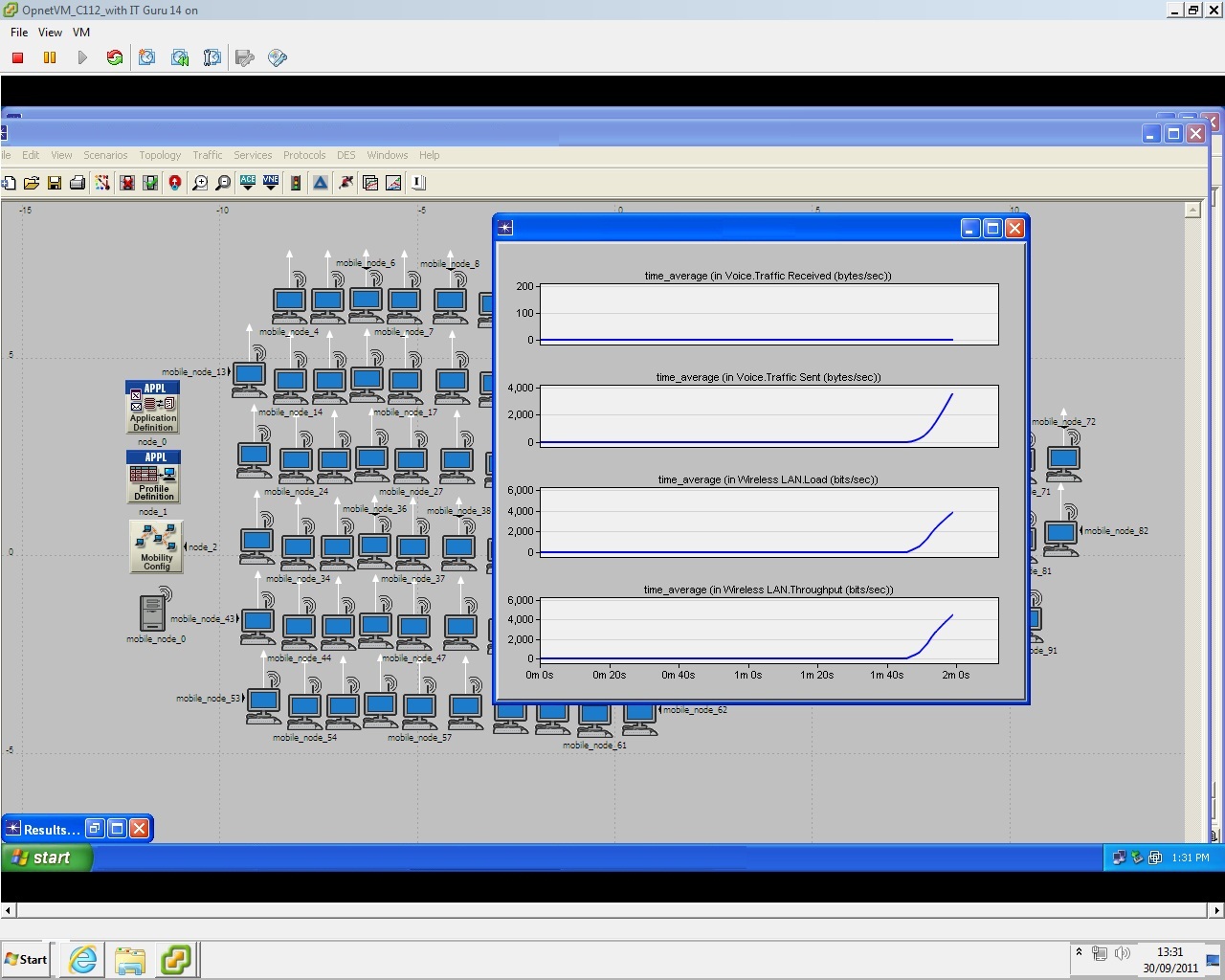
aodv_cbr WIRELESS

This paper is written and submitted by Sujana Priya V.

MANETs using the AODV DSR OLSR and TORA routing protocols

The designed used for the simulation of this project is explained in this chapter. The number of scenarios required for the project is decided in this chapter. And the scenarios require a model family and the MANET family is selected as the model family for these scenarios using different routing protocols. 200 mobile nodes are used for this simulation across a 500X500 meters capacity area for the evaluation of the TCP performance over the CBR performance.

For the scenarios 1,3,5,7 the application used is FTP because generating the TCP traffic is the main aim of those scenarios and these will uses the AODV, DSR, OLSR and TORA routing protocols respectively. Whereas the scenarios 2,4,6,8 the application used is the low quality voice application because of the reason the CBR traffic is generated across the MANETs using the AODV, DSR, OLSR and TORA routing protocols respectively.

DES statistics are used for the simulation and for this the node statistics and global statistics are considered. The time taken for the simulation is 2 minutes. The results obtained from the simulation of all the scenarios are used for the comparison of TCP performance against the CBR performance using some performance metrics like load, delay and through put. The simulation procedure of this design is explained in the next chapter.

This paper is written and submitted by Sujana Priya V.

AODV routing protocol in MANET Scenario

Scenario:                    

This is the second scenario and this is indicated as scenario 2, the main aim of this scenario is generating the CBR traffic across the MANET and also to estimate the traffic’s performance. This scenario also requires the creation of a scenario similarly to the scenario 1 but this scenario can be created by duplicating the scenario 1 by just selecting the scenario menu and then by the duplicate scenario option and then place the duplicate scenario on the work station and then used as the scenario2.

Then for that duplicate scenario changes are made based on the requirement as it suits for scenario 2 and then the scenario will be ready to use as scenario 2. The setting for the scenario 1 and scenario are almost similar but have few differences in terms of traffic type and application used. In this scenario CBR traffic generated and so voice application of low quality is used as the type of application. The parameters required for scenario 2 are as follows:

  • 200 mobile nodes are taken for the simulation
  • Campus is taken as the network scale
  • 500X500 meters area is used as the capacity area
  • MANET model is used as the model family
  • AODV is used as the routing protocol
  • Voice of low quality is selected for the application
  • CBR is the traffic type generated and the traffic parameter is set by default.

                         Therefore it is clear that application type used will show impact of the traffic nature across the Mobile adhoc networks. In order to pass the CBR traffic across the MANETs the voice application of low quality is used as the application for this particular scenario. Then the parameter of traffic in this scenario is set to default. This scenario also uses the AODV routing protocol to send the traffic across the MANET and the results obtained are explained in the results chapter.

                        Once the setting required for the scenario 1 and scenario 2 are completed these scenarios are said to be prepared for running and for this they require few statistics. In this project the DES statistics are used for the running of the scenarios and these are set for the scenarios by just right clicking on the scenario and then by selecting the option. In general the statistics are three types and they are the link statistics, Node statistics and Global statistics. The statistics that are at the entire network are considered as the global statistics, the statistics that are at the node level are considered as the node statistics and the statistics that are a link level are called as the link statistics. Here in this particular project the global and node statistics are used for the evaluating the performance of the traffics. The screen shots given in the appendix section create a better awareness of selecting these statistics.

The individual performance of the traffics is evaluating by considering the node level statistics whereas the global statistics are used for the comparison of the TCP traffic performance over CBR traffic performance. This comparison is done in terms of few wireless LAN metrics like load, delay and throughput using the AODV routing protocol. The time considered for the simulation of these scenarios is 2 minutes. The time taken for getting the results also becomes late because the number of nodes used is 200. The results that are achieved by the simulation of scenario1 and scenario 2 are used for the estimation of individual performance and also for the comparison between the traffic sources in terms of the metrics. The results chapter explains the results obtained by the simulation.

Other scenarios:

The simulation of all the other six scenarios is similar to these two scenarios but with a different routing protocol. The scenarios 3 and scenario 4 are similar to the scenario 1 and scenario 2 respectively but the routing protocol used here is DSR routing protocol. Then the OLSR routing protocol is used for the scenario 5 and scenario 6 and all the other process is similar to scenario 1 and scenario 2 respectively. And the scenarios 7 and scenario 8 uses the TORA hybrid routing protocol and the rest of the simulation procedure is same as scenarios 1 and 2 respectively. All the results obtained from the 8 scenarios are used in achieving the significant aim of the Master of Science project.

This paper is written and submitted by Sujana Priya V.

Scenarios and the Generation of TCP traffic across the MANET Paper Presentation

Scenario design:

In order to initiate the simulation of a scenario in a project first of all a scenario must be created. OPNET can manage the scenarios in an excessive level, whichindicates that OPNET can easily create a new scenario, can easily manage that scenario and can also easily duplicate the scenario. Especially in this project eight scenarios are considered for simulation and the detailed designing is discussed in the following sections. As discussed in the introduction chapter, this project application is simulated with a significant aim to compare the performance of TCP against the performance of CBR with the utilization of few parameters and these parameters are fixed that is 200 mobile nodes are used for the simulation across the 500X500 meters of capacity area. The following sections explain all the eight scenarios that are simulated to achieve the aim of the project:

Scenario 1:

This is the first scenarios and the generation of TCP traffic across the MANET is done using certain simulation setup. Initially a blank scenario is created for the network campus and this is considered as the MANET model. A 500X500 meters area is considered as the capacity area in this project the screen shots representing these are appended with the appendix section. The objects required for the scenario that are taken from the object palette are dragged and dropped in the work station and the objects required are Application configuration, mobile configuration, profile configuration, mobile wireless LAN workstations and a fixed wireless LAN server.

                   The usual process of simulating this scenario uses all these objects and these objects setup is described later in the next chapter. The appendix section is attached with the screen shots that explain the entire procedure of using these objects. This scenario is regarded as a different scenario when compared with the other scenarios because of the traffic type and application type used. The nodes used in the scenario possess mobility character and FTP application is used across for sending the TCP traffic. The other changes made are configuration of nodes, configuration of server, application configuration and profile configuration. Few parameters are used for doing the configuration for the development of scenario simulation and the parameters are:

  • 200 mobile nodes are taken as the number of nodes
  • Campus is taken as the network scale
  • 500X500 meters is the size of the network
  • MANET model is used as the model family
  • AODV is the routing protocol used
  • FTP is the application used
  • TCP is traffic sent
  • Tahoe is the parameter of TCP

                        All the above parameters are necessary for the simulation of scenario 1 and these are explained further in the further chapters. As discussed earlier the application is added with the server, 200 mobile nodes, mobile configuration, application configuration and profile configuration. AODV routing protocol is used in this particular scenario for evaluating the TCP traffic performance throughout the MANET. The results obtained from the simulation of this scenario are analyzed in the results explanation chapter.

This paper is written and submitted by Sujana Priya V.

Group mobility impact over TCP and CBR traffic in mobile ad hoc networks Seminar Paper

Introduction:

The main concentration in this Group mobility impact over TCP and CBR traffic in mobile ad hoc networks is applied towards the actual design explanation that is used for the simulation of this project. The settings required for the simulation and the number of mobile nodes taken for the simulation procedure for estimating the performance of TCP traffic over CBR traffic. The simulation setup required for the project needs few mobile nodes and few attributes and this chapter covers a brief discussion on the attributes required and number of nodes needed.The further section of this project explains the research problem that is considered in the simulation and project and the solution for addressing the research problem with detailed study.OPNET modeler is used for the simulation of this project as it provides several benefits and facilities. The sub-sections of this chapter also discuss the facilities and benefits provided by OPNET at the time of simulating the scenarios using different routing protocols of MANETs.

Simulation tool implemented:           

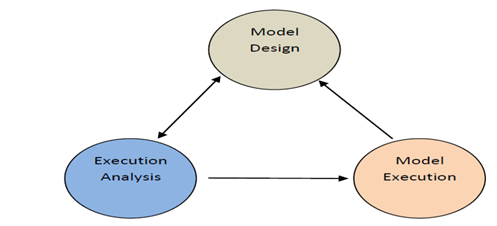
OPNET modeler is used as the simulation tool in this Seminar Paper for simulating the application as it is also discussed earlier. The significant aim of this project is comparing the TCP traffic performance over the CBR traffic performance using different routing protocols across the MANETs. OPNET modeler supports several models of MANETs and also supports all types of routing protocols that are the proactive routing protocols, reactive routing protocols and hybrid routing protocols. The simulation procedure of this Group mobility project includes eight scenarios for achieving the aim of the project. In order to achieve the results needed, a group of programs that are defined are executed at futile environments and this is in general called as a model. The following flow diagram explains the execution of the model.

 Simulation model

Fig: Simulation model

The OPNET modeler offers the required communication model for the application of the Seminar Paper and even several technologies are supported by the OPNET modeler and they are the wireless and wired networks, architectures and protocols. The corresponding simulations implemented for evaluating the performances of traffic sources is also are also supported by the OPNET modeler.OPNET modeler also supports the large extent of models and technologies and some of those models and technologies are Mobile Adhoc Networks, UMTS, Wireless sensor networks, designs of optical network and Wi-Fi are the models and ATM, IPV4 and MPLS are the core technologies.The functionality of OPNET is divided into four significant steps and they are “creation of a network or modeling”, “statistics setting”, “simulation execution” and “results evaluation and results comparison”.

These four steps are very significant in the simulation procedure of the application and also for estimating the traffic performance and their comparison using various performance metrics and all this is based on the requirements of the user. The next chapter clearly explains these four steps during the simulation procedure.The OPNET software can be installed in the computer by making some settings required and the requirements needed are represented in the “system requirement section” of the Appendix. OPNET provides a MANET model which is very simple and the simulation of this project is done using some example projects of MANET model to support the current application simulation.

An object palette is provided by using MANET model in the process of project development and the objects required for the simulation procedure are available in the object palette, the user can drag the objects needed from the object palette and drop them on the work station. The objects selected from the object palette also needs some attribute setting and all that is done by the model. The following figure shows the view of an object palette which contains tools: 

 MANET Object Palette

Fig: MANET Object Palette

The Object Palette of the MANET contains different types of nodes as shown in the figure above, they may be fixed nodes or mobile nodes and even the MANET work stations provided by the object palette are of two types fixed stations and mobile stations. The object palette also provides the wireless LAN work stations and these are also of two types of mobile stations and fixed stations. The object palette also contains the objects like profile config, application config, mobile config, routers and Ethernet routers etc. based on the requirement of the simulation procedure the objects from the object palette are used in order to configure these settings.

This paper is written and submitted by Sujana Priya V.

Understanding the behavior of TCP for real-time CBR workloads Seminar Paper

Behavior of TCP over CBR:

The protocol which is mainly used for broadcasting the data both audio as well as video is UDP i.e. user datagram protocol the main advantage of this protocol is large constant bit rate broadcasting can be done through this protocol. Some restrictions are coming during the UDP protocol in order to back up the CBR this is because of firewalls and therefore it is confined to certain areas.

And very soon alternate studies gave a solution on how to handle the CBR and found that the already famous VOIP application is the successor of UDP which can handle the CBR for using it. In recent times TCP build strong base in loss healing mechanisms such as SACK so this is the main reason for transporting depending on TCP for real-time CBR work scenarios. The drastic improvement of mobile applications Always urge to develop a new quality of services standards (QOS) but most of the protocols failed while backing up these standards (QOS) and these again failed mainly in the mobile networks like MANETS. The main criteria for maintaining mobile multimedia necessities is to follow a vivid QOS standards and among them first5 one is to maintaining of constant bit rate of transmission.

The main flaw here is MANET’s energy conservation is very high for backing these mobile services and due to these TCP remains sufferer for this consequences for errors. There are many experiments done for developing the minimal energy consumption of TCP to improve the CBR around the MANET and many of them are error minimizing patterns.AODV is another different protocol  which is known as hopping protocol because information they holds for a certain time and it is fixed  an let it be 3 seconds for AODV routing protocol. In common an ordinary route entry is developed for an ideal time period but this may not work all the times but still it is considered. It is more beneficial to be short in lifetime span of time period for a route entry around the active routing protocols like AODV’s for MANET’s purpose. 

Many of the times lifespan is confirmed by CBR which is nothing but constant bit rate. If this span is more then we cannot uphold the route and node information and tine is wasted forcalculations and as a whole the overall network size grows. It is recommended to revise the routing table than the developing of CBR data. As we know the dynamic and static environments vary the lifespan is fixed incase of static whereas dynamic this may not be work out for example in MANETS the nodes mobilization is the decision maker which decide the performance of the particular network.

The CBR period for every individual node should be fixed dynamically which follows the AODV network.The advantage in this is REQUESTS are sent from AODV protocol to each node by appending the CBR period field along with the message and transmitted around the network. After message is received by destination node the destination node reads the CBR time span message from the RREQ message and appends another CBR period with updating on the old one with new RREP message and in turn sends to the original one.

Therefore for each node a CBR period lifespan is created and depending upon the lifespan it automatically gets its connection lost and due to this the burden of the system is minimized. These heavy messages can easily be deleted once the dynamic CBR period field uses these RREQ and RREP messages that were transmitted by the usage of well-known AODV routing protocols across MANETS.

This paper is written and submitted by Sujana Priya V.

TCP performance across the MANETS Seminar Topic

The TCP performance across the MANETS is reduced because of several factors that are discussed below and these take the complete responsibility of degrading the performance of TCP throughout the MANETs.

  • Bit Error Rates: The estimation of performance of TCP over the Mobile Adhoc Networks is always based on the High Bit Error Rates. Generally, “High Bit Error Rates” are caused commonly in wireless routes because of the inner issues like multipath fading and degradation of signal and therefore at last leads to TCP data segment loses and packet loses. The entire performance of the system gets affected so much by the congestion control mechanism that is invoked unnecessarily by the TCP.
  • Route Failures: Due to the mobility nature of the MANETs, there are several chances for the failures in the routes and therefore the TCP performance is affected by these frequent route failures. Generally, the routing protocol that is utilized throughout the MANET is responsible for the time taken by the MANET for the re-establishment of route and it may take more time in some situations and thus a congestion control mechanism is invoked by the TCP which is in a state of congestion and thus the performance of the system on the whole is affected a lot.
  • Multipath routing: Multipath routing is one among the most significant factors that degrades the performance of TCP over the MANETs and this is considered as the natural behavior of MANETs. Generally in MANETS several routes are maintained between the source and the destination and therefore the situation of packets out of sequence is observed near the receiver. The generation of duplicate ACKs throughout the network is caused because of this situation and this same to the situation of congestion in TCP and therefore the congestion control mechanism is invoked by TCP in order to decrease the duplications and thus the performance of the entire system is affected.

This paper is written and submitted by Sujana Priya V.