Intelligent Customer Help Desk Python and Node-Red Project

Project Summary:

In this Intelligent Customer Help Desk project, we need to create a chatbot application that can answer the question(s) that falls outside the scope of the pre-determined question set.

This can be done using a chatbot that will use the intelligent document understanding feature of Watson Discovery. 

Project Requirements:

IBM Cloud, IBM Watson, Python, Node-Red.

Project Scope:

In this Python and Node-Red Project, we need to create a website first using HTML code. Next, we should create a chatbot with help of IBM Watson Assistant and Watson discovery.

Using Node-Red we need to build a web application that integrates all services and deploys the same on the IBM cloud.

This project will answer all queries of the user and if any question falls outside the scope of the predetermined question set then this project will use the Smart Document Understanding feature of Watson Discovery to train it on what text in the owner’s manual is important and what is not.

This will improve the answers returned from the queries.

AI-Powered News Articles Search Web Application using IBM Cloud and Slack Bot

Purpose

The purpose of this News Articles Search project is to develop a web application that fulfills our need to find the obvious and recent news articles and update them regularly. After the discovery service is integrated with Slack Workspace, it gives a bot as an intermediate to search news with a keyword. In addition, the web application also analysis the sentimental present in the news article and extracts keywords and concepts to make it an attractive and understandable format for the user to understand what is important and what is not.

Literature Survey

Existing Problem

News Article applications that are currently used are confusing the users, with multiple functions and an overflow of design, these applications still do not fulfill the demand of the news users and often get results from the past days, weeks, and months, which confuses the users only. Also, there is no way in these apps to know what the approximate feeling of the audience is regarding the article or news topic, which makes it less interactive and very low number of users.

Proposed Solution

Discovery service available in the IBM cloud, creating a web app to get the latest and obvious news results fast and user friendly. When integrated with Red Node Flow, the IBM Discovery Service can create a simple, engaging, organized user interface that provides users with relevant news articles as Discovery Service continuously crawls the web for the latest news to provide. By adding emotional analysis, we make the user interface more interactive, easier to understand, and attain more users.

Project Tasks

1. Creating and deploying the Watson discovery news app locally.
2. Integrating Slack-bot with Watson Discovery.
3. Creating node-red user Interface.
4. Integrating node-red UI with Watson Discovery.

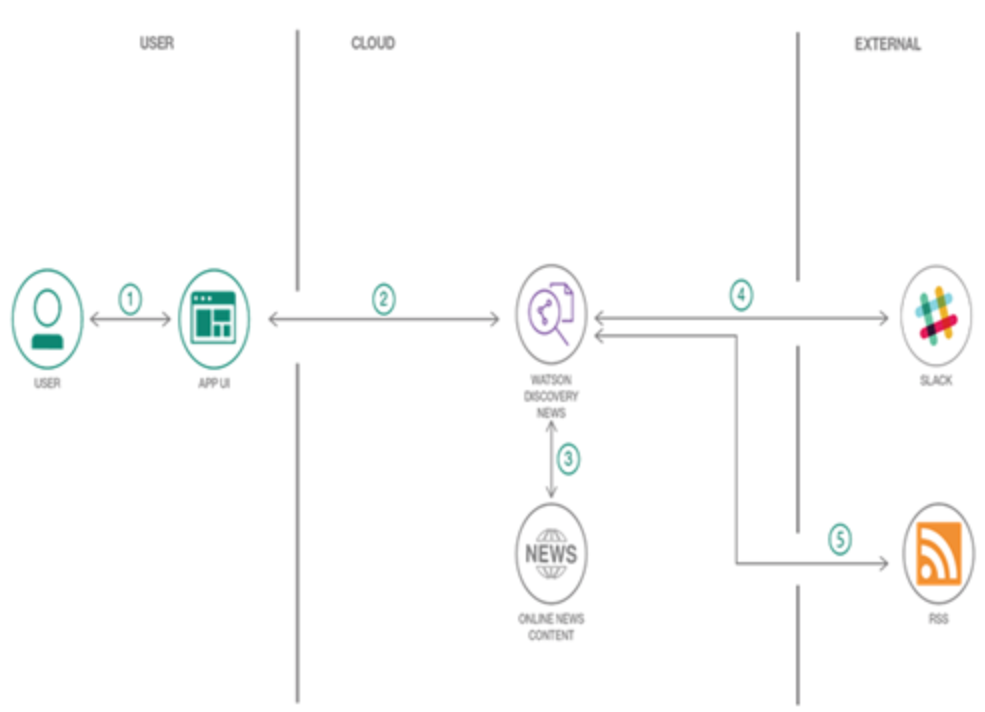
Flow Chart:

Flow Chart

Experimental Investigation

First, we use the discovery service to configure and query adding our collection. A red node application is created in which the discovery is integrated and a simple flow of 5 nodes is created to enter the news topic and the results show related news. Slack then integrates with Watson’s discovery service so that news articles can be searched on more than one platform, and finally, sentiment analysis is performed on the data/news articles being searched.

Advantages and Disadvantages

1. The News Articles Search web application provides interactive sentiment analysis.
2. It can be accessed through more than one platform which is slack.
3. It collects and delivers the most recent data.
4. It does not have additional features like storing news history.
5. It does not provide a stand-alone app but rather uses a web application.

Applications

1. This News Articles Search web application can be used by any user in need of accurate and fast results.
2. Can be used by firms and organizations.
3. Can be used in the stock market to make predictions.

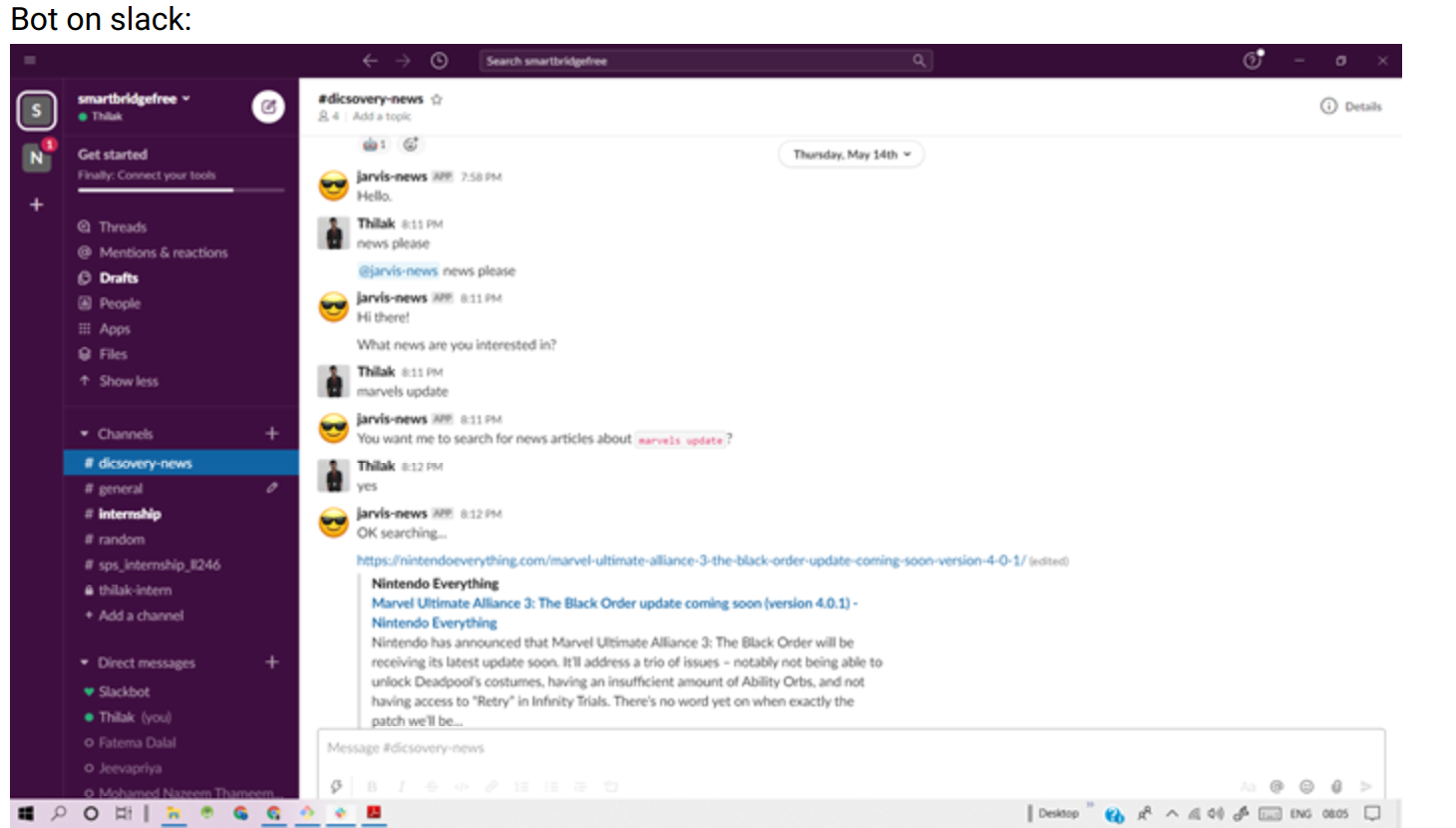
Bot on slack

Bot on slack

Conclusion

This News Articles Search project gives some basic working knowledge of the Watson Discovery Service and showed you how to use Discovery along with JavaScript and Node.js to build your own news mining web application. It also gives insight into real-world applications of AI and helps us understand Slack better.

Future Scope

1. The IBM Cloud and Slack Bot web application can be integrated with the cloud and made into a mobile app to use on it on-the-go.
2. Additional sentiments can be added to the UI.
3. Related and trending news topics can be shown to the user.


Development of Speech Recognition AI Project with Python

Methodology

Working on the Speech Recognition Python Project. Design and Development of Speech Recognition AI Project with Python Source code, report, and ppt using NLP, PLP, and Deep Neural Networks.

Speak– The assistant will speak the following introduction, the output, and the following things according to which good is given. It will use the laptop microphone to hear the input from the user and later recognize the voice said by the user and match the code words and if anything matches it will show the output.

Wish Me-The assistant will speak the Message included in the introduction even if it will wish the morning afternoon and even the evening depending upon the real-time based scenario. It will wish the morning from 04HH to 11HH 59MM. It will wish the afternoon from 12HH to 17HH 59MM. It will wish the evening from 18HH to 03HH 59MM.

Take Command– The assistant will take microphone(speech) input from the user and returns string output. It will be sub-divide into many different parts as described below. Listening-The assistant will open the microphone and try to hear what the user wants to convey to it.

Recognizing– The assistant will try to recognize the input spoken by the user and then check the code whether the word that is recognized by the assistant is there or not if the input matches it will show the output otherwise it will speak “Say that again please” this line which means to give the input again by the user. If the word is correctly recognized, it will follow the instructions assigned to it.

Wikipedia– If the word is recognized as “Wikipedia” it will search Wikipedia according to the input given by the user. E.g. if we say Narendra Modi Wikipedia so the assistant will speak “searching Wikipedia Narendra Modi” and then after it “According to Wikipedia…” and the details of that particular person. Youtube- If the word is recognized as “YouTube”, it will open the internet explorer and directly start opening the default web browser by the link “youtube.com”.

Google– If the word is recognized as “Google”, it will open the internet explorer and directly start opening the Google by the link “google.com”.

Train Information– If the word is recognized as “Train info”. It will fetch the detail from a CSV file and returns the detail of all the train and display them on the terminal. Stack Overflow- If the word is recognized as “Stack Over Flow” it will open the internet explorer and directly start opening the Stack Over Flow website by the link “stackoverflow.com”.

Play Music– If the word is recognized as “Play Music” it will search the .mp3 or .mp4 file in the default path of the device that is provided by the programmer in the programming. E.g. if we say Play Music so the assistant will search in the path like “D:\\Non Critical\\songs\\Favourite Songs2” and it will play that particular song. The Time- If the word is recognized as “The Time” it will check the real-time from the device and speak the same in terms of “HH:MM: SS”. E.g. if we say the time so the assistant will check the time and if the time is 08:14:21 P.M. it will speak “Sir, the time is 20HH:14MM:21SS”.

Open Code– If the word is recognized as “Open Code” it will search the .java or .py file in the default path of the device that is provided by the programmer in the programming. E.g. if we say Open Code so the assistant will search in the path like “C:\\Users\\XYZ\\AppData\\Local\\Programs\\project.py” and it will open the code. Stop- If the word is recognized as “Stop” it will speak “Quitting sir thanks for your time” and the code terminates.

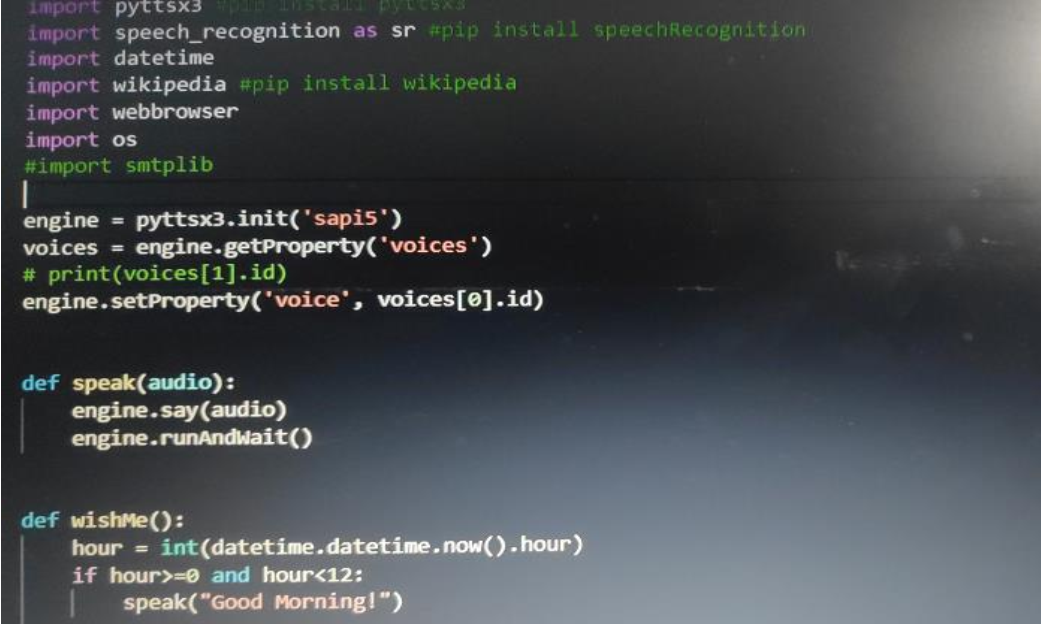
Code-Snippet

Speech Recognition Project Coding

Algorithms used in Speech Recognition

NLP (Natural Language Processing) & Tokenization
PLP
Deep Neural Networks
Discrimination training
WFST Frameworks etc;

The following must be installed-:

1. sudo pip install SpeechRecognition.
2. Sudo apt-get installs python-pyaudio python3-pyaudio or pip install pyaudio.
This is the most important module in your project as it provides the main functionality in our project to convert speech into text.

Future Scope

This specific area of AI ends up being productive in each specialized field. We have additionally actualized this to show how it is valuable in various fields as we have made a little undertaking to exhibit its use in various documented, for example, railroad, looking through feed and so on; Like PCs began to play chess better than human, speech recognition before long will be improved by PCs as well. Critically, that will include some significant information about nature in general and the human mind specifically. So speech recognition is a significant advance in our investigation of natural laws. Our venture can be utilized by railroads and another center point to show distinctive data utilizing speech recognition.

Used Car Price Prediction AI / Machine Learning Project using Python

Abstract

Used Car price prediction using AI / Machine Learning techniques has picked researchers’ interest since it takes a significant amount of work and expertise on the part of the field expert. For a dependable and accurate forecast, a large number of unique attributes are analyzed. We employed 6 different machine learning approaches to develop a model for forecasting the price of used automobiles.

Problem statement

With the Coronavirus sway on the lookout, we have seen a lot of changes in the vehicle market. Presently some vehicles are sought after subsequently making them exorbitant and some are not popular and consequently less expensive. With the adjustment of the market due to the Coronavirus 19 effect, people/sellers are facing issues with their past Car Price valuation AI/Machine Learning models. Along these lines, they are searching for new AI models from new information. Here we are building the new car price, valuation model.

The primary point of this Used Car Price Prediction AI / Machine Learning Project is to create a dataset with the help of web scraping and anticipate the cost of a trade-in vehicle given different elements.

The objective of the Project:

1. Data Collection: To scrape the data of at least 5000 used cars from various websites like Olx, cardekho, cars24, auto portal, cartrade, etc.
2. Model Building: To build a supervised machine learning model for forecasting the value of a vehicle based on multiple attributes.

Motivation Behind the Project:

There are a few major worldwide multinational participants in the automobile sector, as well as several merchants. By trade, international companies are mostly manufacturers, although the retail industry includes both new and used automobile dealers. The used automobile market has seen a huge increase in value, resulting in a bigger percentage of the entire market. In India, about 3.4 million automobiles are sold each year on the secondhand car market.

Collecting the data

We have scraped the data for over 5000 cars using Selenium script from 4 different websites from different locations around the country. The websites are as followed:
1. OLX
2. Cars24
3. CarDekho
4. Autoportal

There are 9 columns:

1.’Brand & Model’: It gives us the brand of the car along with its model name and      manufacturing year

2.’Varient’: It gives us a variety of particular car model

3.’Fuel Type’: It gives us the type of fuel used by the car

4.’Driven Kilometers’: It gives us the total distance in km covered by car

5.’Transmission’: It tells us whether the gear transmission is Manual or Automatic

6.’Owner’: It tells us the total number of owners cars had previously

7.’Location’: It gives us the location of the car

8.’Date of Posting Ad’: It tells us when the advertisement for selling that car was posted online

9.’Price (in ₹)’: It gives us the price of the car.

Here ‘Price (in ₹)’ is our target variable.
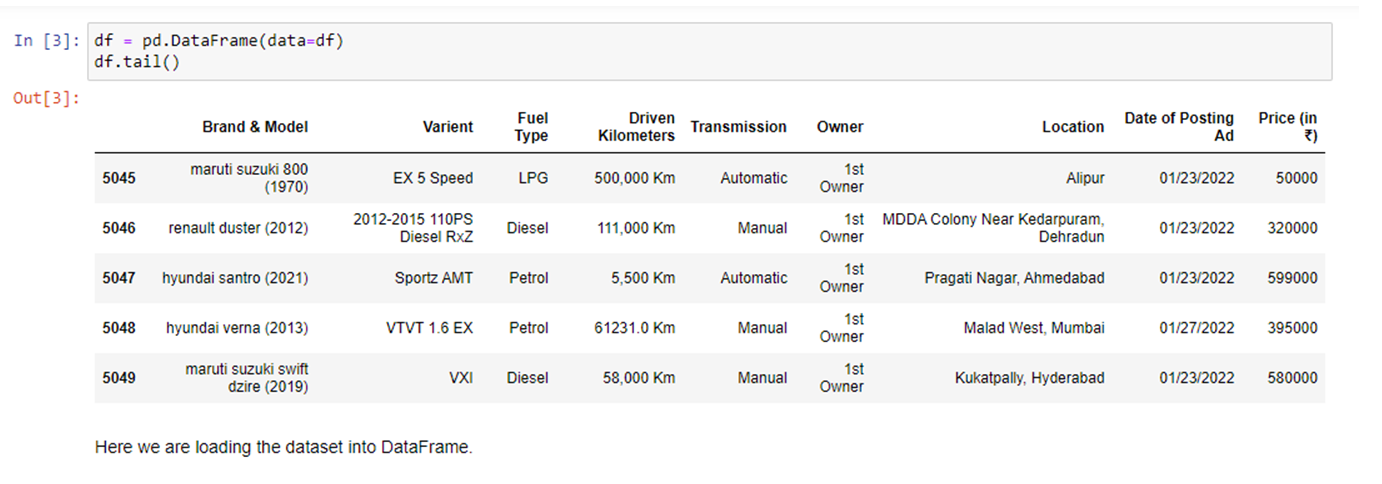
Reading the dataset

Now we read the dataset into Pandas and since the target column ‘Price’ is of integer data type, we will apply regression algorithms to it.

Data Cleaning

We check for null values and find that there are few in column ‘Variant’ and we will treat them with Mode.
Since all the features are categorical hence we need not check for outliers and skewness.
Exploratory data analysis
Firstly, we will plot the boxplot and distribution plot for the target variable. And find that few outliers need not be treated and the data is tightly distributed with an almost normalized distribution.

Bar graph

Since Brands, Varients, Driven Kilometers & locations have a wide range of values in them, we will not perform bivariate analysis for them as they will not give us any specific details. Now by plotting the graph of Fuel Type, Transmission, and Owner against Price, we conclude that a Car that uses Diesel has automatic Transmission, and Has only 1 owner is more likely to have a high price.

Model building

The models used in training and testing datasets are as followed:

SVR
Linear Regression
SGD Regressor
neighbors Regressor
Decision Tree Regressor
Random Forest Regressor
Only Decision Tree Regressor and Random Forest Regressor are performing well and giving an accuracy of 80.2 % and 87.7%, respectively.

Final model

The accuracy of Model ‘PriceCar’ (Random Forest Regressor) after applying Hyper Tuned Parameters is found to be 87.79% and the score is 0.98 which is quite good.

Conclusion

Here, we can see that all the predicted prices are either equal or nearly equal to the original prices of the car. Hence we conclude that our model ‘price car’ is working very well. And we shall save it for further use.

Limitations of this work and Scope for Future Work

As a part of future work, we aim at the variable choices over the algorithms that were used in the project. We could only explore two algorithms whereas many other algorithms exist and might be more accurate. More specifications will be added to a system or provide more accuracy in terms of price in the system i.e.
1) Horsepower
2) Battery power
3) Suspension
4) Cylinder
5) Torque

As we know technologies are improving day by day and there is also advancement in-car technology, so our next upgrade will include hybrid cars, electric cars, and Driverless cars.

Download Used Car Price Prediction AI / Machine Learning Project using Python. For more details about the project feel free to contact the developer at github

Students Marks Prediction Using Linear Regression

Abstract:

Education institutions use new technologies to improve the quality of education but most of the applications which are used in colleges are related to service and development there are web applications that are helping students to take online training and tests. There are very few methods that can help teachers to know about student’s performance. Considering this problem machine learning techniques are used to predict students’ marks based on previous marks and predict results. Linear regression models are used to predict student performance and predict the next subject’s marks.

Problem statement:

Education institutions use web applications for training students and checking performance based on marks but there are no specific steps followed for predicting students’ performance and taking measures to improve performance.

Objective:

Design a machine learning model for the prediction of students’ marks and take measures to improve student performance. The linear regression algorithm is used to train the model and prediction.

Existing system:

Researchers had done work on the automation of grading techniques in which previous marks were used to give grades to students.

Algorithms like association rule mining and apriori algorithms are used for classifying students’ marks.

Disadvantages:

Existing methods mostly work based on marks obtained from exams.

Algorithms are used for classifying students based on marks. 

Proposed system:

The dataset of other subject marks is taken as input and the data set is processed with labels and features then test split is performed on the dataset and then the machine learning model is applied to the dataset then the prediction is performed.

Advantages:

Before the final marks of all subjects are evaluated prediction can be performed.

Using a machine learning process automation of marks prediction can be done. 

SOFTWARE REQUIREMENTS:

  • Operating system: Windows XP/7/10
  • Coding Language: python  
  • Development environment: anaconda, Jupiter 
  • Dataset: students mark the dataset
  • IDE: Jupiter notebook

COVID-19 Data Analysis And Cases Prediction Using CNN Project

ABSTRACT:

Coronavirus ( COVID-19 ) is creating panic all over the world with fast-growing cases. There are various datasets available that provide information on the world affected information. Covid has affected all counties with a large number of cases with a variety of numbers under death, survived, and affected. In this project, we are using a data set that has county-wise details of cases with various combined features and labels.

Covid data analysis and case prediction project provide solutions for data analysis of various counties on various time and data factors and creating models for survival and death cases and prediction cases in the future. Machine learning provides deep learning methods like Convolution neural network which is used for model creation and prediction for the next few months done using this project.  

PROBLEM STATEMENT:

With the increase of COVID-19 cases all over the world daily predictions and analysis are required for effective control of pandemic all over the world

OBJECTIVE:

By collecting data from Kaggle and new York datasets data preprocessing is performed and data analysis is performed on the dataset and a machine learning model is generated for future prediction of cases.

EXISTING SYSTEM:

  • The prediction was performed on COVID-19 cases based on different machine learning techniques which are based on an x-ray data set collected from COVID-19 patients.
  • Disease prediction from x-ray images is done using deep-learning techniques.

Disadvantages:

  • The data set used for predicting disease is different compared to the one we are using for this project.
  • Image processing techniques are used.

PROPOSED SYSTEM:

Using the data set pre-processing is performed on the collected data set and various steps for the deep learning model are performed and prediction of cases is done then data analysis is done on various factors.

Advantages:

  • Data analysis and prediction are performed on textual data
  • Deep learning models are generated for predicting future cases.
  • Data analysis is performed for various factors.

SOFTWARE REQUIREMENTS

  • Operating system:  Windows XP/7/10
  • Coding Language:  python
  • Development Kit:  anaconda 
  • Programming language: Python
  • IDE : Anaconda prompt