
Live Meeting .Net Project Abstract

This application is predominantly produced for the correspondence of Employees of the association situated in various areas. The undertaking entitled “Live Meeting” set of a stage for the project pioneers and director to send messages to keep consistent cooperation with the software engineers.

In the proposed framework is the chairman can sit at his framework and speak with the task pioneers, developers and can likewise keep up the login time, logout time. He can visit about the undertaking going ahead with both the software engineers and project pioneers. This undertaking additionally keeps up disconnected messages. The overseer sees the IP address of the arrangement of undertaking pioneer/developer he is intrigued and talks with the people.The project pioneer gives the moment report about the task to the head.

Through this Communication System, Whenever client signs into the framework then login time is recorded in the chairman’s framework consequently. The chairman can filter the present online framework IP Address and send the messages to the single developer, set of software engineers, project pioneer or Set of undertaking pioneers or every one of the representatives where he/she is available.

This project benefits as much as possible from the monotonous and unremarkable deskwork to limit. This encourages the client to focus more on the project and less on the overseeing of these undertakings.

The proposed framework keeps up

  • Visit cooperation between the head and the project pioneers/developers.
  • Consequently recording the login time/logout time of the client.
  • Keeping up on the web and disconnected Messages and Message View
  • Representative Hierarchical

Useful segments of the task:

MESSAGE SENDING: In the expansive association there are an arrangement of developers, Project pioneer, and Administrator. These software engineers are spread all through the association into different gatherings. Task Leaders are in need to always associate with the developer’s in-bunches spread over the association. It is hard to go and pass the message to every single software engineer in individual

Chat: When a man needs straightforwardly to speak with the associate, he/she can utilize this administration. On the off chance that a man is in online that individual can speak with the other individual through the framework situated at various area.

VIEW MESSAGES: This task comprises of both on the web/disconnected messages. on the off chance that the client is online he can specifically communicate with the other client. On the off chance that the client is in disconnected he can see the message when he logins for whenever.

Worker HIERARCHICAL: This undertaking keeps up pecking order for the representatives.

LOGIN DATE/TIME: When the client logins the framework, the login time is naturally recorded.

LOGOUT DATE/TIME: When the client logouts the framework, the logout time is naturally recorded.

These Login and Logout time are checked by the heads/Project pioneers relying on the chain of command.
Air Pollution Monitor Mechanical Project Abstract

OBJECTIVE: The goal of this project is to measure pollution in the air.

BRIEF METHODOLOGY:

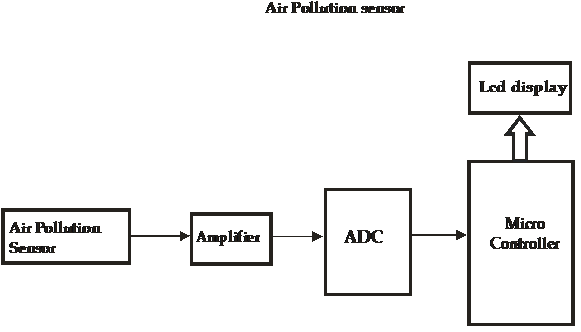
This project was designed with an air pollution sensor, a virtual analog converter, an amplifier and a microcontroller with liquid crystal display. In this system, we use the atmospheric pollutant sensor to measure the pollutants that mix in the air.

It is the only type of sensor that acts as a transducer. It will produce a voltage output that corresponds to the degree of contamination, so it measures the pollutants inside the air and depends on the pollutants that generate the voltage pulse.

These pulses are at the millivolts level. therefore, will be given to the amplifier unit. The amplifier unit includes the operational amplifier. the small received voltage pulses are amplified at a certain voltage level, then the amplified voltage alerts are assigned to the ADC. This is the amplification stage of up to five volts Adc is no more than an analog-to-digital converter.

It is far the eight-bit converter. therefore, the corresponding virtual signals and signals are sent to the microcontroller. here the microcontroller can be atmel89c51 or PIC microcontroller, both are a reprogrammable flash type microcontroller in which we must write an embedded application to receive the ADC indicators and the corresponding variety of contaminants can be displayed on the LCD screen.

In the software program, we can write a set of rules to convert small changes of tension in the percentage degree of pollution.

Scope:

This challenge could be very helpful in the current situation due to the fact that so many people nowadays use cars because the variety of carbon in the air is high. This is very dangerous, it can have an effect on the human body, specifically, it causes diseases of the heart and lungs.

Some manufacturing units also deployed carbon nitrate in the air. then this task measures the combined pollution in the air.

BLOCK DIAGRAM:

Solar based robot for garden grass cutting and watering the plants

Abstract:

The Solar based robot for garden grass cutting and watering the plant’s advanced ECE & EEE paper gives a description of a prototype of Grass cutting and watering robot, as automatic gardening robots have a great demand in the existing robotic market.

This present robot cuts the grass in the field at the same time waters the garden autonomously by using solar power to recharge itself and to save the environment.

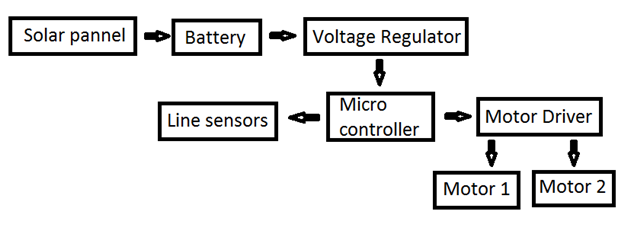
Firstly the robot gets charged throughout the day and uses the same energy to power the motor for cutting the grass and as the robot activates the grass cutting dripping of water will also start in parallel.

The controller receives the environmental data from the sensors like obstacles lawn area and etc and commands the motors accordingly.

A water reservoir is placed above the robot which starts dripping as the robot starts cutting the grass with the motor blades.

Hence the robot autonomously clears the extra grass in the whole field and waters it simultaneously.

Solar based garbage cleaning robot with time slot arrangement

Abstract:

The Solar based garbage cleaning robot with time slot arrangement advanced ECE & EEE project provides the clear description of solar-based cleaning system which can clean the places with respective time slots.

This robot does not require any power from external sources it takes the solar power to actuate the robot. (i.e., If you want to clean a place twice a day then you just need to fix the time at which the robot need to clean).

Firstly the controller will have the path of the places that need to be cleaned. Then it starts the cleaning procedure. Once all the paths are travelled by the robot then it goes to its original position. Robot collects the garbage in its front claws and carries them to dump area at its respective position.

Block Diagram:

Solar based garbage cleaning robot with time slot arrangement

What will your project do?

This is a solar based garbage collecting robot with time slot management, in the current day every individual life is becoming very busy and people don’t like to spend time in throwing garbage safely, so we have come up with a new mechanism like every house will have garbage hanger in defined place.
The robot will travel every day on one particular time slot which is assigned by the user. This robot has a record of where the garbage bags are located, this robot comes to that particular place by line tracking and pulls the garbage bag into its bin, and likewise, it will collect the all houses garbage.

What is the new for this project?

There is no such product in the market.
This project is automatic runs without human interaction, it has solar panel to charge the Battery and it works with time slot management.

What is the current status?

Sir as of now we have ideated the project and designed the plan on paper, we will soon design the robot in solid works and then we will go for fabrication.
We have made research on what motors we have to use, what should be the size of the robot.

Components used?

Robot body will be fabricated on MS sheet metal.

BLDC motors are used for driving the robot forward. (Specifications = 12V BLDC motor, torque = 2kgcms).

A small 2 DOF robotic arm will be used for picking the garbage bags.

Solar based defense cleaning robot with autonomous charging and navigation

Abstract

The Advanced ECE & EEE based Solar based defense cleaning robot with autonomous charging and navigation project provides a clear description of a Solar-based cleaning system which can charge by itself and can navigate to reach the destination to be cleaned or where it can charge.

As we are in the realm of automating the machines around us. Whereas cleaning robots have never encountered a sustainable acceptance in the market due to their heavy complexities in manufacturing and unaffordable costs.

In contrast, this specific robot not only cleans the room but can navigate through rooms to reach to the charging slot or to the muddy field through GPS and sensors.

Firstly the Controller takes input from the GPS to track its route through the doors and commands the motors to move as per the requirement. Whenever the robot encounters an obstacle it receives information through sensors to defend it from brutal hits and avoids falling from steps.

Once the controller senses that its charge is getting depleted through the sensor the robot navigates itself to the charging station and charges itself without any human intervention.

Spark Streaming Hadoop Project

Agenda:

  • Abstract
  • Existing system
  • Drawbacks of existing system
  • Proposed system
  • System requirements

Abstract:

  • In this project, Spark Streaming is developed as part of Apache Spark.
  • Spark Streaming is used to analyze streaming data and batch data.
  • It can read data from HDFS, Flume, Kafka, Twitter, process the data using Scala, Java or python and analyze the data based on the scenario.
  • This basically implements the Streaming Data Analysis for DataError extraction, Analyse the type of errors.

Existing System:

  • Apache storm is an open source engine which can process data in real-time.
  • Distributed architecture.
  • Written predominantly in Clojure and Java programming languages.
  • Stream processing.
  • It processes one incoming event at a time.

Drawbacks of Existing System:

  • One at a time processing
  • Higher network latency

Total Time=10*(network latency + server latency + network latency)=

20*(network latency ) + 10*(server latency)

  • “At least once” delivery semantics.
  • Less fault tolerance
  • Duplicate data

Proposed System and Advantages:

  • Micro-batch processing.
  • Low network latency
  • Total time=network latency + 10* server latency +network latency     =2*network latency + 10*server latency
  • “Exactly once” delivery semantics.
  • High fault tolerance
  • No duplicate data

Methodology:

  • Let us consider different types of logs and store in one host.
  • This creates a large number of log files and processes the useful information from these logs which is required for monitoring purposes.
  • Using Flume it sends these logs to another host where it needs to be processed.
  • The solution providing for streaming real-time log data is to extract the error logs.
  • It provides a file which contains the keywords of error types for error identification in the spark processing logic.
  • Processing logic is written in spark-scala or spark-java and store in HDFS/HBase for tracking purposes.
  • It uses Flume for sending the streaming data into another port Spark-streaming to receive the data from the port and check the logs which contain error information, extract those logs and store into HDFS or HBase.
  • On the Stored error data, it categorizes the errors using Tableau Visualisation.

Architecture & Flow:

System Requirements:

  • Java
  • Hadoop environment
  • Apache Spark
  • Apache Flume
  • Tableau Software
  • 8 GB RAM
  • 64- bit processor

Advanced Slider Captcha Project

Completely Automated Public Turing test (CAPTCHA) is a way of differentiating humans and computers. As the technology is growing exponentially in this fast-moving world, it is highly important to complicate the process of differentiating.

The current approach of using distortions to an image will only complicate the understanding skills of a human more than a machine. So, in this paper, we propose a new approach of slicing an image in such a way that only by overlapping one will be able to understand what is inside a captcha. This will make sure that robots cannot understand or cannot use a brute force to crack the captcha and achieve access to the system.

This attempt will prove that the slicing of an image is more effective than distortions as more and more image processing techniques are available.

Abstract

CAPTCHA is an acronym for the totally robotized open Turing test to advice machines also people separated. CAPTCHA is an approach how we can confirm that web provision client is a human being.

Today it is commonly used by types based on the recognition of alphanumeric characters, On existing framework, these tests need aid getting to be an ever-increasing amount muddled for people, but, on the different hand, they would get to be Actually simpler for bots with some effort added by the hackers.

In this paper, I will make an idea with a chance to be In view of An totally distinctive guideline in Endeavour through Puzzle based captcha Algorithm, to be secure I have actualized this Puzzle based CAPTCHAs, which gives more security. That paper depicts on point of interest these Puzzle based CAPTCHAs innovative principle, system for distinguishing humans from robots.

INTRODUCTION:

CAPTCHA is one of the best technologies in the fight against spam, with some vulnerabilities. These days the systems are being cracked regularly, with Google, Microsoft, and Hotmail among the victims as listed in the news (http://www.informationweek.com/yahoos-captchasecurity-reportedly-broken/d/d-id/1063466) Now Advanced Slider CAPTCHA system which claims to be both possibly unbreakable and easier for humans to solve than the old text and audio based system. In this paper simply stated as Advanced Slider CAPTCHA nice to humans, bad for Hackers”. This paper is an attempt towards a systematic analysis of usability issues that should be considered and addressed in the design of robust and usable of Image CAPTCHAs.

So far, there are the following three main types of CAPTCHAs:

1) Text Based schemes They typically rely on sophisticated grasping of text from given images.

2) Audio-Based Schemes-They typically needs the user to solve a speech recognition test which will be played during the authentication.

3) Image-Based Schemes They typically ask the user to identify an image which has been specified by the web. All the above-mentioned captchas have some vulnerabilities.

In this paper, I aim to understand what kind of issues should be addressed to make CAPTCHAs usable in the contexts where this technology has been widely deployed. Solving issues of poor accessibility caused by CAPTCHAs, e.g. by exploring Advanced Slider CAPTCHA which could be implemented in a different way.

KEY METHODOLOGY The CAPTCHA:

proposed by me generates a challenge by displaying a special distorted image from my image database which is split into parts within the specified matrix frame using pixel division techniques. For this special image, each part of the Image will be divided into a square-shaped one. Some image treatment will be done in order to prevent image detection without using the slider so that it will be unidentifiable without using the slider.

The image will be a meaning full one when the user uses starts sliding the slider below the displayed image when the user moves the slider to a predefined point the image will be identifiable and he will be able to solve the captcha. More details are described in next section.

Advantages of Slider Captcha Slider CAPTCHA:

has several fascinating characteristics. It is one of a kind to use image division as a CAPTCHA. The user doesn’t have to enter the fuzzy texts, the user doesn’t have to solve maths puzzles or recognize a sound, and it doesn’t require any knowledge.

The user has to use the slider to see the image, which most of the people know nowadays because of the smartphones. Experiments and security analysis proved that human users can complete the CAPTCHA verification quickly and accurately, but computers rarely can, this will be one of a kind of captcha which will be even interesting to the users.

  1. Image handling solving slider CAPTCHA automatically by a robot will be an issue. However, it seems difficult for computers/robots but easy for humans. According to my research, most previous works only focused on the text recognition where the solve rate is 76 percent and the hack rate is 1/3 when compared to the image captcha it is very high.
  2. Image selection the image used to generate slider CAPTCHA are randomly selected, carefully chosen from the available set of images from the database. It is very important that the images will not affect the usability of the code. In this project the code is confinedtouseaparticularsetofimagesbasedontheirdimensions. The code can be further modified/developed to handle various kinds of images based on the user rate of the system. The pictures which will be used will be downloaded from websites, such as www.google.cn. In the beginning, a mere 5 to 10 images will be chosen to generate the CAPTCHA. The images will be divided into several categories and the ones which are familiar to most of the people will be used in the system. Based on the response time and recognition from the user certain images will be considered as a candidate to be discarded.
  • Image size and grid granularity selection As discussed prior the system will handle the images which are present in the system and with a particular dimension and pixel type. The vital problem I will encounter when designing this mechanism is the size of the image and the grid granularity selection. I tried to use a larger image than the smaller one the UI is going to consume a large amount of space which will be fuzzy. In contrast, the smaller image takes up less screen space, and it takes less time to be processed by the code.

Will use algorithm to achieve the concept and functionality

Captcha using Grid Colors Project

Abstract

In the current world, the Internet is being widely for every activity we can think of and it ranges from online communication to e-commerce, education, health, sports and a variety of other things. Progress in any field has its own problems and in the world of web applications and websites, one of the primary concerns is bots accessing this application thereby severely hampering performance as well as crashing the availability of a system. In order to tackle this widespread problem, CAPTCHA (Completely Automated Public Turing Test to Tell Computers and Human Apart) was introduced in the early 2000s to protect internet applications against bots. In the present world, most of the commercial websites are equipped with the CAPTCHA functionality to overcome any imminent attacks. However, a common complaint has been related to the ease of solving CAPTCHAs by users of the web applications. Several methods of CAPTCHA functionality have been introduced and each of them has their own positives and drawbacks. The goal of a CAPTCHA solution should help users in resolving it fairly while being strong to counter-attack automated responses. With this project, the goal is to introduce a new CAPTCHA method with grid colors where the user will be prompted to draw a specific colored line based on the instructions provided in the interface.

I. INTRODUCTION

With the arrival of the World Wide Web technology, everything we can think of has been made available on the internet through websites and web applications and it is only growing with each minute at a rapid speed. This technology has been embraced by people all over the world which allows for easy communication and accessibility to a variety of information.

However, with increasing popularity automated solutions known as bots have been developed to attack these web applications. To counter these attacks the CAPTCHA solution was introduced with the focus being on both securities as well as ease of use for end users. CAPTCHA is generally a web page that poses the user with a challenge that could be resolved based on instructions provided.

The goal here is to block automated machines from performing activities such as registrations, automated feedback, spam and other resource blocking activities. A variety of CAPTCHA solutions based on text, image, and audio interfaces have been made available to users. Some of these solutions are easy targets for the bots depending on how they have been implemented.

The challenge lies in developing a CAPTCHA that meets ease of use requirements while not compromising on application safety. The proposed solution will be a web page with a grid interface provided to the users along with instructions on how to solve the CAPTCHA. The grid interface will contain multiple colors scrambled across the grid and user is instructed to draw a line through the mentioned colors or path in the textual hint.

The colors and the grid will be designed to look intuitive enough for the users and drawing the line is something that will make the users feel comfortable and it will be difficult for the bots to crack. An example question for the user would be-”Draw a line connecting all green squares”.
II. RELATED WORK & existing solutions:

Variety of CAPTCHA solutions based on text, image, video, and audio have been made available to the users. Text-based CAPTCHA is being used widely and the CAPTCHA challenges are sometimes very hard to solve even by the human. All existing CAPTCHA challenges require a significant conscious effort by the person answering them — e.g. reading and typing a nonsense word.

Many existing CAPTCHAs irritate or threaten users since they are obvious tests of skill. Most existing CAPTCHAs are vulnerable to out” attacks in which challenges are passed to a networked community of human readers. There are some problems with the existing text-based CAPTCHAs, If it is simple text-based CAPTCHA then it can be easily solved by OCR (Optical character recognition) software and segmentation; If it is complex text-based CAPTCHA humans also may not be able to solve the challenge.There are six text-based challenges.

While the first two sets can be solved with some effort the third set is highly difficult for a human to solve. An ideal CAPTCHA solution should always be easy for the users to solve while not compromising on the security aspect. The proposed solution would be a 4*4 grid which is filled with different colored images in random sections. The user has to follow the provided instructions to solve this CAPTCHA.

This CAPTCHA has several advantages.

• It will be easy for humans to understand the challenge and solve the CAPTCHA since it is color based images that are being used in the grid.

• The user can solve this type of CAPTCHA in few seconds without any frustration or stress.

• Bots cannot solve this type of CAPTCHA because the grids are actually images of grid colors and not a direct fill.

III. The 4*4 grid will be generated with 16 identical square boxes.

  1. The grid will be filled using five grid colors (Red, Green, Blue, Yellow, and Black). The colors are images and not color codes.
  2. Red, Green, Yellow are selected out of the five to fill a total of 12 boxes in a random manner and each color occupying four boxes.
  3. Black and Blue are used to fill the remaining four square boxes. Combinations can be one Black, three Blue or two Black, two Blue and one Blue, three Black.
  4. CAPTCHA Challenge- Form a horizontal red line in row two using the red colored image.
  5. The user drags and drops the specified colored image as per instruction.
  6. Positions of the colored images are interchanged based on drag and drop moves.
  7. A line formation based on instruction will be deemed as successful CAPTCHA answer else it will be considered a failure.
  8. Failure will result in generation of a new CAPTCHA challenge.

Algorithm for the idea: 

  1. Step1: generate an image with random words
  2. Step2: in the generated image find the middle pixel (height of the image/2)
  3. Step3: separate images into two. One image will run through 00 to mid, width another will run through mid+1,0 to height, width
  4. Step4: place the separated images separately and allow the user to drag an image
  5. Step5: allow the user to type the captcha the response after hovering
  6. Step6: validate the user input

Employee Safety and Welfare Measures Questionnaire

Questionnaire for employee safety and welfare measures:

The Student is doing final year M.B.A .as a part in fact of his research activity .“The student is doing a groundwork and had taken a study on employee safety and welfare measures in an organization”.

Note: please tick mark the option you feel is most appropriate as per the following.

Mark your experience with the company employee safety and welfare measures?

1. Gender:

Male:
Female:

2. Educational qualification:

Hsc:
Sslc:
Diploma:
Graduate:

3. WORK EXPERIENCE:

BELOW 1 YEAR
1-2 YEARS
2-4 YEARS
4 YEARS AND ABOVE

Section: 2

1. From how long you are functioning with this Organization?

a. 0-5 Years
b. 5-10 Years
c. 10 to 15 Years
d. Over 15 Years

2. How do you rate the Working Environment of the Organization?

a. Exceptionally Satisfactory
b. Agreeable
c. Averagely Satisfactory
d. Dissatisfactory
e. Exceptionally Dissatisfactory

3. How do you rate the health advantages gave by the Organization to the workers and their families?

a. Exceedingly Satisfactory
b. Tasteful
c. Normal
d. Dissatisfactory
e. Profoundly Dissatisfactory

4. Does the organization give maternity leave to Female Employees?

a. Yes
b. No

5. How do you rate the working Hours of the Organization?

a. Very Satisfactory
b. Acceptable
c. Normal d. Dissatisfactory
e. Very Dissatisfactory

6. How do you rate the sitting course of action of the Organization?

a. Exceedingly Satisfactory
b. Tasteful
c. Normal
d. Dissatisfactory
e. Exceedingly Dissatisfactory

7. How do you rate the Conveyance Allowance offered by the Organization?

a. Very Satisfactory
b. Acceptable
c. Normal d. Dissatisfactory
e. Very Dissatisfactory

8. Rate the Overtime stipend offered by the Organization?

a. Very Satisfactory
b. Acceptable
c. Normal d. Dissatisfactory
e. Very Dissatisfactory

9. How do you rate leave approach of the Organization?

a. Exceptionally Satisfactory
b. Palatable
c. Normal
d. Dissatisfactory
e. Exceptionally Dissatisfactory

10. Do you get customary additions?

a. Yes
b. No

11. does the Organization offers an adequate number of toilets?

a. Yes
b. No

12. Rate the bottle administrations gave by the association.

a. Profoundly Satisfactory
b. Attractive
c. Normal
d. Dissatisfactory
e. Profoundly Dissatisfactory

13. Rate the Restroom and lounge office to the representatives?

a. Profoundly Satisfactory
b. Attractive
c. Normal
d. Dissatisfactory
e. Profoundly Dissatisfactory

14. Does working in the association give you a sentiment security?

a. Yes
b. No

15. Does the organization take wellbeing measures for representative security?

a. Yes
b. No

16. Do you think worker welfare exercises of the Organization give a sentiment security and enhance your execution?

a. Yes
b. No

17. Rate the general fulfillment with representative welfare exercises of the Organization?

a. Exceedingly Satisfactory
b. Agreeable
c. Normal
d. Dissatisfactory
e. Exceedingly Dissatisfactory

Employee Job Satisfaction A Study at ICICI Prudential Life Insurance Co Ltd

OBJECTIVES

The main objective of this Employee Job Satisfaction A Study MBA HR Project at ICICI Prudential Life Insurance Co Ltd is to describe the various expectations that determine the satisfaction level of employee.

To identify the factors concerning employee job satisfaction and to analyze and interpret the collected data.

LIMITATIONS

  1. Due to the constraint of time and resources, the study was conducted in ICICI Prudential Life Insurance Co. Ltd and the results of the study cannot be generalized.
  2. The accuracy of the analysis and conclusion drawn entirely depends upon the reliability of the information provided by the employees.
  3. Sincere efforts were made to cover maximum departments of the employees, but the study may not fully reflect the entire opinion of the employees.
  4. In the fast moving/changing employee’s behavior, many new and better things may emerge in the near future, which cannot be a safeguard in this report.
  5. Confidential matters restricted to an in-depth study.

FINDINGS

  • 78% of employees are receiving regular job performance feedback in the organization, remaining 22% of employees specified that the organization needs to take regular job performance feedback.
  • 80% of the employees said that they are satisfied with the employee welfare programmes
  • 80% of employees felt that they are treated fairly by the superiors as well as by the organization members
  • 74% of respondents satisfied with the employee policies at the company remaining 6% are neutral and 20% of respondents are dissatisfied.
  • 62% of respondents are satisfied with the salary structure, 18% of respondents are extremely satisfied, 7% of the respondents are neutral, 13% of the respondents are dissatisfied that the company offers a salary structure.
  • 50% of respondents said good about the safety and health standard of the company.
  • 55% of respondents are giving very important towards the recognition and 35% of respondents are giving importance remaining 10% respondents are neutral towards the recognition.
  • 20% of the respondents are highly satisfied with their position in the company and 30% of respondents are satisfied 10% are neither or nor 40% of respondents are dissatisfied with their position.
  • 62% of the respondents satisfied with the vision & values of management, 18% of the respondents are highly satisfied.
  • 28% of the respondents felt relaxed, 58% are felt normal, and remaining 14% of the respondents felt the work is burdened for them.
  • 80% of respondents give more importance to training & development provided by the company,10% are neutral, 10% of respondents have not given importance.
  • 72% of the respondents have expressed satisfaction towards existing career plan & growth opportunities in ICICI Prudential Life Insurance.
  • 65% of employees are receiving cooperation from all other departments remaining 35% of employees are not receiving cooperation from all other departments.
  • 40% of respondents are satisfied with the company’s quality management system.
  • 71% of the respondents are satisfied with the reward system which is provided by the company.
  • 80% of the employees agree the organization environment is suitable for developing their self-esteem
  • 63% of respondents are satisfied with the appraisal system of the company, 27% of respondents are dissatisfied, 10% of respondents are neutral.
  • 65% of respondents felt duty timings schedule is convenient remaining 35% of respondents felt duty timings schedule is inconvenient.

SUGGESTIONS

  • The organization should try to maintain the same level of satisfaction among employees through better recognition & reward system mechanism.
  • The organization may further try to create a healthy competitive environment through its Programs like employee meeting.
  • An organization may go for facilitating the security for the employees and create awareness about the safety measures provided by the company.
  • For improving the employee’s problem-solving abilities company HR Manager has to take training sessions through the Case study Methods.
  • The company has to provide some better packages like Target achieve incentives, Cash Awards.
    The company has to give the salaries through their performances and provide better positions to best workers.
  • Mainly company has to decentralize the authority to make decisions for better growth and Provide all above-mentioned benefits to the employees.
