Dynamic Routing with stegnography Project Implementation in Java

Implementation is the major phase in the software development process. I consider the Dynamic Routing with stegnography project development as the following modules:

  1. Network Module
  2. Dynamic Routing
  3. Randomization Process
  4. security enhancement module

Technologies:

To implement this stegnography Project, I consider java as the programming part   and java swings is for graphical notations which can embed with different types of system configurations.

Java:

Java overview:

Most of the software companies are working hard to fulfill the client’s requirements with the best use of the resources. Clients are looking for the best performance, speed with cost management. So, the companies prefer the best technology to development of software.

  To achieve the best standards companies are giving importance for the programming language such as Java.  Java is a purely object oriented programming language and simple to implement the applications. Programmers feel comfortable to working on this application. The applications can be executable in any platform i.e. platform independent. These are applicable in the real time such as ATMs, PCs, smart cards, application server and embedded devices. 

Java is a distributed language and very secure. The features of this language make it very popular and it useful for the next generation. We can implement the internet programs with the help of applets. It supports distributed, robust, multithreaded, portable and memory management. It is secured language with virus free. It provides web services and it allows programmers to work on quality service development and object development.

  I choose java programming language to implement my project. The important factor to develop software product are data integrity, accessibility and scalability that are fulfilled by this language. I consider java with swings to make my application success with rich interface. To develop GUI (Graphical User Interface) applications of my project, I choose java swings which are more efficient and effective.

Java Swings:

In java language using swings will give you the creation of GUI (graphical user interface) application. These are applications are very effective with text boxes, tables, buttons, text field, trees, scroll bars etc. this is the latest version of the java to create GUI application before that is uses AWT (abstract window toolkit) package. This AWT package is having the classes which are needed to create the application but with the limited scope. To overcome this problem, java introduce the swings which very dynamic in behaviour.

This Paper is written & submitted by Chandu.

Data flow diagram of Dynamic Routing with stegnography Engineering Project Report

DFD Data flow diagram level 0 diagram: 

DFD Data flow diagram level 0 diagram

In the initial level of data flow diagram, describe about the intension part of project with overall view. My Dynamic Routing with stegnography project aim is to transmit the data with considering of dynamic routing by considering security. This complete Engineering Project Report process can do with the two end process that represented with sender and receiver. These are entities in the data flow diagrams.

DFD Data flow diagram level1 diagram: 

DFD Data flow diagram level1 diagram

By considering the level 0 as the main process, we will obtain two sub process levels like dynamic routing and security considerations, so I maintain two sub process with the unique number representation.

DFD Data flow diagram level2 diagram: 

DFD Data flow diagram level2 diagram

By considering the dynamic routing strategy as the main process, will get two main processes as distance vector algorithm implementation and data packet fragmentation. even the distance vector algorithm process will get the sub process as routing strategy which can be obtained through the hop count.


DFD Data flow diagram level3 diagram: 

DFD Data flow diagram level3 diagram

In the security level of process, I am considering the stegnography as the major process level. In the complete data flow diagrams, we maintain hierarchy levels which makes easy to developer to implement their modules. 

ACTIVITY DIAGRAM:

Activity Diagram

This Paper is written & submitted by Chandu.

Sequence Diagram of Dynamic Routing with Stegnography Final Year Project

Sequence Diagram:

Sequence diagram is the major model that represents the data sequential flow among various states by maintaining the time. In my Final Year Project I considered the process are sender, routing data, routers available in network, dynamic routing process including the stegnography and receiver.

Sequence Diagram of Dynamic

Explanation of the Final Year Project:

In this diagram we mainly deal with the sequence of process that are occurred with the time considerations. Time order of Dynamic Routing with Stegnography project flows will represents with the vertical line that are showed below:

  • Sender send the data into network by maintain the information about the nodes in the network.
  • Then data packets are randomly transmit through the different paths that is possible through routers updated information
  • Every node maintains the best route information to their neighbor nodes according to that it will make utilize the dynamic routing methodology.
  • In this routing, routing information dynamically changed and updated to all the nodes and routers in the network periodically.
  • In this step, stegnography will apply to obtain the security on the data packets which maintains the security levels with high.
  • Then data is transmitted in network by using the dynamic routing methodology.
  • At the end receiver will receive the message and cluster all the data packets that are come from the different routes and form original data. 
This Paper is written & submitted by Chandu.

Dynamic Routing with stegnography project Use case diagram

 Unified modelling language:

UML is a language for graphical representation, to visualize, construct, specify then document the artifacts of software development process. It is a standard specification to achieve the blue print for Dynamic Routing project which includes conceptual process like business process and system functions. Even it also depicts the data base schema specifications and language statements and software components which are reusable.

Unified modelings have some methods and procedures which makes the designing patterns without any difficulty. It defines the semantics as follows:

User interactions (use case model): it is model which describes interactions among the users and system environment to required models

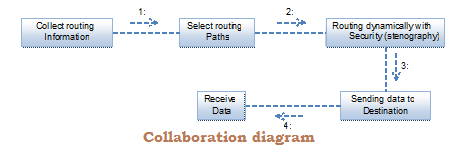
Interactions model (communication model): it is a model which describes about the interactions of objects that are there in the model to perform a task or work done.

State model (dynamic model): it is a model which defines states of classes with conditions. Graphs in this view will shows the work flow of modules which is useful for project implementation.

Logical model (class model): it is model which describes about classes and objects in the system environment.

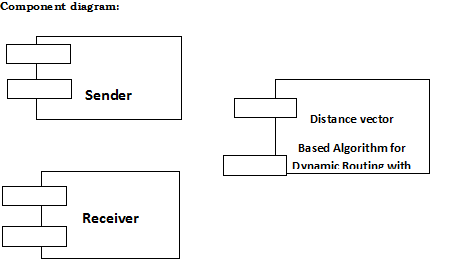
Physical model (component model): it is a model which describes software components and hardware components that are used for the project development.

Deployment model: it is the model which describes the physical architecture and deployment process with the hardware of system that is used for project development.

Use case diagram:

In my Dynamic Routing with stegnography project, I consider the basic actors as clients which help to design the use cases efficiently. The major task of the project is data transmission for that I need to consider the sender and destinations. Here two actors are placed at different ends, the process which consists the use cases are maintain the node information, configure routing tables, security consideration, dynamic routing, distance vector consideration and data transmission process. Here both the actors are interact with the all the use cases in the system, because sender and destination ends are interacting by sharing the information of nodes. Even both the actors are containing the routing table information by maintain the hop count which will help for the route establishment.

Here security consideration also perform with the both the actors, I am proposing the system to use the stegnography as the main technique which can be achieve through the mutual understand of the both the terminals.

Use case diagram

Name of the Use case Transmission of data by considering two terminals
Actors Participation sender
Flow of events Sender sends the data into network, which will transmit over network by applying dynamic routing with security  using stegnography technique.
Name of the Use case Achieve dynamic routing strategy
Actors Participation Receiver
Flow of events At the destination end data should be clustered which will get through different routes and make it as original data.

This Paper is written & submitted by Chandu.

Proposing system design of Dynamic Routing with Stegnography

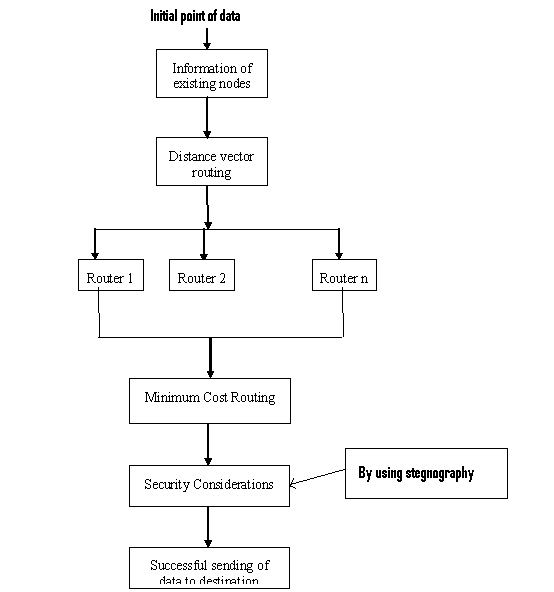
 Proposing system design:Proposing system design of Dynamic Routing with Stegnography 

The modules which I consider come in this proposed design flow diagram.

  • Terminal end or client will send the data to the destination end through the network medium.
  • Every node has information about the all the terminals in the network, so it will establish the route according to the hop table.
  • By using the distance vector algorithm, it will establish the route dynamically. It is possible by maintain the routing table information update periodically. Routers in the networks are updated with the routing and minimal cost of nodes, for periodical duration.
  • In the next level, data packets are dynamically sent in different routes where the two consecutive packets never go through a one route.
  • Next level, minimize the routing strategy by reducing the cost effects for routing.
  • Security comes in this step to protect the data from the attacker, for that we are using the stegnography concept which makes the data in to hidden format by sending it to image.
  • At the destination end, all the data packets are clustered as per the sequence number in the data packets.
This Paper is written & submitted by Chandu.

Dynamic Routing with Stegnography Module Design

Module design:

While we are going to consider the Dynamic Routing with Stegnography project development, initially we have a plan which we virtually design the structure in our minds. That structure will become the design part of Final Year MS project by making the proper analysis on the project. Design is plays the important role in project development, which can made the project development or implementation easier. In order to make the normalized structure of project, modules are considered. In my project I considered the entire project in three modules as follows:

  • Network module
  • Dynamic routing
  • Randomization process 

Network module:

In this module, mainly we consider about the structural positions of terminals and how they are connected. The terminals in the network have different configurations in terms of hardware and software specification. Initially communication strategy starts with the client request or terminal request, and then other end server or other terminal will respond with the appropriate response message. Then the communication process will established. In this module, I will make arrange of network terminals with the proper arrangement.

Dynamic routing:

This is module, achieving the routing strategy by using distance vector algorithm which is the essential and main part of my project. Distance vector algorithm will establish the route which is dynamically and securable manner. In this module, we rely on existing routing strategy which will achieve through the neighbor nodes by passing the information to each terminal. Here each and every terminal in the network will maintain the hop table which maintains the routing and terminals information of associated terminals. Here hop count specifies minimal cost for sending packet to the particular terminal end.

Randomization process:

In this module, I consider to reduce the eaves drops of packets and traffic. For that I design the module for randomize the routing process which can be achieved by registering the hop of previous node and transmit it to two neighbor nodes randomly. By using this technique, two consecutive packets will never go through one route, so attacker can difficult find the data sequence on network. Even it is also difficult to find the data packet sequence in the network.

This Paper is written & submitted by Chandu.

TCP/IP Protocol Layer Seminar Topic

TCP/IP Protocol Layer:

The TCP/IP protocol defines the data networks for networking protocols in the internet layer. The TCP/IP network implements the best design and it ensures the reliability and security, performance of the enterprise. So internet layer is suitable for this security in routing strategy.

In this Dynamic Routing with stegnography project Seminar Topic, I have planned to add the security enhancements with the routing strategy by using stegnography process which can hide the data into some other process.

“Crypto is mainly designed to make available the data confidential, authentic of source (sender) identity. Between the sender and receiver the service transmission should be integrity and non repudiation”.

In dynamic routing system, data will send through the different paths with randomization technique, so data in the routes can be securable. Here data can be in the original format, so there may b a chance to attacker to grab the data at the receiver end to cluster all the data to form the original data. For that we are using the stegnography which hide the data into some other format.

Image stegnography is the method that captures the data into it. Image stegnography is the method that captures the original data along with some original image. Then it combines those as single file which called it as stego image.  That is transmitting over the network and at the destination end it is unstego and gets the original data.

This Paper is written & submitted by Chandu.

Securing IP Network Traffic Planes Seminar Report

Securing IP network traffic planes:

This Seminar Report gives the implementation and understanding of IP protection and separation on IP routers. It gives the detail view of the advanced techniques how we will give the security to traffic planes of the IP networks. It includes the management and control and data. The IP infrastructure can be provided by the service plans.

 In this fist section the detailed explanation of the IP networking and Internet protocol. The brief explanation of the fundamental principles of defense and breadth security to the IP traffic planes can be at the end of the section. In the Second section the detail security techniques of the IP control plane, IP services plane, IP management plane, IP data plane.

In the final section the Seminar Report case study of the service provider network and enterprise network. The security techniques of the IP traffic plane can be reviewed that can help to create in an integrated and breadth security architecture.

It is critical to understand and to give the security to the IP infrastructure. The brief explanation of the techniques in this book can protect against the attacks. To protect the IP infrastructure is very critical if the vulnerability continues for both network providers and vendors.

The IP core network security architecture and technology can be supported by the Gregg for users of the web services. 

The service provider organization was invented by the consulting system engineer in 1995. The edge architectures and IP core were supported by the David and he includes the MPLS technologies and IP routing and infrastructure security. 

The operations of the IP routers and networks can be understood. 

The layer2 Ethernet switching and environments, IP networks were faced Many threat models. 

How to protect the IP traffic plane if it is applied in breadth and depth principles? 

The rate limiting, IP option filtering, uRPF, Qos, RTBH these security techniques can used to protect the data plane of IP and Ethernet networks. 

The techniques such as ICMP, MDS, and GTSM can secure the IP control plane in layer 2 switched networks. 

To protect the password management and access management and IP management plane techniques.

This Paper is written & submitted by Chandu.
Computer Networks Routing Strategy Seminar Report

What is meant by routing strategy?

Routing:

In Computer Networks, Routing is minimizing the hardware. And it is selecting paths in networks to send network traffic. It performs many places like circuit switching, internet, transportation networks.

Static routing:

In computer networks, data communication is described by the static routing. It characterized by the communication between routers regarding the current topology of the network. Opposite of this routing is dynamic routing is called adaptive routing.

Alternative routing:

One Routing Strategy less preferable than another routing. But preferable routing offering the same terms of the less preferable routing is called alternative routing.

Adaptive routing:

In this Seminar Report, it describes the capability of the system to routes are distinguished by the destination, system is response, when takes the alter paths to change conditions. It controls to allow many routes in response to change.

Examples of the adaptive routing:

  • Every 10 sec, it collects data from each switch in the network.
  • In this, routing table derives for each switch

Characteristics of routing protocol:

  • It prevents routing loops from forming.
  • Using hop cost information to select preferred routes.
  • They take time to coverage.

Routing strategies:

Fixed routing:

Fixed route is permanent to source to destination and using least cost algorithm to determine routes. This route is fixed, until we change the topology of network.

Adaptive routing:

This Routing Strategy is used by packet switching networks. Change the routing decisions, when change the conditions on the network like failures, congestion. In this, decision is more complex and quickly reacting to cause oscillation and slowly to be irrelevant.

Drawbacks of adaptive routing:

  • To process the decision, when burden on nodes.
  • To deliver status information, when extra burden on network.
  • Slowly react to be irrelevant.
  • Quickly react to cause congestion producing oscillations.

Advantages:

  • Improve the performance.

Flooding:

  • Packet stores the destination distance in submitted packet.
  • The counter reduced by one at each node and then resubmitted into adjacent nodes.
  • In this, counter 0 packets are discarded.
  • Destination node doesn’t resubmit the packets

Advantages:

  • Highly robust.
  • It is suitable for virtual circuit.
  • It useful for broadcasting.

Disadvantages:

  • High traffic load.

Random routing:

  • It is like a flooding, simple and robust. But, with less load on network.
  • For retransmission of incoming packet, selects an outgoing path by intermediate node.
  • It can be random or round robin selection.
  • Based on probability calculation to select outgoing path.
  • In this, no need information of network.
  • It is typical not least cost.
  • In this, not more than net work traffic, to reach final destination to take.
This Paper is written & submitted by Chandu.
Computer Networks MS Paper Presentation Topic

Computer Networks :

       The connection of two or more devices that can share files, resources such as compact disks and printers and internet connections. The devices can be connected through cables, satellites and radio waves on a network without using of the data key the files can be shared to the networked computers. The users of the networked computers can communicate through electronically without using of the internet. This MS Paper Presentation can be useful for students who loves computer networks.

Networks are divided into three types:

  • LAN (LOCAL AREA NETWORK)
  • WAN (WIDE AREA NETWORK)
  • MAN (METROPOLITAN AREA NETWORK)

LAN:

     It is smaller area network and it can be existed in small geographical area. It can be connected to group of computer networks. Examples of LAN networks are small offices and colleges, school buildings.

In LAN network we consider one lab in that one computer can perform the role of the file server. All software’s can be stored in that computer and it controls the network. The file server plays the important role in LAN. By connecting the computers to the file server is called workstation. It has less power than file server because it doesn’t store more applications and files like file server and they won’t keep the network up and running and work station can store software’s in the hard devices. These LANs can be connected through the cables.

It provides the two different types of networks

Peer-to-peer network:

 Without using the central computer the communication can be carried from one computer to another computer in which computer plays the important role.

Client/server environment:

   The services can be provided to the users by using the central computer. 

MAN:

      It connects the multiple LANs at one location but it does not connect to the outside of the town, city and metropolitan area. It is smaller than LAN Larger than MAN. It connects the LANs in the limited functional areas like industrial complexes and college campus.

WAN: 

     It is made by the computers and it exchanges the data across the internet over a great distance. The example of the WAN network is internet through the internet it can connects the various countries. It connects the smaller networks like LANs (Local Area network) or MAN (metropolitan Area network).

 It connects the number of resources across the larger areas such as multinational business. By using WAN different networks can be connected. Depending on the cost the speed in the WAN wires can be high or low. The WAN can pass the data to the network node by using router. Like internet the connection can be local and metropolitan network to communication network can be done by using the multiplexers. It is different to the LAN.

Wired network:

                 For small business and homes the computers networks can be connected through wired or wireless technology. Both the networks like wired and wireless networks have so many advantages.

 The wired network has so many advantages

 It is more secure and it is more reliable    

The two computers can be connected through the wired network by using the Ethernet cable and it requires the central devices like hubs, switches and routers.

Wireless network:       

                        By using this wireless network the computers can be communicated to other devices can be done by the radio signal .It is made up of radio signal frequency and it called as some times WIFI network. By using this wireless network the devices can connect in anywhere there is no need of the wires.

            When we can send the data from computer the radio frequency can encode the binary data and it can be transmitted through the wireless router. The receiver can decode the binary data and it can send back to the sender.

There are two parts of wireless network

  • Wireless router
  • Wireless clients

         It attaches the cable/DSL modem to the wired network and then adds the wireless card to each computer through the simple wireless network. The cable connects directly through the router then the switch ports can be available.

This Paper is written & submitted by Chandu.