
MBA Project Literature Review on Urban Transport in India

Shreekant Gupta (2008), revealed his opinion on Nano that it is the low cost car introduced with huge hype and expectations. This article included different opinions of business analysts on Nano car. The engine and other specifications of Nano are explained along with its actual fuel efficiency of 18-20 kilometers per one liter. This article explained the actual reason behind the establishment of Nano car by its chairperson Rata Tata specifying that his father was maintaining a scooter by which their entire family members cannot travel. Then Ratan Tata decided to establish a low cost car that can carry entire family once and introduced Nano in order to fulfill the needs of middle-income customers. This article even revealed the automobile domestic sales trends of Indian auto market. According to this article, buying behavior of car is entirely based on car price and income of the customer willing to buy the car. Nowadays, every Indian is having a minimum income through which they are capable of buying Nano car. According to this article the actual price of Tata Nano car starts from 10,000, 125,000 and 150,000. Tata motors are even offering easy loan facility to Nano car in order to sale their cars to all average income people.

Future work is required in order to explain the detailed features and specifications of Nano car through which reader can easily buy Nano car.

 The Tata Nano car is taken as example for the research process and information on Nano car is considered from this particular article because it specified the significant information on Tata Nano car which is essential to fulfill the research requirements.

Tata Nano Car – World Cheapest Car

Kate Cadbury (2008) acknowledged that in the world automobile industry Tata Motors created a new trend of offering world’s cheapest car to get competitive advantages among the competitors. According to this author views Tata Motors change the dream of middle class people into reality and allowed many middle-income people to become car owners. Automobile industry is the most competitive industry in the World when compared with other industries, which needs more competitive steps to be taken to stand in the competition. Many inventions have taken place in automobile industry and many companies proved their competitive standards in the market. Among the total inventions, Tata Nano is the biggest competitive success in the world, which has shown major impact on automobile industry. Nano car even allowed international companies to think strategically to satisfy customers of all ends and they are planning to give competition to Nano car. According to this article Nano car is made up of steel parts and aluminum engine with Air conditioner and these features clearly specifies the strategic thinking of Tata motors to satisfy the customers.

Finally this article concludes that Nano has changed the innovation history of automobile industry but future work is required on this article in order to explain the added advantages of Tata Nano car.

This article is taken into consideration to fulfill the research requirements by taking Nano car as example because Tata Nano is one of the significant aspects in the entire research process.
A Local Area Network File Transfer System by using FTP & HTTP File Share Server

  • Name :
  • Student Id: 
  • Type Of Proposal: Formal 
  • Supervisor: 
  • Title: A Local Area Network File Transfer System by using FTP & HTTP File Share Server
  • Keywords: Http Services ,Ftp Services, Java Socket Api,Java 1.4.2,Piv Processor(1.3 GHz) 

Problem Definition: The whole pc-based systems which are available right now are all running through the network type communication .it is more time consuming to transfer files between all the systems connected in a network manually. We have some limitations in this application like users should have knowledge of ftp commands and if we share any file with in the network it can be accessed by anyone with this network becomes insecure. To overcome these limitations we can develop a new type of system called ftp &http file share server. It acts as a network administrator to its client to provide remote service like file transfer. 

Aim: To Develop Http & Ftp File Share Server Environment. Http&Ftp File Share Server Application Provide Remote Services To Its Entire Client Over The Network. 

Objectives:

  1. To Design The Data Flow Diagrams And Testing At Different Levels,
  2. analyzing The System Development Environment. 

Research Method:

1) Expanding My Knowledge By Reading Books Related To File Transfer System, And Ftp, Http Services.

2) Having Discussions With My Supervisor I.E With You.

3) Observing My University Network Operations. 

Delivarables:

1)File Transfer System Coding In The Object Oriented Programming Language.

2)Design Details(Data, Architectural, Procedural Designs)

Conclusion: It Provides Very Fast, Easy And Reliable Access To The File Server Data. Initially The Entire Procedural Flow Of The System Is Represented Diagrammatically In The Form Of Data Flow Diagrams.

A Gantt Chart Is Included Below.

Gantt Chart:

Ic Task Name Start  Finish Duration July                 August
1 Design     10 Days  
2 Testing     1 Week  
3 Analysing Results     10 Days  
4 Documentation     11 Days  


MBA Literature Review on Impact Of Nano On Automobile Industry

This article is the report of Tata Motors specifying the impact of Tata Nano car on automobile industry. According to this report, Tata Nano has shown major impact on different automobile companies and allowed those companies to think strategically as Tata Motors to reach target customers. In the first year, sales of NANO are two high and many low-income customers purchased NANO car in the place of two wheelers. In simple words NANO replaced Maruthi 800 and became major competitor for many other car companies in the automobile market. The best example is that many companies are offering NANO car as incentives and benefits to their employees. The low price of NANO attracted many customers and allowed them to buy a car and fulfill their dream. The maintenance of NANO car is even less according to low budget of customers. According to this article no other car company in the world is offering a car with one lakh rupees which can be considered as the major competitive benefit to Tata Motors. Even though there are many other cars in the markets with good features, most of the people prefer NANO as the car because of its low price. Even though there are some negative remarks on reviews of NANO car, Tata Motors considered them as suggestions and established Tata Nano 2012 Car with previous customer feedback.

Future work is required in order to explain the success of Tata Nano 2012 Car.

The article is related to Nano car, which is the example car company considered for the research process in order to analyze the information on Tata Nano impact on Indian automobile industry. 

According to the report of Wharton.com (2009) Nano has entered the Indian roads as a small wonder and it is considered as the word’s number one cheapest car. This article revealed the information on Tata Nano Car introduction by specifying its features etc. The information on Tata Motors agreements with financial companies is explained. This article explained the price of Nano Car in US $ as 2,400 to US$3,600 based on the model selected which is exactly one lakh Indian rupees. Tata Motors is even offering loan and finance facility to the customers that show the actual intention of Tata Motors to fulfill the car needs of low income customers. Tata Motors is having many competitors in the market and to get competitive advantages chairperson of Tata tried to reach normal customers and established a plan to introduce Nano as the cheapest car in the World. The technology used in Nano car is illustrated within this article.

The future work is required in order to explain the customer feedback of Nano car to suggest those reviews to Tata Motors.

The information on Tata Motors and Tata Nano is considered and analyzed from this article to fulfill research requirements and to give a clear idea on Tata Nano current status in Indian automobile market. 

MBA Literature Review on Tata Nano Overview

According to the report of Srmuniv.in (2010), Nano is the cheapest car in the World manufactured by Tata Motors India, which is one of the biggest automobile companies in India. This article explained the information on the situation analysis of Tata Nano car that reveals the current situation of Nano in automobile market. The market summary of Nano is explained that gives a clear idea on target market and positioning of Nano car in the automobile market of India.

The competitor review and distribution review along with SWOT analysis strengths, weaknesses, opportunities and threats of Nano are illustrated. The different types of marketing mix strategies of Tata Nano are considered product strategy, product review, comforts, fuel efficiencies, safety requirements, branding and pricing strategies of Nano are described in this article. The different promotional strategies to be followed by Nano in order to get good competitive advantages are elucidated.

Finally, the detailed information on marketing campaign of Nano is explained but a future work should be carried out to this article in order to explain the Indian market of Nano.

Tata Nano car is the example company taken into account in the research process in order to explain the current status of Tata Nano Company in Indian automobile industry. For this particular reason this article information is included in the research process. 

Literature Review on The Tata Nano

According to the report of Tata Company, NANO entered the Indian roads in the year 2009 and it is the cheapest car in the world replacing Maruthi 800. This article was an introduction to Tata NANO car and its features with detailed information on making of NANO. According to this article, buying a car is the major dream for many people in India, especially for middle income and rural people.

Even though two wheelers are widely used in India, people are still looking to buy car according to their budget. Ratan Tata owner of Tata Motors specified his views on NANO that it is the only car that has fulfilled the dream of individuals to buy a car with general income. Tata NANO price is one lakh Indian rupees which is equal to that of two wheeler price.

The establishment of NANO can be considered as the competitive strategy of Tata Motors in order to attract customers of all ends. The detailed information on facts and figures of Tata NANO is explained in detail and according to TATA report NANO is “the people’s car”.

The significant information available on Tata NANO is explained clearly but still this article should be improved with new information on review of Tata NANO customers.

Tata NANO is taken as an example in the research process and for this specific reason this article is used in the research and analyzed according to the research requirements. 

The report submitted by PCTI (2011) includes significant information on overview of Tata NANO car along with its features, benefits etc. This article includes the significant information on conception and design of NANO car, expectations of customers on NANO introduction, modular design, pricing strategy and release date etc. On the other hand, this article even explained the impact on NANO car on Indian economy along with opinions of different analysts on Tata NANO car. This article includes a table that contains detailed information on entire features of Tata NANO car and their specifications. This article even explained the information on reviews of different communities of people who has used Nano cars previously. The actual failures and problems of Tata NANO car are explained clearly. Finally this article includes the information on major competitors of NANO car such as Bajaj Auto and some other electric cars.

The future work is required in order to explain more reviews on NANO car in order to identify whether NANO is a useful car or not.

 NANO car is taken as example in the research process and information on NANO is considered from this article. 

Literature Review on Automotive Industry

The report of (FICCI-2007) specified the overview of automotive industry of India and explained the added advantages of automobile industry in India. According to this article India has high potential of automobile industry, which contributes 4%GDP in Indian economy. Indian automobile industry offers different types of automobiles such as cars, scooters, bikes, busses, trucks, jeeps, tractors and all types of two wheelers, three wheelers as well as four wheelers.

Indian automobile industry includes nearly 500 huge firms as well as 1000 small scare registered firms that are offering automobile services to the customers. India is having huge benefits because of managing automobile industries as its major sector and it is getting many technological benefits, cost and manpower advantages etc.

The Auto Ancillary Industry is the world famous R&D test center in India for automobile verifications that can be considered as one of the competitive advantage to Indian automobile industry. According to the World automobile statistics, India is the fast growing market sector for cars in the year 2004 and it is the second largest two wheeler market sector in the world and third largest three wheeler dealer in the world. According to this statistics India is the fourth largest market, which is having high tractor sales in the world.

Research work is required in order to specify the detailed statistics on these aspects that reveals the standard of Indian automobile industry in the world.

The information and statistics on Indian automobile industry is included in this article, which can be considered as the most significant aspect in the entire research process. 

According to the report of KPM (2010) Indian automobile industry is a developed industry that is having high opportunities when we compare among the others industries. Indian market is an open door for many opportunities and it is having wide range of employment opportunities. Because of presence of  a higher population the work prospects are also high which is allowing Indian customers to depend on vehicles to manage their daily activities. These reasons lead to huge demand for automobile vehicles in India and for this reason many automobile companies are offering wide range of vehicles according to customer preferences. This article even explained the significant information on automobile sector of India and even specified the information on growth and development of Indian automobile industry. The information on short term and long term sectors of Indian automobile industries are explained clearly.

The future work is required in order to give a clear idea on developmental factors that lead to development of Indian auto industry.

The significant information on Indian automobile industry is described in this article, which is significant aspect for research process. 

Mobile Applications and Systems MAS Assignment

Mobile Applications and Systems MAS Assignment

You are required to develop a card game application for use on a mobile phone. The application has several components. To achieve the maximum number of marks the application must be well tested. The work you produce MUST be your own work. If two or more students produce similar code they may be reported for suspected plagiarism.

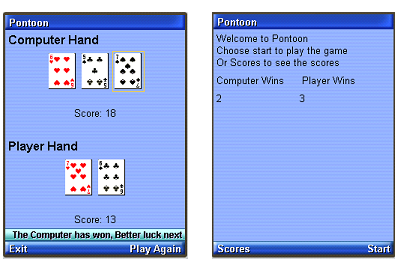
The card game consists an opening screen which invites the player to play the game or view the Scores, you need to add commands “Scores” and “Start” to the opening screen (10 marks)

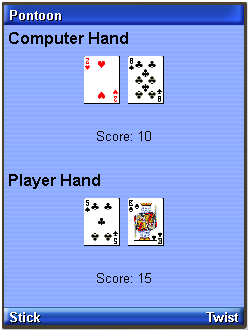
When the Start button is pressed the following screen is displayed.

 When the Start button is pressedThe cards must be randomly chosen from the deck of 52 cards. The card images are available from Blackboard.  You need to add the commands Stick and Twist to your screen  (30 marks)

You need to display the current score for both the Computer hand and Player hand (in this case 10 and 15.)  The scoring systems works with the cards having their face values apart from Aces which are worth 11 and Jack, Queen and King which are worth 10.     (10 marks)

Once a card is displayed the same card cannot appear again (5 marks) 

If the command Twist is selected:

Another Player Hand card is chosen at random and displayed and the Player’s score is updated. If the computer hand score is less than or equal to the player hand score another Computer Hand card is chosen at random and displayed and the Computer score is updated.

If any of the scores add up to 21 then the game is won either by the Computer or the Player and the game is over. If any of the scores are greater than 21 then the game is lost by either the computer or player (whoever scored more than 21) . If the game is not over the player can select Twist or stick and so on.  (10 marks) 

If the command Stick is selected:

A Computer Hand card is chosen at random and displayed and the Computer score is updated. If the Computer hand is greater than or equal to the player and less or equal to 21 then the computer wins else the player wins.  (5 marks) 

If the game is over and the computer has won a ticker is displayed saying the computer has won else if the player has won a ticker saying the player has won. Also the stick and twist commands  are replaced with a PlayAgain command which returns the player to the opening screen and an exit command which just exits the game (see screen shot below) (10 marks)

As a result of playingAs a result of playing several times the no of wins by the computer and player are stored in the rms database. These score are displayed when the score command is selected from the opening screen (see screen shot above)  (15 marks)

The report must contain print out of the source code                                          

The report must contain screen shots of the application running (5 marks)

The report must contain a CD with all your work on and a project that can be dropped into the WTK20/apps folder (which will run when the Ktoolbar is loaded) OR a project that runs in netbeans. The program must run! or you may not receive any mark.

MBA Dissertation Literature Review on The Global Automotive Industry Value Chain

This report United Nations Industrial Development Organization (2003) includes different author opinions on value chain of global automobile industry and among them the significant aspect is that, it includes the information on global automobile industry. The automobile industry has changed the World technology and it has dominated the other industries by leading the Industrial World.

This article even explains the sales forecast of automobile companies of different countries that gives overall figure on global automobile industry sales. The information on different types of regional markets in global auto industry is described.

The value chain process of automobile industry is explained which reveals that auto industry includes wide range of companies in it that plays vital role in economic standards of world.

Future work is required to this article in order to explain the detailed value chain process of global automobile industry.

 The information on global automobile industry is included in this article and which is more important for the research process. 

Improving the Quality of Service for Video and Voice Applications in Mobile Ad Hoc Networks

Following are the key objectives for this Improving the Quality of Service for Video and Voice Applications in Mobile Ad Hoc Networks project 

  • To critically review the QoS requirements for voice and video applications across MANETs and evaluate the key findings and limitations
  • To design four scenarios, where the first two scenarios deals with improving the quality of voice application in terms of audibility and quality of speech and second two scenarios deal with multimedia and voice conferencing applications
  • To create the designed scenarios using OPNET modeler and test the scenarios against the simulation metrics
  • To evaluate the resultant graphs and compare the corresponding scenarios against the QoS requirements for voice and video applications
  • To conclude the work done and suggest few recommendations 

Literature Review 

Quality of service requirements are essential to ensure a reliable communication across any network and in this context, there are many proposal made by different authors in the literature and even there is always an open door towards the quality of service requirements. When it comes to the high end applications like video and voice, the level of quality of service should be more as these applications need more attention towards a low delay and high bandwidth requirements. In general the QoS requirements for voice and video applications are categorized in to different classed which depends on the level of quality of voice and video being transferred across the network and these classes are categorized by different service providers.

Voice applications can be categorized into different types and the key among them are IP voice and these applications are sensitive towards delay, jitter, latency and packet drop and all these aspects should be given the top priority while providing the quality of service requirements to the voice applications and even the same case can be applied to the IP video applications.

Bandwidth also plays an important role across the QoS standards as the voice and video applications required more bandwidth and thus it should also be given top importance in this context and if the network does not has the required bandwidth the voice and video applications are degraded and ultimately the overall quality is affected a lot due to these constraints. Packet loss is the key issue to be considered while talking about the quality of service requirements to the voice and video applications and if there is any packet loss across the network, the quality of the applications are degraded and the output is affected a lot due to these issues and thus to ensure the maximum delivery rate for the voice and video applications all these issues should be considered . 

The level of quality of service requirements also depends on the type of network as well and they will different at the range of operations against the wireless and wired networks. Providing the quality of service standards for wired networks is quite different when compared with wireless networks and in general QoS for wired networks is quite comfortable than providing QoS for wireless networks. In general wireless networks operate under some constraints like infrastructure, deployment and bandwidth and all these aspects play an important role while deciding upon the QoS requirements for the wireless networks.

The critical applications like voice and video which include different ranges like videoconferencing, multimedia and VOIP need more bandwidth requirements across the wireless networks when compared to the wired networks and these applications has a greater tendency to lose the packets and also the quality across the wireless networks and thus considering the optimal quality of service requirements  and there is lot of research done in this context and still there are many issues to be covered in this area while providing the optimal level of quality of service requirements. When the wireless ad hoc networks are considered, there are more critical than the simple wireless networks and this automatically leads to the administrators to provide a high range of quality of service requirements as these ad hoc networks are very peculiar in nature when compared to the normal wireless networks.

In general the mobile ad hoc networks are infrastructure less networks and dynamic in nature and thus providing the quality of service requirements are a tedious job and also the level of QoS requirements across the MANETs depends on the type of traffic being generated on the network and there are different types of traffics like TCP, CBR and VBR. Voice applications in general generate the CBR traffic and the video applications will generate the VBR traffic and based on these traffic requirements the level of QoS requirements will vary and always these issues should be considered against the standard of communication across the networks like MANETs.

The nature of the routing protocol also plays an important role against the quality of service requirements and in general there are three important types of routing protocols like reactive, proactive and hybrid routing protocols and nature of these routing protocols has a significant impact on the type of service provided for the voice and video applications and their quality. 

Research methodology 

As the main aim of this project is to provide quality of service requirements for voice and video applications across MANETs, OPNET modeler is used as the required simulation tool. Four important scenarios are created using this simulation tool, where two scenarios are used to evaluate the QoS requirements for voice applications and two scenarios are used to evaluate the QoS requirements for video applications. When the individual applications like voice and video are considered, initially a blank scenario is created with default attributes and the second scenarios deal with the improved quality of service requirements and these scenarios are compared and the corresponding results are evaluated. 

Project plan 

Task Description Start Date


End Date


Duration
Introduction


Basic introduction to the project along with the problem definition and aims and objectives are defined in this section.


    2 weeks


Literature review


Following topics are covered under the literature review


  • Introduction to MANETS and different routing protocols
  • Critical analysis on voice and video applications in MANETS
  • Detailed study of QoS requirements and corresponding parameters for voice and video applications


    4 weeks


Simulation design


Following design aspects are discussed in this section

  • Introduction to OPNET modeler as the required simulation tool
  • Parameters description of the scenarios
  • Detailed design procedure of the scenarios
  • Explanation to performance evaluation metrics like energy consumption and energy savings


    3 weeks


Simulation procedure


Following aspects are covered under this chapter


  • Detailed explanation to the scenarios considered
  • Steps explaining the simulation procedure to be followed using the OPNET modeler across the scenarios
  • Simulation steps and the corresponding screenshots
  • Procedure to setup the required wireless sensor network
  • Explanation to parameters setup and running the simulation process


    4 weeks


Evaluation of results


Results achieved after running the individual scenarios and after comparing the scenarios are explained in this chapter with reference to the aims and objectives of this project.


    2 weeks


Conclusion and Future work


Conclusion from the total work done and the results evaluation is given and the better ways to improve the project in future are also explained.


    1 week


Indian Automotive Industry Analysis

In views of Donald Bradley (2005), Indian automobile industry has big history with many success stories. This article even explains significant information on porter five force analyses of Indian automobile industry such as degree of rivalry, threat of substitutes, barriers of entry, buyer power and supplier powers of Indian automobile companies.

The significant information on different auto companies of India like Ford, General motors, Hyundai, Maruthi, Toyota, Tata motors and Volkswagen are explained clearly. The different attributes of successful car companies in India are illustrated within this article that gives a deep overview on direction and evolution of those companies. Future work should be done to this article in order to specify the detailed overview on these companies and their strategies.

This article includes the significant information on analysis of Indian automobile industry for which this particular article is considered for the research process. 

According to the report of Shine.com (2008) automobile industries designs, manufactures, sales and offers different two-wheeler and four wheeler vehicles to the customers. In general, automobile industry vehicles are classified into three different categories such as commercial vehicles, passenger vehicles and two-four wheeler personal vehicles. The rise of oil prices has shown the major impact on automobile companies and facing many challenges in balancing their operation costs. The huge customer demand towards fuel-efficient vehicles even impacted automobile companies and they faced many problems in fulfilling customer needs. The entire revenue of Indian economy is based on automobile industry and many foreign companies have implemented their plants in India in order to get additional advantages.

 Future work is required in order to understand the actual problems faced by automobile companies in India.

The information related to analysis of automobile industry is included in this article, which allowed considering this article for research process. This particular reason initiated researcher to consider the information to the research process from this article.